How many metres of wire are on a spool
A spool is sold by mass while the feeder counts metres per minute. This converter ties the two together: how much wire is really on there, how many minutes of arc it is, and how far the weld will run.
Short answer
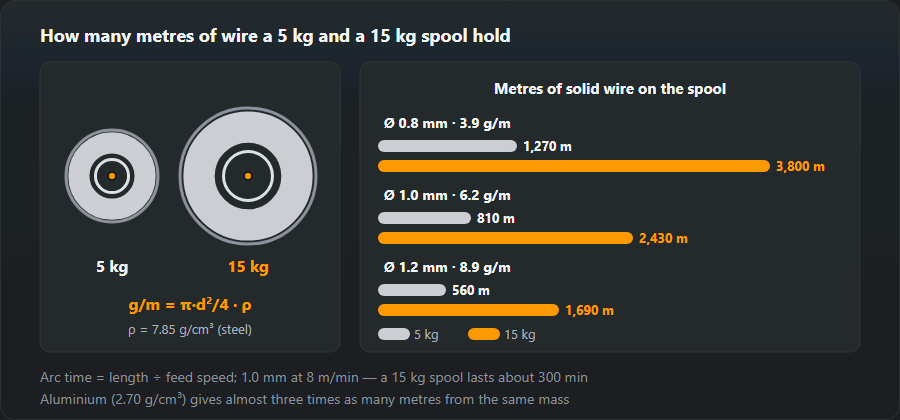
A 15 kg spool of solid wire holds: 0.8 mm — 3,801 m, 1 mm — 2,433 m, 1.2 mm — 1,690 m. The calculator below takes any spool mass and shows how much is left on it.
Where the length comes from
Wire is a cylinder, so the mass per metre is the cross-section times the
density: g/m = π·d²/4 · ρ. With the diameter in millimetres the
area in mm² is numerically the volume in cm³ per metre, so the formula reduces
to a multiplication. Length is the spool mass divided by the mass per
metre.
| Ø, mm | g/m | m in 5 kg | m in 15 kg |
|---|---|---|---|
| 0.6 | 2.2 | 2250 | 6760 |
| 0.8 | 3.9 | 1270 | 3800 |
| 1.0 | 6.2 | 810 | 2430 |
| 1.2 | 8.9 | 560 | 1690 |
| 1.6 | 15.8 | 320 | 950 |
The figures come out of the wire geometry and the density of steel, exactly as in the calculator above; lengths are rounded to tens of metres.
At the same diameter an aluminium spool holds nearly three times the metres a steel one does: density 2.70 against 7.85 g/cm³. That is why a 2 kg aluminium spool lasts longer than it looks — though the feed speed on aluminium is noticeably higher too.
Why bother working it out
- Ordering for a job. Metres of weld times consumption per metre gives kilograms, and those give the number of spools to have on the shelf.
- Planning a shift. At 8 m/min a 15 kg spool of 1.0 mm wire is about 300 minutes of pure arc — two to three shifts on a wire feeder.
- Judging what is left. Weigh the part-used spool with its hub, subtract the empty mass, and you know at once whether you will finish the joint.
How many metres of wire on a 5 kg and a 15 kg spool
The table above gives ready lengths for the two most common spools. For any other mass, multiply it by the metres per kilogram — for steel wire:
- 0.6 mm — 451 m/kg (5 kg spool ≈ 2,250 m),
- 0.8 mm — 253 m/kg (5 kg ≈ 1,270 m, 15 kg ≈ 3,800 m),
- 1.0 mm — 162 m/kg (5 kg ≈ 810 m, 15 kg ≈ 2,430 m),
- 1.2 mm — 113 m/kg (15 kg ≈ 1,690 m),
- 1.6 mm — 63 m/kg (15 kg ≈ 950 m).
Length falls with the square of the diameter. Going from 1.0 to 1.2 mm gives 1.44 times fewer metres from the same mass; dropping to 0.8 mm gives 1.56 times more. A small 1 kg spool for a hobby MIG is 253 m of 0.8 wire or 451 m of 0.6. Stainless wire is close to steel in density, which is why the calculator groups them.
Aluminium, copper and bronze
With aluminium (2.70 g/cm³) a metre of 1.0 mm wire weighs 2.12 g, so a 2 kg spool is about 940 m, and 1.2 mm wire about 655 m. Copper and bronze wires for MIG brazing (8.80 g/cm³) are heavier than steel: 1.0 mm is 6.91 g/m and a 5 kg spool gives about 720 m. Pick the right material in the calculator — aluminium left on the steel default comes out almost three times too short.

How many minutes of arc a spool gives
Time is length divided by wire feed speed. The speeds below come from the same current-to-feed relationships used by the wire feed speed calculator:
- 0.8 mm at 120 A — 7.5 m/min. A 5 kg spool lasts about 170 min of arc, a 15 kg spool about 8.5 hours.
- 1.0 mm at 180 A — 8 m/min, i.e. 49 g of wire a minute (about 3 kg per arc hour). A 15 kg spool is 300 min, roughly five hours.
- 1.2 mm at 250 A — 7.5 m/min and 4 kg/h. A 15 kg spool is gone in under four hours of arc.
With MIG the arc typically burns about two hours in an eight-hour shift, so a 15 kg spool of 1.0 mm wire is two to three shifts, and of 1.2 mm at higher current a bit under two.
Worked example: how many spools to order for a job
The job: 120 m of fillet welds with a 6 mm leg (throat a ≈ 4.2 mm), MAG, 1.0 mm wire.
- Weld cross-section: z²/2 plus 10 % for convexity = 6²/2 × 1.1 ≈ 19.8 mm².
- Deposited metal per metre: 19.8 mm² × 7.85 g/cm³ ≈ 0.155 kg/m.
- Wire per metre at a MAG efficiency of 93 % (spatter, stubs): 0.155 / 0.93 ≈ 0.167 kg/m.
- Total: 120 m × 0.167 ≈ 20 kg of wire.
- Spools: one 15 kg spool covers about 90 m of this weld, so you order two. The deposited metal calculator gives the same figures, and entered here as “consumption per metre” they give the weld length per spool.
How much is left on a part-used spool
Weigh the spool and subtract the mass of an empty spool of the same type — plastic, wire-basket and wooden spools all weigh differently, so weigh one empty once and write the figure on the feeder in marker. 8 kg of 1.0 mm wire left? That is about 1,300 m, at 8 m/min 160 min of arc. Knock off a few per cent for the last turns at the hub, which will not go through the feeder anyway.
Common mistakes and how to spot them
- Gross instead of net mass. The label gives the wire mass; the scales show wire plus spool. Working from the gross figure overstates what is left.
- Flux-cored wire treated as solid. The core has a different density from the sheath, so there are more metres than the formula says. Take the mass per metre from the maker’s data sheet.
- A spool left on the feeder for weeks. Rust on the wire means jerky feeding and porosity. Between jobs the spool goes back in its bag.
- A slack spool brake. The spool keeps turning after the trigger is released and the wire drops off the turns — which is a matter for wire feeding problems.
Wire cost together with gas and labour is totalled by the weld cost calculator.
Frequently asked questions
Why is there less wire than the calculation says?
The last turns at the hub never come off — they rarely make it through the feeder. Spools also come in light within tolerance. Treat the figure as an upper bound and knock a few per cent off for the remainder.
Does it work for flux-cored wire?
Not directly. Flux-cored wire has a core of a different density from the sheath, so its mass per metre comes out lower than solid wire of the same diameter — usually by 10–20 %. For an exact figure take the mass per metre from the maker’s data sheet.
Where do I get the consumption per metre of weld?
From the deposited metal calculator: it gives the kilograms of consumable per metre for a particular preparation. Put that number in here and you get how far one spool goes.
How many metres of wire are on a 5 kg spool?
For steel wire: 0.6 mm about 2,250 m, 0.8 mm 1,270 m, 1.0 mm 810 m, 1.2 mm 560 m. Length goes inversely with the square of the diameter, and aluminium gives almost three times as much.
How much does a metre of 1.0 mm wire weigh?
Steel: 6.2 g (6.17 g exactly at 7.85 g/cm³), so 162 m to the kilogram. 0.8 mm wire weighs 3.9 g/m and 1.2 mm 8.9 g/m.
How long does a 15 kg spool last?
1.0 mm wire at 8 m/min (about 180 A) lasts roughly 300 minutes of arc — two to three MIG shifts. In a fillet weld with a 6 mm leg that is about 90 m.
Updated: