Deposited metal and number of passes
How much metal has to go into the groove, how much wire or how many electrodes that costs, and how many passes it breaks into. Estimating and shift planning both start here.

How it works it out
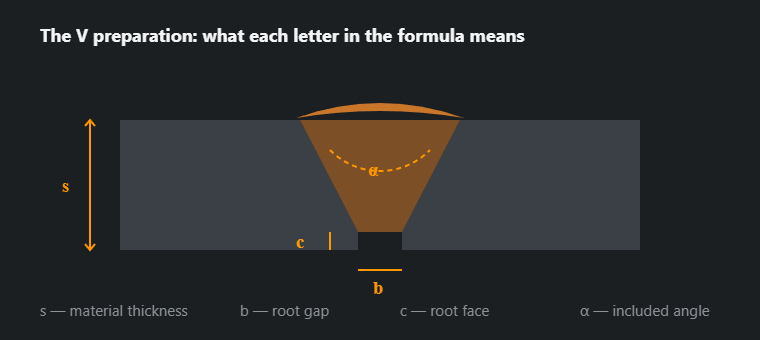
Cross-section. For a single V:
F = b·s + tan(α/2)·(s − c)², increased by 10 % for the cap. For a
double V the same, over two half thicknesses. For a fillet
F = z²/2, again with the 10 % addition.
Deposit. The area in mm² times one metre gives the volume
in cm³, and that times the density of 7.85 g/cm³ gives the mass. Hence the
handy rule: kg/m = F · 0.00785.
Consumable. The deposit divided by the deposition efficiency of the process: a covered electrode yields about 65 % of its own mass (the rest is coating and stub), solid wire under gas over 90 %.
Efficiency and deposition rate
| Process | Efficiency | Output, kg/h | Pass cross-section, mm² |
|---|---|---|---|
| MMA, rutile (111) | 0.65 | 1.3 | 25 |
| MAG, solid wire (135) | 0.93 | 3.2 | 35 |
| FCAW, flux-cored wire (136) | 0.85 | 4.2 | 45 |
| TIG (141) | 0.95 | 0.6 | 12 |
The calculator gives arc hours. A real shift also holds fit-up, tacking, turning the work, cleaning and changing electrodes: the arc burns for 25–35 % of a shift on MMA and 40–55 % on a wire feeder. The full time with overheads comes from the cost per metre calculator.
What it is for
- Estimating. Deposit mass times material price is the most predictable part of what a joint costs.
- Ordering material. Kilograms for the whole structure, rather than “grab two packs”.
- Choosing the preparation. Run the same joint as a V and as an X — the difference in deposit and passes can be a factor of two. The type comes from the groove preparation calculator.
Weld metal per metre for V and X butt welds — table
Deposit mass for the most common plate thicknesses at the calculator's default settings. It uses the same formula, so with the same inputs the calculator above gives exactly the same result.
| t, mm | V: area, mm² | V: deposit, kg/m | V: MAG passes | X: area, mm² | X: deposit, kg/m | X: MAG passes |
|---|---|---|---|---|---|---|
| 6 | 23.4 | 0.183 | 1 | — | — | — |
| 8 | 40.5 | 0.318 | 2 | — | — | — |
| 10 | 62.6 | 0.492 | 2 | — | — | — |
| 12 | 89.9 | 0.706 | 3 | 58.2 | 0.457 | 2 |
| 15 | 140.3 | 1.102 | 5 | 86.7 | 0.680 | 3 |
| 20 | 249.8 | 1.961 | 8 | 146.9 | 1.153 | 5 |
| 25 | 391.0 | 3.069 | 12 | 223.0 | 1.750 | 7 |
| 30 | 563.9 | 4.427 | 17 | 315.0 | 2.472 | 9 |
Bevel angle 60°, gap b = 2 mm, root face c = 2 mm (the calculator defaults), +10 % reinforcement, one MAG pass about 35 mm². X from 12 mm — thinner plate is bevelled from one side.
What the table shows
Weld metal in a V joint grows almost with the square of the thickness: 10 mm is 0.492 kg/m, 20 mm is already 1.961 kg/m — four times as much for twice the thickness. An X joint at 20 mm needs 1.153 kg/m, 41 % less, and five MAG passes instead of eight. That is why the joint preparation calculator suggests an X preparation from just over 12 mm — provided you can reach both sides.
Worked examples, step by step
Example 1: 12 mm plate, 60° single V, MAG, 1 m
Area: (10² · tan 30° + 2 · 12) · 1.10 = (57.7 + 24) · 1.10 ≈ 89.9 mm².
Deposit: 89.9 · 0.00785 ≈ 0.706 kg/m. Wire at 0.93 efficiency:
about 0.759 kg. Passes: 89.9 / 35 ≈ 2.6, so 3 — and 4 in
practice, because the root is laid as a thinner pass. Arc time at
3.2 kg/h: about 0.22 h, or 13 minutes per metre.
Example 2: the same joint with stick electrodes
The deposit does not change — 0.706 kg/m, because it depends only on the geometry. What changes is the consumable and the time: at 0.65 efficiency about 1.09 kg of electrodes go per metre, the arc burns about 0.54 h (1.3 kg/h), and at 25 mm² per pass it takes 4 passes plus the root. How many rods of a given diameter that is, the electrode consumption calculator works out.
Example 3: what angle, gap and root face do
For the same 12 mm plate a 50° angle instead of 60° cuts the area to 77.7 mm² (−14 %). A 3 mm gap instead of 2 raises it to 103.1 mm² (+15 %), and so does a 1 mm root face instead of 2. A millimetre of error in edge preparation is therefore more than ten per cent of wire and time — which is why you measure the groove before welding, not after.
Example 4: ordering wire for 25 m of weld
25 m of 12 mm V joint: 25 · 0.706 ≈ 17.6 kg of weld
metal, 17.6 / 0.93 ≈ 19.0 kg of wire. One 15 kg spool is
not enough — you need two. How many metres of wire a spool holds and how much
weld the rest will cover is shown by the
spool calculator.
Consumables for a whole structure: the order of work
- List the welds. Each joint type separately: thickness, preparation, length. The weld map makes this easy.
- Get kg/m for each type — from the table, or from the calculator if the angle, gap or root face differ from the defaults.
- Multiply by the lengths and add up. Double-sided and X welds count in full, not "per side".
- Divide by the process efficiency from the table above: that turns weld metal into wire or electrode mass.
- Round up to packages — spools, electrode packs — and only then order.
Pass cross-section: how to check it without a macro
The values filled in by the calculator (25 mm² for MMA, 35 for MAG, 45
for FCAW, 12 for TIG) are typical, but every welder lays beads differently. You
can estimate your own from the settings: wire area times wire feed speed,
divided by travel speed, times efficiency. A 1.2 mm wire has
1.13 mm²; at 8 m/min feed and 30 cm/min travel that gives
1.13 · 800 / 30 · 0.93 ≈ 28 mm² per pass. Put that figure in
the pass cross-section field and the pass count fits you. The feed speed for a
given wire and current comes from the
wire feed calculator.
Typical mistakes in weld metal estimates
- Reinforcement left out. The groove triangle alone is not enough — cap and root reinforcement take the 10 % the calculator adds.
- Gap from the drawing, not from the shop floor. A joint tacked tight or with a wider gap has a different area (example 3).
- Fillet worked out from the throat. The calculator asks for the leg z. The throat-to-leg calculator converts a into z; mixing them up means half or double the weld metal.
- Arc time taken as working time. The hours still have to be divided by the arc-on share of the shift.
- One efficiency for everything. The same weld metal is 0.76 kg of MAG wire but 1.09 kg of electrodes.
Frequently asked questions
Why do I end up with more passes than the calculator says?
Because the first pass is always thinner. The root goes in as a narrow bead at low current so it does not blow through or hang a drop — its area can be half that of a fill pass. The calculator divides the whole area by one pass area, so in practice add one pass.
Where do I get the area of one pass?
Measure it on a macro section of your own test piece — the only honest route, because it depends on current, travel speed and how you carry the torch. The values filled in here are typical for the process and are a starting point, not a rule.
Is this the same as the cost per metre calculator?
The geometry is the same — both work the cross-section from one formula so the two never disagree. There, prices, gas, electricity and labour are added on top; here what is left is the metal and the planning: how much deposit, how many passes, how many arc hours.
How much weld metal does a metre of V butt weld in 10 mm plate take?
About 0.492 kg/m at a 60° included angle, 2 mm gap and 2 mm root face (62.6 mm² with reinforcement). MAG wire at 0.93 efficiency: about 0.53 kg; electrodes at 0.65: about 0.76 kg. Other thicknesses are in the table on this page.
How many passes does 20 mm plate need?
For a 60° single V the calculator gives 8 MAG passes (about 250 mm² at 35 mm² per pass); for a double V, 5. With stick electrodes, 10 and 6. Add one pass to each result for the thinner root.
How do I convert weld metal into wire or electrodes?
Divide by the process efficiency: solid MAG wire 0.93, flux-cored wire 0.85, rutile electrode 0.65, TIG rod 0.95. One kilogram of weld metal is therefore about 1.08 kg of MAG wire or about 1.54 kg of electrodes.
Updated: