Groove calculator: angle, gap, root face and weld area
Thickness, process, and whether you can reach the far side — those three settle the preparation type, the included angle, the root gap and the root face. The calculator gives the usual values and the deposit area with them.

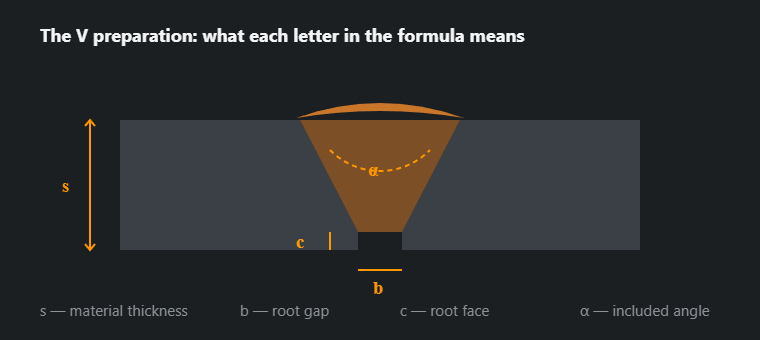
Where the values come from
A preparation reconciles two things that pull against each other. The arc has to reach the root — hence the opening and the gap. At the same time every extra millimetre of opening is more deposit, more heat and more shrinkage — hence the wish to keep the angle small. ISO 9692-1 collects the compromises that have proved themselves.
| Thickness s, mm | Preparation | Angle α | Root face c, mm | Root gap b, mm | When |
|---|---|---|---|---|---|
| ≤ 3 … 4 | I — square edge | — | — | 0–3 | Thin material: the gap alone gives penetration |
| 3 … 12 | Single-V | 50–70° | 1–2 | 1–4 | The default when access is from one side only |
| 12 … 40 | Double-V (X) | 50–60° | 1–3 | 1–3 | Access from both sides: about half the deposit of a single-V |
| > 30 | Single-U | 8–12° | 1–3 | 1–3 | Heavy plate, one-sided access; needs machining |
| > 40 | Double-U | 8–12° | 1–3 | 1–3 | Very heavy plate, access from both sides |
| 5 … 20 | Single-bevel (½V) | 45–55° | 1–3 | 1–3 | T-joint with full penetration |
| > 15 | Double-bevel (K) | 45–55° | 1–3 | 1–3 | T-joint with full penetration, access from both sides |
| — | Fillet, no preparation | — | — | 0–2 | Where full penetration is not required |
The angle depends on the process too: MAG allows a narrower opening because the arc is more concentrated and digs deeper, while TIG takes a wider one so a hand-fed rod fits.
What the angle costs
The area grows with the square of the thickness and with the tangent of half the angle. The practical upshot: the difference between 60° and 50° on 20 mm plate is about a fifth of the deposit, and moving from a V to an X at the same thickness saves roughly half. Run the same joint through the deposited metal calculator — the numbers argue better than words.
Welding from one side there are three ways out: penetrate the root fully (needs a steady hand and an accurate gap), back-weld after gouging, or use backing — ceramic, copper or permanent. The choice goes into the WPS along with the geometry, because it changes the range of qualification.
How the calculator picks the groove
It applies the rules of the table above in a fixed order, and the first rule that fits decides:
- Square edge (I) up to 3 mm with MMA and TIG and up to 4 mm with MAG. Gap 0–2 mm up to 2 mm thickness, 1–3 mm above that.
- Single-V up to 12 mm whatever the access, and up to 30 mm when only one side can be reached. Angle by process: 60° for MMA, 50–60° for MAG, 60–70° for TIG. Gap 2–4 mm for MMA and TIG, 1–3 mm for MAG. Root face 1–2 mm.
- Single-U above 30 mm with one-sided access: 8–12° per side, gap and root face 1–3 mm.
- Double-V (X) from 12 to 40 mm with access from both sides: 60°, or 50–60° with MAG; gap and root face 1–3 mm.
- Double-U above 40 mm with access from both sides.
The process changes the result because the arcs dig differently: MAG penetrates deeper and gets away with a narrower opening and a smaller gap, TIG needs room for a hand-fed rod, and MMA needs room for the electrode and its coating.
How the weld area is calculated
The cross-section is the triangle of the bevel plus the strip of the gap, with a tenth added for the cap and the root:
- V:
A = [(s − c)² · tan(α/2) + b · s] · 1.10 - X:
A = [2 · ((s − c)/2)² · tan(α/2) + b · s] · 1.10 - I:
A = b · s · 1.10
Where the table gives a range, the calculator takes its middle: 50–60° becomes 55°, a 1–3 mm gap becomes 2 mm, a 1–2 mm root face 1.5 mm. For a U groove no area is shown: its profile is not a triangle, and the V formula would overstate it noticeably.
Weld metal per metre follows directly: multiply the area in mm² by 0.00785 and you have kilograms per metre of steel (density 7.85 g/cm³). The filler you actually burn is more than that, because of spatter, stubs and slag — the electrode consumption calculator adds those losses.
Worked examples
| Thickness, process, access | Groove | α | b, mm | c, mm | Area, mm² | Weld metal, kg/m |
|---|---|---|---|---|---|---|
| 6 mm, MAG, one side | V | 50–60° | 1–3 | 1–2 | 25 | 0.19 |
| 10 mm, MAG, one side | V | 50–60° | 1–3 | 1–2 | 63 | 0.50 |
| 10 mm, MMA, one side | V | 60° | 2–4 | 1–2 | 79 | 0.62 |
| 12 mm, MAG, one side | V | 50–60° | 1–3 | 1–2 | 90 | 0.70 |
| 20 mm, MAG, one side | V | 50–60° | 1–3 | 1–2 | 240 | 1.88 |
| 20 mm, MAG, both sides | X | 50–60° | 1–3 | 1–3 | 137 | 1.07 |
| 30 mm, MAG, one side | V | 50–60° | 1–3 | 1–2 | 531 | 4.17 |
| 30 mm, MAG, both sides | X | 50–60° | 1–3 | 1–3 | 290 | 2.28 |
| 35 mm, MAG, one side | U | 8–12° | 1–3 | 1–3 | — | — |
The default case, 12 mm with MAG from one side, worked through: (12 − 1.5)² × tan 27.5° = 110.25 × 0.521 ≈ 57.4 mm² for the bevel, plus 2 × 12 = 24 mm² for the gap, gives 81.4; times 1.10 that is about 90 mm², or 0.70 kg of weld metal per metre.
60°, 50° or 45° on 20 mm plate
Same V, gap 2 mm, root face 1.5 mm, only the angle changing: 60° gives about 261 mm² (2.05 kg/m), 50° about 220 mm² (1.72 kg/m), 45° about 200 mm² (1.57 kg/m). Going from 60° to 50° saves roughly a sixth of the weld metal, gas and arc time. Narrower still pays only while the torch or electrode still reaches the root at a proper angle — otherwise the saving turns into side-wall lack of fusion.
What an extra millimetre of gap costs
Each millimetre of gap adds b × s × 1.10 — that is, 1.1 mm² for every millimetre of thickness. On 12 mm plate it is about 13 mm², some 15 % of the whole groove; on 20 mm it is 22 mm². A gap that opens up during tacking costs filler over the whole joint, and a gap that closes costs penetration — see lack of root penetration.
Twice the thickness, nearly four times the metal
The bevel term goes with the square of the thickness. A MAG V on 10 mm takes about 63 mm²; on 20 mm, 240 mm² — close to four times as much. That is why the calculator switches to an X as soon as access from both sides allows it: on 30 mm the X needs 290 mm² against 531 for a V.
Which end of the range to use
The calculator shows ranges and computes with their middle; the value for a particular joint goes into the WPS. As a rule of thumb, the narrow end of the angle suits MAG in the flat position with good access, the wide end suits MMA, positional welding and thick electrodes. The larger gap helps the root through where the root face is at its upper limit; the smaller gap is safer on thin root faces, where the risk is burning through. How the edge is cut, cleaned and tacked to hit these numbers is covered in the article on weld joint preparation.
Frequently asked questions
When a V and when an X?
Access and thickness decide. Up to 12 mm a V usually does. Above that, if the work can be turned and reached from behind, a double V wins twice over: roughly half the deposit, and the angular shrinkage is symmetrical so the part does not pull to one side. With no access to the back a V is what is left — and the root has to be got right first time.
Why leave a root face at all?
Without one the thin edge simply runs away. A 1–2 mm root face gives the root bead something to stop against and lets it be run at a steady current. Too large a root face does the opposite: the arc cannot melt through it and you are left with lack of root penetration.
Can these numbers go straight into a WPS?
As a starting point yes, as a final entry no. ISO 9692-1 gives shapes and ranges; the values for a particular joint are set by the engineer, allowing for the steel grade, the position, the requirements on the root and whether the procedure was qualified.
How much weld metal does a 10 mm V butt weld take per metre?
With MAG (50–60°, gap 1–3 mm, root face 1–2 mm) the calculator gives about 63 mm², i.e. 0.50 kg of weld metal per metre. With MMA (60°, gap 2–4 mm) it is 79 mm² and 0.62 kg. The filler bought is more than that, because of spatter, stubs and slag.
How is the groove cross-section calculated?
For a V: A = [(s − c)² · tan(α/2) + b · s] · 1.10, with the middle of each range from the table; the factor 1.10 covers cap and root reinforcement. For an X the bevel term is split between two halves of the thickness. Area in mm² times 0.00785 gives kilograms of steel weld metal per metre.
Why is there no area for a U groove?
Because its profile is a narrow slot with a rounded bottom, not a triangle. The V formula would overstate it noticeably, and a wrong figure is worse than none. U grooves are machined, and their area is taken from the drawing of the preparation.
Updated: