Lack of fusion vs lack of penetration: how to tell them apart
The two defects that look like nothing and behave like a crack. A weld can pass a visual inspection with either of them running its whole length.
Short answer
Lack of fusion (401) is a weld that touched the metal without melting it. Lack of penetration (402) is a root the arc never reached at all. The first is cured with heat and technique at the machine, the second with geometry at the fit-up bench. Neither is permitted at quality levels B and C.

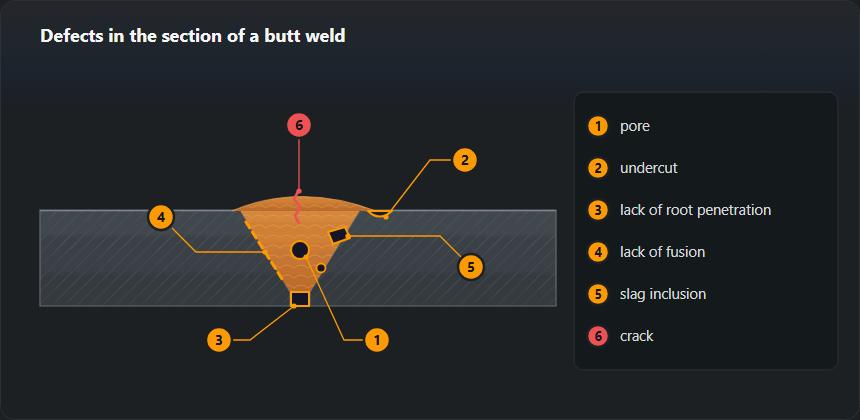
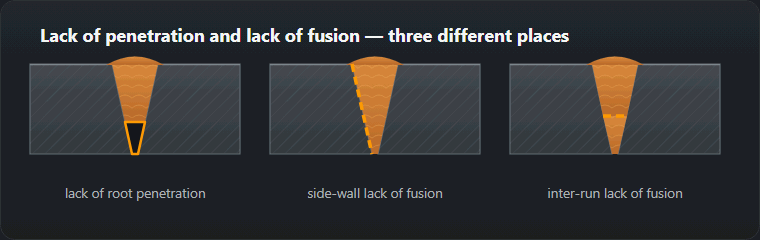
Lack of penetration (402) is a root the weld never reached. Lack of fusion (401) is metal that was laid down but never fused to what was next to it. The first comes almost always from fit-up — gap, root face, electrode diameter. The second from parameters and technique. ISO 5817 permits lack of fusion at no quality level and lack of penetration at neither B nor C; level D tolerates a short lack of penetration up to 0.2 t, 2 mm at most.
The difference
| Lack of penetration (402) | Lack of fusion (401) | |
|---|---|---|
| What it is | The weld was not fused to the required depth | Metal was deposited but never fused to the edge or to the previous run |
| Where it turns up | In the root of a single-sided joint | Along the fusion line, between runs |
| Visible from outside | Sometimes — a narrow root bead gives it away | Practically never |
| How it is found | UT, radiography, inspection from the far side | UT; radiography is poorer — the flaw is planar |
| Main cause | Fit-up geometry: gap, root face, electrode diameter | Parameters and technique: too little heat, wrong angle |
Lack of fusion vs lack of penetration: how to tell which one you have
Lack of penetration sends you back to the fit-up, lack of fusion to parameters and technique. Four checks separate them.
| Check | Lack of fusion (401) | Lack of penetration (402) |
|---|---|---|
| Position in the section | Bevel face, between runs or a root face — anywhere through the thickness | At the root, on the centreline |
| Macro section | A thin line along the fusion boundary or between beads, often with slag | The root faces are still there: straight, parallel edges with a gap or unmelted band between |
| Radiograph | A thin line offset towards the edge of the bead, often intermittent; may not show at all | A straight dark line on the centreline with even edges |
| Ultrasonics | A planar reflector on the bevel or between runs; strong echo only when hit square | A reflector at the root, at far-surface depth |
| Bend or fracture test | Opens along the fusion line; smooth, unmelted bevel face | Opens at the root; a band of unmelted root face |
On a macro section
An etched section (ISO 17639) is the most direct evidence. Lack of penetration leaves the joint visible as fitted: straight root faces with the gap between them. Lack of fusion shows as a thin dark line; slag in it points to cleaning, a clean line along the bevel to heat and angle.
On a radiograph
Radiography (ISO 17636) shows lack of penetration well: a straight line down the centre with even edges. Side-wall lack of fusion lies nearer the edge of the bead, where the bevel is, often in pieces. A flat defect at an angle to the beam may leave no image at all.
With ultrasonics
Ultrasonic testing (ISO 17640) answers to planar defects. An echo from far-surface depth on the centreline is a root problem; one from the bevel at mid-depth is side-wall lack of fusion. The probe angle is chosen to meet the bevel squarely, so the inspector needs the preparation sketch.
In a bend or fracture test
A face or side bend (ISO 5173) with lack of fusion opens along the fusion line and shows a smooth, dull bevel, sometimes oxide-tinted. A root bend with lack of penetration opens at the root and shows a flat band of unmelted root face.
The three kinds of lack of fusion: 4011, 4012, 4013
Lack of side-wall fusion (4011)
Weld metal against the bevel face, unmelted, usually over a length. Comes from a narrow groove, the wrong torch angle, cold MAG modes.
Lack of inter-run fusion (4012)
A run not fused to the one beneath. Causes: slag or oxide left on the bead, deep notches at the toes of a convex bead, too little current on filling runs.
Lack of root fusion (4013) — not the same as 402
The root run reached the bottom but did not fuse to a root face; in 402 the root was not reached at all. On a macro, 4013 has a filled root with the line along one face, 402 a gap in the middle. 4013 comes from an arc aimed to one side or arc blow; 402 from fit-up — see lack of root penetration.
Why they are the dangerous ones
A pore is round; stress flows around it. Lack of fusion is a flat discontinuity with a sharp edge, which concentrates stress exactly the way a crack does. Mechanically it is a crack that was built in rather than grown.
ISO 5817 therefore does not give it a permitted size at any quality level. There is no measurement to argue about — found means repaired.

Lack of fusion: causes
Not enough heat. Current too low for the thickness, or the travel too fast. Short-arc MIG is the classic offender: it is a cold mode, and on anything above about 6 mm it will lay a bead that sits on the joint rather than into it.
The arc pointed at the pool instead of the leading edge. If molten metal runs ahead of the arc, the arc is melting metal that is already molten and never touches the cold side wall. This is what "the pool got ahead of me" means in practice.
Slag or oxide between runs. Whatever is left on the previous run stops the next one fusing. Grinding and wire-brushing between runs is not cosmetic.
Groove too narrow. A tight preparation with a steep side wall gives the arc no angle to reach it. If the joint has to be filled from the bottom of a narrow slot, the geometry is wrong before anyone strikes an arc.
Nine causes of lack of fusion: the sign and what to change
- Cold start. Sign: lack of fusion at the start of runs and at restarts. Action: strike ahead and come back over the start, run-on tabs on critical joints, taper the end of the previous run.
- Current too low. Sign: a high, rounded bead with sharp toes. Action: set current for electrode and plate — the current calculator for MMA, the settings table for MIG/MAG.
- Travel too fast. Sign: a narrow bead that does not wet both walls. Action: slow down until it flattens into them.
- Pool running ahead of the arc. Sign: a smooth surface hiding lack of fusion — MAG with slow travel for the wire feed, vertical-down on thicker plate. Action: keep the arc on the leading edge, travel faster or reduce wire feed, weld thick plate vertical-up.
- Wrong torch or electrode angle. Sign: the defect on the wall the arc pointed away from. Action: aim at the wall; in a wide groove lay two beads per layer, each against its wall.
- Groove too narrow. Sign: 4011 low in the groove on both walls. Action: gauge the angle. The site's table gives 50–70° for a single-V from 3 to 12 mm, 60° for MMA, 50–60° for MAG — weld joint preparation, groove calculator.
- Scale, oxide, slag. Sign: 4012 with slag, or a line along an unground cut face. Action: grind to bright metal, deslag every run, grind out notches at the toes.
- Short-circuit MAG on thick plate. Sign: a neat bead, cold inside. Short-circuit runs at 16–22 V with a cool pool; for 8–10 mm the settings table gives 1.2 mm wire, 220–280 A, 26–29 V — spray territory (from 26–28 V, metal from 5 mm). Action: fill in spray or pulse — see MIG/MAG welding.
- Magnetic arc blow. Sign: with DC the arc wanders at seam ends and near the earth clamp. Action: move the clamp, weld towards a heavy tack, incline the electrode against the blow, use AC on MMA where the electrode allows.
Lack of penetration: causes
Lack of penetration now has a page of its own: nine causes, the sign that tells each one apart, root gap and root face figures, and the ISO 5817 limits — lack of penetration. What follows here is the short version.
Almost always fit-up rather than welding. The root gap is too small, the root face too thick, or the included angle too tight for the electrode to reach the bottom. Then: current too low for the root run, an electrode too large in diameter for the gap, or a travel speed that carries the arc past before the root melts.
On single-sided joints where the root must be full penetration, this is where a backing bar, a consumable insert or a back-gouged and re-welded second side earns its keep.
Preventing both
- Prepare the joint to the WPS sketch and check the gap with a gauge, not by eye. The root gap tolerance is there for this reason.
- Enough current for the thickness — the current calculator for MMA, and for MIG a mode with enough heat: spray or pulse rather than short arc above 6 mm.
- Keep the arc on the leading edge of the pool, never behind it.
- Clean between every run.
- On a critical single-sided joint, expect to back-gouge. Planning for it is cheaper than discovering it at inspection.
Repair step by step: remove, check, reweld
- Mark start and end of the indication from the UT or RT report.
- Grind or air-arc gouge to sound metal, past both ends; grind the gouged surface.
- Keep the excavation open: a narrow slot is the groove that makes 4011.
- Check it with MT on ferritic steel, PT on stainless and aluminium.
- Reweld to the WPS or repair procedure, cause corrected.
- Re-inspect with the method that found it — eyes prove nothing here.
What ISO 6520-1 and ISO 5817 say
ISO 6520-1: 401 lack of fusion (4011 side-wall, 4012 inter-run, 4013 root), 402 lack of penetration. Limits from the site's ISO 5817 table: 401 not permitted at B, C or D; 402 not permitted at B or C, at D a short imperfection up to 0.2·t, 2 mm at most. On 8 mm plate that is 1.6 mm; on 15 mm, 3 mm is capped at 2 mm. EXC2 under EN 1090-2 means level C, so there any lack of penetration is a repair.
Frequently asked questions
What is the difference between the two?
Lack of fusion is metal that touched but never melted together — between a run and the parent metal, or between two runs. Lack of penetration is a root that was never reached at all, so part of the joint thickness was never welded. Different causes, nearly the same verdict: neither is accepted at ISO 5817 levels B and C, and only level D tolerates a short lack of penetration.
Why does radiography sometimes miss it?
Because both are planar. A tight, flat discontinuity lying at an angle to the X-ray beam absorbs almost nothing extra, so it leaves no contrast on the film. Ultrasonics reflects off exactly that kind of flat face, which is why UT is specified where these defects are the concern.
Lack of fusion vs lack of penetration on an X-ray: how do you tell?
Lack of penetration is a straight dark line on the weld centreline with even edges. Side-wall lack of fusion is a thinner line parallel to the weld, shifted towards the edge of the bead and often broken. A clean film proves little when lack of fusion is suspected.
Can lack of fusion be welded over?
No. A run on top melts the bead below, not the unfused plane under it. The defect is ground or gouged out to sound metal, the groove checked with PT or MT, and the joint rewelded to the WPS.
What is side-wall lack of fusion?
Imperfection 4011 in ISO 6520-1: weld metal lying against the bevel face without melting it. Usual causes are a narrow groove, the arc pointed down the joint instead of at the wall, or a cold MAG mode.
Updated: