Lack of penetration
The root of the joint never melts. The cap looks right, the weld measures right, and the joint carries a fraction of the load it was drawn for. Number 402 in ISO 6520-1, and not permitted at all at quality levels B and C. If the bead merely rests against the groove wall or the previous bead without melting into it, that is lack of fusion (401), not lack of penetration — see lack of fusion.
Short answer
Lack of penetration (402 in ISO 6520-1) is a root the arc never reached, and it is not permitted at quality levels B and C. It is mostly a fit-up problem: root face 1–2 mm for every process, gap 2–4 mm for stick (60° bevel), 1–3 mm for MAG (50–60°) and 2–4 mm for TIG (60–70°). Root a 10 mm single-V with a 3.2 mm electrode at 90–140 A in the flat position and watch for the keyhole: no keyhole on an open root means no penetration. The root run step by step is below.
Lack of penetration or lack of fusion?
They are named together and they are not the same thing. Lack of fusion (401) is a weld that touched the parent metal without melting it: the bead is where it should be, the bond is not. Lack of penetration (402) is a root that was never reached — the arc did not get to the bottom of the joint at all.
The difference matters because the fixes live in different places. Fusion is a heat and technique problem, solved at the machine and in the hand. Penetration is mostly a geometry problem, and it is usually solved at the fit-up bench, before the arc is struck. The other defect has a page of its own — lack of fusion.
Incomplete penetration, lack of root penetration: one defect
The ISO 6520-1 list on this site names 402 incomplete penetration (lack of root penetration); AWS A3.0 says incomplete joint penetration; the shop says "the root didn’t go through". It is always the same thing: the joint was not melted through its full thickness and the unfused part sits at the root.
Geometry decides more than current does
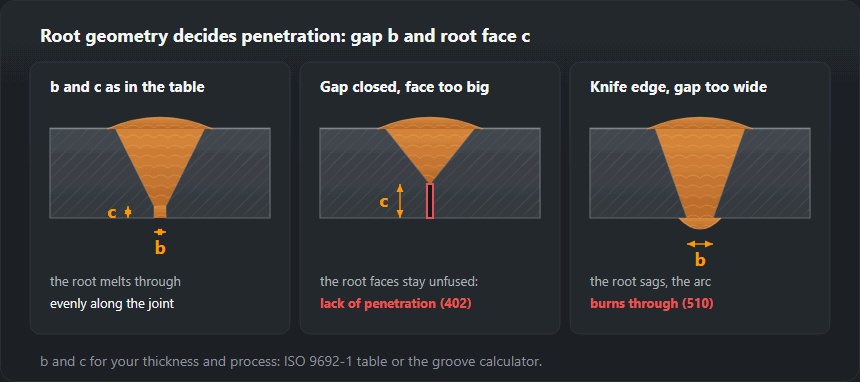
Before touching the current, look at what the joint gives the arc to work with. Root gap, root face and included angle decide whether the arc can physically reach the bottom. A 3 mm root face on 6 mm plate leaves half the section for the root run to melt through, and no amount of amperage makes that reliable in position.
| Thickness s, mm | Preparation | Angle α | Root face c, mm | Root gap b, mm | When |
|---|---|---|---|---|---|
| ≤ 3 … 4 | I — square edge | — | — | 0–3 | Thin material: the gap alone gives penetration |
| 3 … 12 | Single-V | 50–70° | 1–2 | 1–4 | The default when access is from one side only |
| 12 … 40 | Double-V (X) | 50–60° | 1–3 | 1–3 | Access from both sides: about half the deposit of a single-V |
| > 30 | Single-U | 8–12° | 1–3 | 1–3 | Heavy plate, one-sided access; needs machining |
| > 40 | Double-U | 8–12° | 1–3 | 1–3 | Very heavy plate, access from both sides |
| 5 … 20 | Single-bevel (½V) | 45–55° | 1–3 | 1–3 | T-joint with full penetration |
| > 15 | Double-bevel (K) | 45–55° | 1–3 | 1–3 | T-joint with full penetration, access from both sides |
| — | Fillet, no preparation | — | — | 0–2 | Where full penetration is not required |
Two numbers from the table do most of the work. The root gap is what lets the arc down into the joint — close it with a heavy tack and the root closes with it. The root face is what the root run has to melt through, and 1–2 mm is the figure. Measure it: a flame-cut edge is rarely what the drawing says.

Setting up the root run step by step
Example: a 10 mm single-V butt welded from one side, numbers from the groove calculator.
- Fit-up. Root face 1–2 mm for every process. Stick (MMA): 60° and a 2–4 mm gap; MAG: 50–60° and 1–3 mm; TIG: 60–70° and 2–4 mm. Measure the face at both ends and in the middle; set the gap with spacers. Cutting and cleaning the bevel: edge preparation.
- Tacks. Each tack shrinks and pulls the gap closed, so re-measure after every one. Grind tack ends to a taper, or the root leaves an unfused spot where it runs into them.
- Root current against fill. Fill runs on 10 mm: 4.0 mm electrode at 140–180 A (MMA mode table). The root is usually a size smaller, so the tip reaches the root face: 3.2 mm at 90–140 A flat, 75–120 A vertical, 70–110 A overhead (current table with position factors). With MAG the root is dip transfer into an open gap; the 220–280 A listed for 8–10 mm are fill figures.
- Angle. Across the joint, the electrode or torch stays on the root centreline so both faces get the same heat. Along it, a stick electrode drags 5–15° from vertical, keeping slag behind the pool.
- Keyhole. A penetrating root shows a small hole at the front of the pool with both root faces melting into it. Keep it one size: if it closes, slow down, shorten the arc and check the gap; if it grows, a burn-through (510) is coming. No keyhole on an open root means no penetration.
Nine causes, and the sign that tells them apart
Each cause below shows itself differently on the plate, and that is what tells you which one you are looking at. Read the middle column first, then the third.
| Cause | What it looks like | What to change |
|---|---|---|
| The root gap has closed up | The root is unfused along the whole length, as an even band rather than in patches | Restore the gap: shorter and more frequent tacks, wedges against shrinkage, tack from the middle outwards |
| Root face too thick | The edges are fused but a dark line runs down the middle of the root | Root face of 1–2 mm, measured rather than eyeballed. Grind a thick one down before assembly |
| Current too low for the thickness | Narrow, convex bead, wedge-shaped penetration, slag hard to remove | Raise the current to the table value, and in MMA take one electrode size up for the root run |
| Travel speed too high | The pool never gets time to spread; penetration is narrow and ragged | Slow down until the pool is roughly twice as wide as the gap |
| Included angle too narrow | The cap is sound but the arc never reaches the root | Open it out to the ISO 9692-1 figures — the preparation table is further up this page |
| Electrode not on the root centreline | One edge fused, the other not — the whole way along | Track the centre of the gap and watch the pool rather than the arc; on pipe, reposition the hand more often |
| Long arc in MMA | The root is covered with metal from above but never melted | Hold an arc about one electrode diameter long, and in the root almost rest the electrode on the edges |
| MAG dip transfer on thick material | A good-looking bead on the surface, and an untouched root on the macro | Move to spray transfer or open a root gap. Dip transfer belongs on thin sheet and on a gapped root |
| Root not gouged before the sealing run | A slag-filled gap is left between the first run and the sealing run | Gouge or grind the root back to clean metal before the sealing run |
Six cases: symptom, cause, fix
Penetrated at the tacks, unfused between them
The gap was right and closed as the tacks shrank: a stick root set at 3 mm that pulled in below 2 mm is outside its band. Re-measure after each tack, add tacks instead of making them heavier, wedge the gap open on parts that keep closing.
Both edges fused, dark line in the middle
A 3 mm root face on 10 mm plate against 1–2 mm in the table, usually a flame-cut or hand-ground edge nobody measured. Grind it to 1–2 mm before assembly; more current only widens the pool at the top.
One root face fused, the other untouched
Linear misalignment (507): the arc melts the higher edge and passes over the lower one. Even a step within ISO 5817 limits can leave the low face unfused. Level the edges with clamps or wedges before tacking; if the step stays, favour the low side.
Thin, ragged penetration
Travel too fast: the pool never spreads onto both faces. Slow down until the pool is about twice the gap — roughly 6 mm with a 3 mm gap.
Root bridged over, slag in the gap
The electrode is too thick for the groove, so the arc burns on the bevels: a joint prepared at 50° for MAG, rooted with a 4.0 mm stick electrode that needs 60°. A size up helps only when current alone is short and the tip still reaches the bottom. Root with 3.2 mm or open the groove to 60°.
Pipe: no root at the bottom
A fixed horizontal pipe (5G uphill, PF/PH) is sound on the sides and top, but around six o’clock the root is unfused or concave (515). There you weld overhead, the pool sags away and the arc lengthens. Start at the bottom with the overhead band (3.2 mm: 70–110 A), keep the arc shortest there, and taper each stop before tying in — see pipe positions and welding positions.
Seeing it before the inspector does
From the face side you cannot, and that is the whole difficulty: a root that never fused looks like a good weld from above. What is available is a visual check of the root from the back where there is access, a macro section on a test piece, and radiography or ultrasonics on production work.
On a single-sided pipe butt the root run is inspected before the fill runs go on top of it. After that, finding it costs a gouging job.
Checking the root without access
- Endoscope or videoscope through an open end or a hole: shows whether the bead came through all along, whether it is concave or burnt through. The quickest check on pipe before the fill.
- Radiography and ultrasonics. On film, lack of penetration is a straight dark line along the middle of the weld; ultrasonics finds and sizes it as a root reflector.
- A test joint broken on purpose. Same fit-up, same settings, then a fracture test or a bend with the root outside. An unfused root opens on the bend or shows as a smooth unmelted strip on the fracture.
What the standard allows
ISO 5817 lists it as 402, incomplete penetration. It is not permitted at levels B and C; only at level D is a limit given at all, 0.2·t up to 2 mm. On structural work of any consequence that means there is no allowance: the joint is either penetrated or it is repaired. The levels themselves are explained under ISO 5817 quality levels.
Limits for 10 mm
Each limit is the smaller of formula and cap. 402: not permitted at B and C; at D 0.2·t = 2 mm. Root concavity (515): 0.5, 1.0 and 2.0 mm at B, C and D. Linear misalignment (507): 0.10·t, 0.15·t and 0.25·t, so 1.0, 1.5 and 2.5 mm. Other thicknesses: the ISO 5817 calculator.
When you only get one side
Pipework and closed sections give no second chance at the root, and three answers exist. A backing bar or backing ring turns the root into a fillet against a plate instead of an open butt. A consumable insert does the same and becomes part of the weld.
A TIG root run, filled out afterwards with stick or flux-cored wire, is the standard procedure on pipe: the TIG arc is controllable enough to place the root deliberately, and the slow first pass pays for itself by not having to be gouged out. Which of the three a job allows is a question for the procedure, not a preference.
Backing and forming the root bead
- Ceramic backing: tiles on adhesive tape under the gap. They shape a smooth bead and come off afterwards.
- Copper bar: the weld does not stick to it and its groove shapes the root. It must sit tight — where it stands off, the pool drops through.
- Permanent steel backing: a strip or ring fused in for good. The arc has to melt both root faces and the backing; whether the notch it leaves is acceptable is a design decision.
- Argon purge for stainless: without it the back of the root oxidises and the bead comes out rough and crumbly — see stainless steel.
Repairing lack of penetration
With access to the back: gouge or grind along the defect until the dark line is gone and the groove shows clean metal; after arc-air gouging, grind off the carburised layer. Then a sealing run at root settings.
Without access: cut the joint out and weld it again on a new bevel, or grind through the whole weld from the face down to the root.
Why burning through from above fails: several runs already lie between the arc and the root. High current melts the top of them, not the root faces most of the thickness below, and adds undercut or a burn-through beside the defect. The root stays unfused, only buried deeper.
Frequently asked questions
Can more current make up for a closed root gap?
Not reliably. Past a point the extra current widens the pool and undercuts the top edges before it reaches the bottom, and in the vertical or overhead position the pool falls out first. The gap is the cheaper fix: it is set once at fit-up and costs nothing to weld.
There is a dark line on my macro — which defect is it?
Depends where the line runs. Up the bevel, along the fusion boundary, it is lack of fusion. At the bottom of the joint, between the two root faces, it is lack of penetration. Neither is permitted at levels B and C; only 402 has an allowance at level D.
Why does it show up on pipe and mostly at the bottom?
Because the position changes underneath you. In 5G and 6G the same hand travels through overhead, vertical and flat inside one run, and the pool behaves differently in each. At the bottom of the pipe, welding overhead, the pool wants to sag away from the root — that is where the arc has to be kept shortest.
How do you fix lack of penetration?
With access to the back: gouge or grind the root from that side to clean metal, until the dark line has gone, and weld a sealing run. Without access: cut the joint out, re-bevel and reweld. A hotter pass over the top does not reach a root buried under a full weld.
What root gap do you need to get full penetration?
For a 10 mm single-V the groove calculator on this site gives 2–4 mm for stick and TIG and 1–3 mm for MAG, with a 1–2 mm root face. Measure the gap after tacking, not before.
How do I avoid lack of root penetration?
Root face measured at 1–2 mm, gap inside the band for your process and re-checked after every tack, edges level. Then an electrode that reaches the bottom of the groove, the current for your position, and a keyhole kept open ahead of the pool.
Updated: