What is a weld pool?
A weld pool is the small volume of molten metal under the arc that freezes into the weld bead as the arc moves on. A finished weld tells you what happened; the pool tells you what is happening now — the only indicator that works in real time.
What it actually is
Surface tension and arc pressure hold the molten metal in place, and the size of the pool follows from the balance between heat going in and heat conducted away into the material.
Everything else follows from that. Anything that shifts the balance — current, travel speed, thickness, the starting temperature of the part — changes the pool at once, in front of the welder, and does so many seconds before the consequences show in the finished weld.
Weld pool meaning: a definition
A weld pool is the metal the arc keeps molten at the spot being welded — parent metal and filler mixed together — which freezes behind the heat source and becomes the weld bead. Once frozen it is weld metal; the plate around it that was heated but never melted is the heat-affected zone.
What the pool is made of
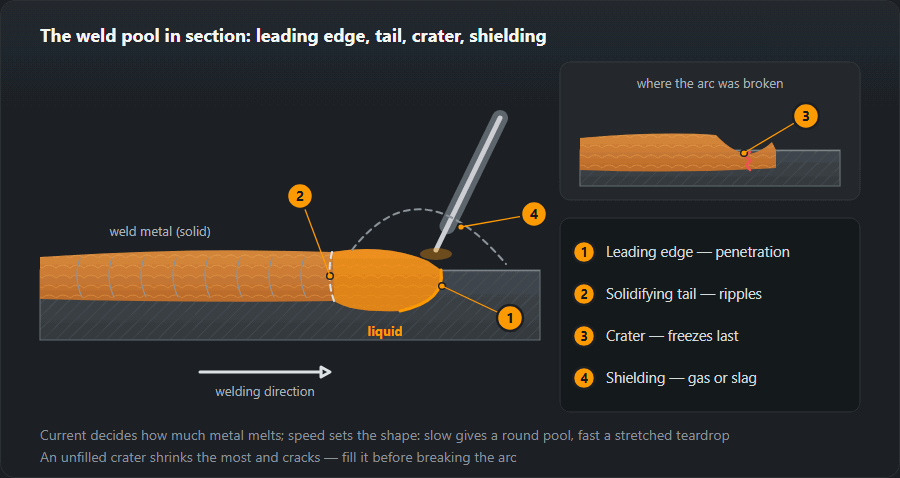
- Leading edge (melting front) — under and just ahead of the arc, where the joint edges melt. Fusion is decided here.
- Trailing edge (solidification tail) — where metal freezes from the plate towards the centre. The ripples on a bead are its traces.
- Crater — the hollow left where the arc stops. It freezes last and shrinks most, so a crater left unfilled cracks.
- Protection — slag and coating gas in MMA and flux-cored wire, shielding gas in MIG/MAG and TIG. Lose it and the pool turns porous.

Size and shape: what changes the pool
Current sets how much metal melts: more amps, a wider and deeper pool. Travel speed sets how long the heat stays put: slow travel makes the pool round and tall, fast travel stretches it into a teardrop and leaves a narrow bead. Arc length (stick-out on MIG/MAG) spreads the heat: a long arc gives a wide, shallow pool.
Current and speed meet in the arc energy, E = U·I·60 / (v·1000) kJ/mm; multiplied by the process efficiency k it becomes heat input — both are in the heat input calculator. Halve the speed and each millimetre gets twice the energy. A thick, cold plate pulls heat away and keeps the pool small; the same settings on a hot plate give a bigger one.
How to read it
| What you see | What it means | What to change |
|---|---|---|
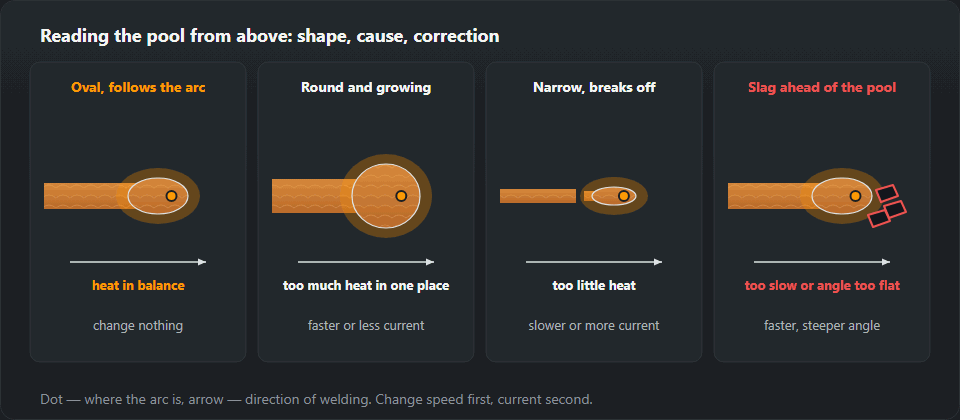
| Oval, following the arc evenly | The balance is right | Nothing |
| Round and growing under the electrode | Too much heat in one spot | Speed up or drop the current |
| Narrow, tearing away behind the arc | Too little heat | Slow down or add current |
| Darkening and thickening as you go | The part has cooled, or the current has fallen | Check the earth and the leads |
| Starting to sag downwards | Volume beyond what surface tension holds | Thinner bead, less current |
| Slag running ahead of the pool | Too slow, or too flat an electrode angle | Speed up, raise the angle |
The last row is the important one. Slag that has washed ahead of the arc stays under the liquid metal and comes out as an inclusion (301) — and it is visible while you are still welding, while there is still something to be done about it.

What to watch through the helmet
- Shine. Liquid metal is mirror-bright, frozen metal dull. If the shiny area keeps growing, heat is going in faster than it leaves.
- Edges. Watch the sides, not the arc. A dark line between pool and plate on one side means that edge is not fusing.
- Keyhole in the root. A small hole at the front of the pool means the root face is melted through. Steady keyhole — steady penetration; growing — burn-through coming; none — no penetration.
- Slag. Darker and duller than the metal, it should stay behind and at the sides. Slag sliding ahead of the arc gets trapped.
When the pool misbehaves
It spreads and runs
Too much heat for the speed. Speed up first, then take off current and shorten the arc; in position use a thinner electrode or a narrower weave. Metal rolling onto the plate without fusing is overlap.
It will not wet the edges
The bead sits on the joint like a rope with sharp toes — the start of lack of fusion. Pause at each side, aim the arc at the dry face, keep it short; on MIG/MAG check stick-out and voltage. Toes melted but not filled are undercut.
It drops through
The keyhole widens and the pool falls out of the back. Less current or faster travel, a tighter gap, short stitches or a whip movement that lets the pool freeze — see welding thin sheet.
Why position changes everything
Flat, the pool is held by the bottom of the groove. Vertical and overhead, it is held by surface tension alone, and surface tension supports a limited volume of liquid metal — far less than the pool that a comfortable flat-position current produces.
That is the origin of every positional rule that otherwise looks arbitrary: current down by 10–20 %, electrode one size thinner, weave instead of a straight run. Each of them does the same thing — reduces the volume of the pool at any one moment. Details in welding positions.
The figures by position
The site's current tables take off 10 % for horizontal (PC), 15 % for vertical and 20 % for overhead. A 3.2 mm rutile electrode on 6–8 mm plate, 110–140 A flat, becomes 100–125 A horizontal, 95–120 A vertical and 90–110 A overhead. In horizontal the pool sags onto the lower plate, so undercut appears on the upper toe. Vertical-up is where pool control is learnt — the pool climbs on a shelf of frozen metal with a dwell at each side (welding vertical up).
The pool in MMA, MIG/MAG and TIG
MMA (111): the pool sits under slag — the metal is brighter, the slag duller and slower. Arc length about one electrode diameter, fed down as the electrode burns.
MIG/MAG (135): in short-circuit transfer (16–22 V) the arc restrikes 50–200 times a second and the pool stays cool — thin sheet, all positions. Spray (from 26–28 V) gives a large, fluid pool, for metal from 5 mm in the flat. The trap: a bright centre while the edges stay cold.
TIG (141): heat and filler are separate. Form the pool with the torch, wait until it wets both edges, dab the rod into the leading edge. The tungsten never touches the pool.
To read it you first have to see it
It sounds obvious, and it is the commonest reason a welder does not read the pool at all: a filter darker than necessary hides its edges. You see a bright arc and darkness around it, so the electrode is guided from memory and the bead wanders off the groove.
The shade is chosen for the current, not for habit — the DIN shade calculator. The other half of the problem is the cover lens: a film of spatter costs more visibility than one shade number, and it is replaced in a minute.
Exercises for pool control
- Fusion runs without filler — TIG on 1.5–3 mm sheet, a pool moved along a line without rod, same width start to finish.
- Beads between two lines — on 6–8 mm plate, the pool touching both soapstone lines; ripples even, toes without a notch.
- Speed ladder — one bead slow, normal, fast without touching the machine; compare width and ripple shape.
- Tilt — the same beads on a plate tilted step by step to vertical, current reduced by the factors above.
Check by cutting a bead across: the section shows whether the pool fused.
Examples: tracing a fault back to the pool
MAG fillet on 6 mm, bead sitting on top. Wire 1.0 mm, 200 A, 24 V — inside the site's band for 5–6 mm (160–220 A, 22–25 V). At 300 mm/min, E = 24·200·60 / (300·1000) = 0.96 kJ/mm, Q = 0.8 × 0.96 = 0.77 kJ/mm — the band for thin material. At 200 mm/min, Q = 1.15 kJ/mm, the working range for steel, and the pool wets both plates. The speed was wrong, not the settings.
MMA vertical-up, pool drips. 3.2 mm electrode left at 140 A from the flat run. The vertical band is 95–120 A; at about 110 A with side dwells the pool holds.
Open root, keyhole growing near the end. The plate has heated up; travel a little faster or drop the current a step.
What next
Matching current to electrode diameter — the welding current calculator. What happens when the pool never reached the groove face — lack of fusion and penetration. How to prepare a groove so the pool has room to work — joint preparation.
Frequently asked questions
What should a correct pool look like?
Like an oval, slightly elongated drop that follows the arc at the same speed as your hand, and whose trailing edge freezes into an even pattern of ripples. A round pool growing under the electrode means you are dwelling; a narrow one tearing away behind the arc means you are moving too fast or running too little current.
Why does the pool run in the vertical position?
Because gravity acts on liquid metal and surface tension only holds a small amount of it. That is where the whole of positional technique comes from: current down by 10–20 %, a thinner electrode, and a movement that gives the pool time to freeze — several narrow beads instead of one wide one.
Can you see the pool the same way through an auto-darkening helmet?
You can, provided the shade suits the current. Too dark a filter hides the edges of the pool and you end up welding from memory — the bead wanders off the groove because you cannot see where the liquid metal ends. The shade is picked by the DIN shade calculator.
What does weld pool mean?
It is the small volume of molten metal under the arc — melted joint edges plus filler — that solidifies into the weld bead as the arc moves on. In the workshop it is also called the puddle.
Why won't the weld pool wet the edges?
The heat is not reaching the joint faces: current too low, travel too fast, arc too long or the arc aimed at the pool instead of the plate. Slow down, pause at each side and point the arc at the face that stays dry.
How big should the weld pool be?
There is no fixed size. It should melt both edges of the joint while its trailing edge keeps freezing at a steady distance behind the arc; if it keeps growing, there is too much heat for the speed.
Updated: