Cooling time t8/5 calculator
How long the joint takes to fall from 800 to 500 °C decides what structure forms in the heat-affected zone. It is the parameter a welding procedure hides behind its heat input range and preheat temperature.

The formulas in EN 1011-2
The standard gives two, because heat leaves in two different ways.
Three-dimensional — thick material, heat escapes in every
direction:
t8/5 = (6700 − 5·T₀) · Q · (1/(500−T₀) − 1/(800−T₀)) · F3
Two-dimensional — thin plate, heat spreads only in the
plane:
t8/5 = (4300 − 4.3·T₀) · 10⁵ · Q²/d² · (1/(500−T₀)² − 1/(800−T₀)²) · F2
Which one applies is settled by the transition thickness — the thickness at which both give the same answer. The calculator works it out and shows it beside the result: below it the 2D formula rules, above it the 3D one. Under three-dimensional flow the thickness drops out of the result altogether — adding more material changes nothing.
The shape factor
A joint sheds heat the worse, the more walls meet at one place. The standard captures that with the coefficients of Table D.1.
| Type of joint | F2 | F3 |
|---|---|---|
| A run on a plate | 1.0 | 1.0 |
| Butt weld | 0.9 | 0.9 |
| Fillet weld, corner joint | 0.9 | 0.67 |
| Fillet weld, T-joint | 0.45–0.67 | 0.67 |
For a T-joint the standard gives F2 as a range, 0.45–0.67. The calculator uses the upper value: it yields a longer t8/5, that is, the less cautious estimate — and that is the one worth checking.
For the T-joint the standard gives F2 as a range. The calculator takes the upper value: it yields a longer cooling time, that is, the less cautious estimate — and that is the one worth checking with a measurement, not the safe one.
What counts as a good time
| t8/5, s | What it means |
|---|---|
| < 5 | Hardened structure in the HAZ, hardness above 380 HV, risk of cold cracks |
| 5–25 | The working range for unalloyed and low-alloy structural steels |
| > 25 | Coarse grain, loss of toughness and, on heavy sections, distortion as well |
For quenched and tempered high-strength steels — S690, S890 — the maker states its own range, typically around 6–15 s, and it is easier to fall outside it than on S355. There the material data sheet governs, not a general table. The same goes for stainless steels: what matters is not hardening but the time spent in the carbide precipitation range.
Where it earns its keep
- Choosing the preheat. If the preheat temperature comes out high and there is nothing to heat with, t8/5 shows how much has to be made up with heat input.
- Qualifying a procedure. The WPQR records the actual heat input; converting it to t8/5 tells you whether the toughness and hardness stand a chance.
- Investigating cracks. A cold crack in the HAZ is almost always too short a cooling time together with hydrogen. Check both, not just the electrode brand.
t8/5 table by heat input and plate thickness
Cooling time for a butt weld without preheat (20 °C), worked out with the same formulas as the calculator — including the choice between the 2D and 3D formula by transition thickness.
| Q, kJ/mm | d = 6 mm | d = 10 mm | d = 15 mm | d = 20 mm | d = 30 mm |
|---|---|---|---|---|---|
| 0.8 | 18.2 | 6.5 | 3.83D | 3.83D | 3.83D |
| 1.0 | 28.4 | 10.2 | 4.83D | 4.83D | 4.83D |
| 1.2 | 40.9 | 14.7 | 6.5 | 5.73D | 5.73D |
| 1.5 | 63.9 | 23.0 | 10.2 | 7.13D | 7.13D |
| 2.0 | 113.6 | 40.9 | 18.2 | 10.2 | 9.53D |
| 2.5 | 177.6 | 63.9 | 28.4 | 16.0 | 11.93D |
t8/5 in seconds for a butt weld (F = 0.9) at a starting temperature of 20 °C. The 3D mark means the thickness is above the transition value and the three-dimensional formula applies; no mark means two-dimensional. Window 5–25 s as in the calculator.
What the table shows
On thin plate the time grows with the square of the heat input: 6 mm at 0.8 kJ/mm is 18.2 s, at 1.5 kJ/mm already 63.9 s — far outside the 5–25 s window, with a risk of coarse grain. On thick plate (3D mark) the thickness stops mattering: 20 and 30 mm at 1.2 kJ/mm give the same 5.7 s, because the heat now escapes in every direction. There the time rises only in proportion to heat input and is hard to lengthen without preheat.
Worked examples
Example 1: 10 mm plate, 1.2 kJ/mm, no preheat
These are the calculator defaults (butt weld, F = 0.9). The transition
thickness comes out at 16.1 mm, so at 10 mm the 2D formula applies:
t8/5 ≈ 14.7 s, an average cooling rate of
300 / 14.7 ≈ 20.4 K/s. The result sits in the middle of the
working window.
Example 2: the same plate preheated to 100 and 150 °C
At T₀ = 100 °C the time rises to 21.1 s, at 150 °C to 27.5 s, which is already past the 25 s upper limit. On thin plate it is easy to overdo preheat: for 10 mm at this heat input 150 °C is too much unless hydrogen demands it.
Example 3: 20 mm S355 preheated to 120 °C
Without preheat, 20 mm at 1.2 kJ/mm gives 5.7 s (3D formula) — right at the lower limit. Preheating to 120 °C, which the preheat calculator works out for S355 with a rutile electrode, stretches it to 7.6 s, and raising the heat input to 1.5 kJ/mm takes it to 9.6 s. Both levers together move the joint well inside the window.
Example 4: the same 10 mm in different joints
At 1.2 kJ/mm and 20 °C: bead on plate (F = 1.0) — 16.4 s, butt weld (0.9) — 14.7 s, fillet in a T-joint (0.67) — 11.0 s. Three plates draw heat faster than two, so a T-joint cools a quarter faster than a butt joint in the same plate.
What heat input to choose for a target t8/5
The formulas can be turned round. With 3D heat flow, 20 °C and
F = 0.9 the time is proportional to the heat input:
t8/5 ≈ 4.76 · Q. To get 10 s on thick plate you need about
2.1 kJ/mm — a lot for one pass, which is why thick sections are usually
slowed down with preheat instead. With 2D heat flow the time grows with the
square of Q: for 10 mm t8/5 ≈ 10.2 · Q², so 10 s takes about
1.0 kJ/mm and 25 s about 1.56 kJ/mm. Heat input from your welding
parameters comes from the
heat input calculator.
2D or 3D formula: what the transition thickness depends on
The transition thickness grows with heat input and starting temperature. For a butt weld without preheat it is 13.1 mm at 0.8 kJ/mm, 16.1 mm at 1.2, 18.0 mm at 1.5 and 23.2 mm at 2.5 kJ/mm. The same 20 mm plate can therefore be "thick" for a root pass and "thin" for a wide fill pass — the calculator picks the formula for you and shows which one it used.
Typical mistakes in t8/5 calculations
- Arc energy instead of heat input. The formula takes Q with
the thermal efficiency of the process, not bare
U·I·60/(v·1000). - Units. Q is in kJ/mm; entering kJ/cm (ten times more) gives absurdly long times.
- T₀ from the first pass for the whole weld. For later passes the starting temperature is the interpass temperature, usually higher than the preheat.
- Wrong joint type. A T-joint worked out as a butt joint overstates the time by about a third (example 4) — the assessment comes out too optimistic.
- One window for every steel. 5–25 s applies to non-alloy and low-alloy steels; quenched and tempered steels have a narrower range from the material data sheet.
Frequently asked questions
Why 800 to 500 °C in particular?
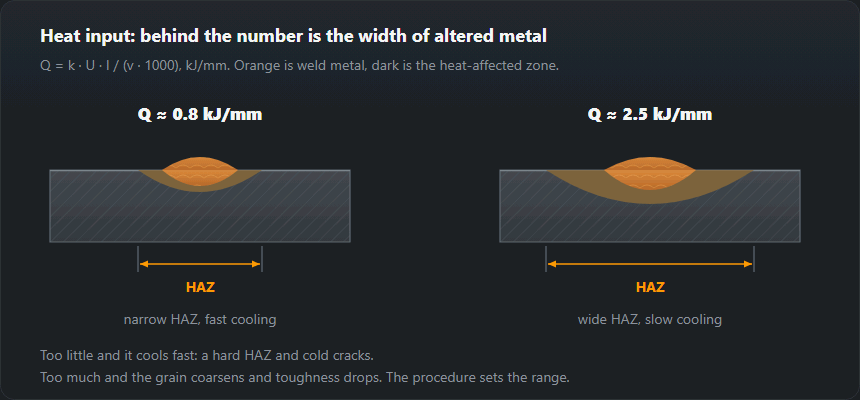
In that band the austenite turns into the structure the joint will live with. Fast, and you get martensite: hard and prone to cold cracking. Slow, and the grain coarsens and toughness drops. Below 500 °C the transformation is over, above 800 °C it has not started, so that is the stretch worth measuring.
Where does the heat input for the formula come from?
From the heat input calculator: current, voltage and travel speed give Q = k · U · I · 60 / (v · 1000). Enter the value that already includes the thermal efficiency, not the arc energy.
What if the time comes out too short?
Two levers: preheat and heat input. Preheat is the stronger one, because it enters the formula twice — as the factor in front and inside the temperature differences themselves. Raising the current also works, but there you soon hit the upper limit in the procedure.
What t8/5 is right for S355?
For non-alloy and low-alloy structural steels, S355 included, the working range is 5–25 s. Below 5 s there is a risk of a hardened structure and cold cracking; above 25 s, coarse grain and lower toughness. Quenched and tempered steels (S690, S890) have a narrower window from the maker's data sheet.
Does thicker plate cool faster?
Only up to the transition thickness. Below it (2D formula) the time falls with the square of the thickness: at 1.2 kJ/mm, 10 mm gives 14.7 s and 15 mm 6.5 s. Above it (3D formula) thickness no longer counts: 20 and 30 mm give the same 5.7 s.
How much does preheat lengthen t8/5?
Noticeably. 10 mm plate at 1.2 kJ/mm: 14.7 s without preheat, 21.1 s at 100 °C, 27.5 s at 150 °C. 20 mm plate: 5.7 s without preheat and 7.6 s at 120 °C.
Updated: