Shielding gas consumption and cylinder life
How much gas the job needs, how long the cylinder will last and what the gas costs per weld. Arc time is what counts here, not the length of the shift.
Short answer
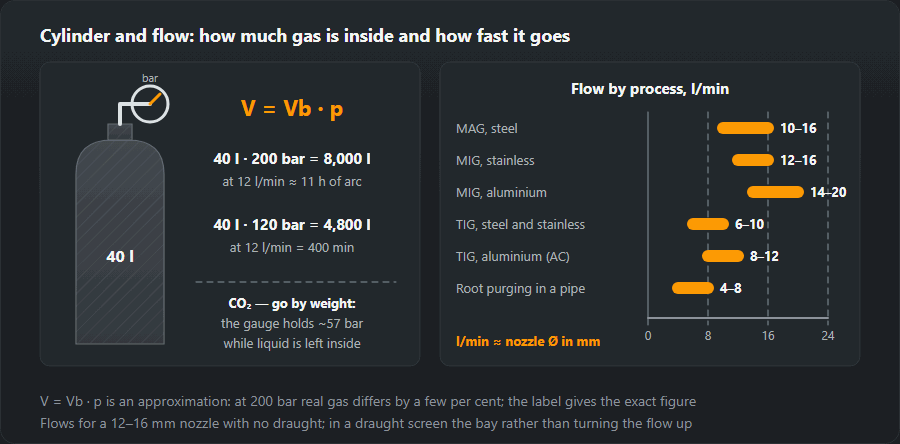
Typical flow: MAG, steel — 10–16, TIG, steel and stainless — 6–10, root purging in a pipe — 4–8 l/min. A 40 l cylinder at 200 bar holds 8,000 litres of gas — at 12 l/min that is about eleven hours of arc time. The calculator below works out the reserve and the consumption per shift.
How it is worked out
Consumption is flow rate multiplied by arc time. The gas left in a cylinder is its water volume multiplied by the gauge pressure: a 50-litre cylinder at 200 bar holds about 10 m³ of gas at atmospheric pressure. Cylinder life is that volume divided by the flow rate.
The figure that surprises people is arc time. A welder who works a full shift has the arc lit for perhaps two hours of it — the rest is fitting, tacking, grinding and moving. Feeding the shift length into the calculation instead overstates gas use by a factor of three or four.
Setting the flow rate
Ten to sixteen litres per minute for MIG/MAG, six to twelve for TIG. Turning the flow up does not improve shielding beyond a point: too high a flow makes the stream turbulent and pulls air into the pool, which is exactly the failure it was meant to prevent. If the welds are porous, look for the draught, the leaking hose and the blocked nozzle before touching the flowmeter — see porosity in welds.
| Process | Gas | Flow, l/min |
|---|---|---|
| MAG, steel | CO₂ or Ar+18 % CO₂ | 10–16 |
| MIG/MAG, stainless | Ar+2 % CO₂ (M12), Ar+He (I3) | 12–16 |
| MIG, aluminium | Ar, Ar+He | 14–20 |
| TIG, steel and stainless | Ar 99.99 | 6–10 |
| TIG, aluminium (AC) | Ar 99.99 | 8–12 |
| Root purging in a pipe | Ar, N₂+H₂ | 4–8 |
For a 12–16 mm nozzle with no draught. In a draught do not turn the flow up — screen the bay instead: too strong a stream turns turbulent and pulls air in by itself.
Worked example: gas per shift and per month
A MAG welder on structural steel, 1.0 mm wire, Ar+18 % CO₂ mix, flow 14 l/min (the middle of the 10–16 range in the table). Of an eight-hour shift the arc is lit for about two — the rest is fitting, grinding and moving about.
- Gas per shift: 14 l/min × 120 min = 1,680 l.
- Gas in the cylinder: 40 l × 200 bar = 8,000 l.
- Shifts per cylinder: 8,000 / 1,680 ≈ 4.8 — one cylinder a week.
- Per month: at 20 shifts that is 33,600 l, a little over four 40 l cylinders.
- Cost per shift: 1,680 / 8,000 = 21 % of the refill price. Multiply by what your supplier charges — you never need the price per litre.
The same shop on TIG: 8 l/min and an hour and a half of arc, because the welding is slower and preparation takes longer. That is 720 l per shift, a 40 l cylinder lasts 11 shifts and a shift costs 9 % of a refill.
Starts and tacks: gas that never shows up as arc time
Every arc start brings a pre-flow and every stop a post-flow. If the two together take 5 s at 12 l/min, each start costs 1 l of gas. With 200 tacks and short welds in a shift that is 200 l — about an eighth of the example above. Add the surge from the hose after a pause: the hose holds gas at regulator pressure and it all rushes out on the first trigger pull. On tacking work a shorter pre-flow saves more than any fiddling with the flowmeter.
Root purging is counted differently
Purge gas in a pipe flows the whole time, including when no arc is lit: the purge before welding, the pauses, the rod changes. For purging, enter the whole time the pipe is plugged and being purged, not the arc time, and the flow from the “root purging” row of the table (4–8 l/min).

How much is left — reading the gauge
The high-pressure gauge on the regulator shows pressure; the volume you work out yourself. A 40 l cylinder reading 120 bar holds 4,800 l — at 12 l/min that is 400 min, just under 7 hours of arc. With argon and argon mixes the reading falls evenly, in step with use: needle at half means half the gas.
- Temperature changes the reading, not the contents. Pressure rises and falls with absolute temperature: a cylinder filled to 200 bar at 20 °C reads about 180 bar at −10 °C (263/293 ≈ 0.9). The gas is all still there — on a winter site do not mistake it for a leak.
- V = Vb · p is an approximation. At 200 bar a real gas departs from the ideal by a few per cent; the exact content in m³ is on the label or the supplier’s paperwork.
- Do not run it to zero. Near the end the pressure ahead of the regulator is no longer enough and the flow wanders, and an empty cylinder left open draws in moisture. The remainder goes back with the cylinder.
CO₂ cylinders: go by weight
CO₂ in the cylinder is liquid. As long as some liquid is left the gauge holds the vapour pressure — around 57 bar at room temperature — and drops only once the liquid is gone, so the needle tells you nothing about the reserve. Weigh the cylinder and subtract the tare stamped on the collar; one kilogram of CO₂ gives roughly half a cubic metre of gas. At high flow pure CO₂ frosts the regulator and can freeze it — the answer is a heated regulator, not opening the valve further.
l/min and CFH — conversion
American flowmeters and manuals give flow in CFH (cubic feet per hour). 1 CFH = 0.472 l/min, 1 l/min = 2.12 CFH. Common settings: 10 l/min ≈ 21 CFH, 12 l/min ≈ 25 CFH, 15 l/min ≈ 32 CFH, 20 l/min ≈ 42 CFH. Convert a CFH figure to l/min first, then enter it in the calculator.
CFH, along with inches per minute, psi and kJ/in from American sheets, converts in one step in the welding unit converter.
Typical mistakes and how to spot them
- Shift length instead of arc time. The answer comes out three to four times too high. The tell: the calculator says a cylinder lasts one shift and in practice it lasts a week — you entered working time.
- A flowmeter made for another gas. A ball flowmeter is calibrated for one gas. Moved from argon to CO₂ it reads something other than what is flowing. Check the setting with a flow gauge held against the nozzle.
- Leaks. Close the cylinder valve with the regulator pressurised and watch the high-pressure gauge for a quarter of an hour. Any drop is a leak at the regulator, hose or quick coupling — find it with soapy water.
- Flow turned up “to be safe”. Consumption rises and the shielding gets worse. Pores at a high flow are the cue to look for a draught and a blocked nozzle — see porosity in welds.
Which gas suits which metal is covered by shielding gas selection; gas together with wire and labour is totalled by the weld cost calculator, and argon flow for TIG is explained on the TIG welding page.
Frequently asked questions
How much gas is in a 20-litre cylinder?
The water capacity times the pressure: 20 l at 200 bar is about 4000 l of expanded gas, or 4 m³. At 12 l/min that is a good five and a half hours of arc time — not five and a half hours of work.
Why is the consumption higher than calculated?
Pre-flow, post-flow and the surge that shoots down the hose when the valve is opened. On many short welds more goes that way than into the welding itself — which is why a shorter pre-flow pays off on tacking work.
How far down can the cylinder be run?
To about 10 bar. Below that the pressure at the valve becomes unstable and the flow wanders, and the cylinder should not be emptied completely because of moisture. The rest is paid for and stays inside.
How much gas does a MIG welder use per hour?
At 12 l/min an hour of pure arc time is 720 l, at 16 l/min 960 l. An hour of MIG work contains 12–24 minutes of arc (20–40 %), so at 12 l/min the real figure is roughly 140–290 l per working hour.
What is 1 CFH in litres per minute?
1 CFH = 0.472 l/min; the other way round, 1 l/min = 2.12 CFH. The usual 25 CFH in an American manual is about 12 l/min.
How much gas is in a CO₂ cylinder?
CO₂ is counted by mass, not pressure: 1 kg gives about 0.5 m³ of gas. The gauge shows the vapour pressure above the liquid and only drops at the very end, so weigh the cylinder and subtract the tare stamped on the collar.
Updated: