TIG welding: arc, tungsten and filler
Process 141, GTAW in the American numbering. A non-consumable tungsten electrode, an inert shield and a filler rod added by hand — the slowest process in the shop and the one that produces the best-looking welds.
What it is called
| What it is called | Name |
|---|---|
| In the standard (ISO 4063) | 141 — TIG welding with solid filler |
| Process number | 141 |
| International abbreviation | TIG · GTAW |
| On the shop floor | TIG welding |
Three names for one thing. The welding procedure specification and the welder’s certificate carry the standard name with its number; the job advert and the shop floor use the abbreviation; an American drawing uses its own. All three are worth knowing: it is the same work, and it looks different on every piece of paper.
Why it is different
In every other arc process the electrode is also the filler, so heat and deposition are locked together: more filler means more heat, whether you want it or not. TIG separates them. The arc supplies heat, the rod supplies metal, and you decide how much of each. That is the whole reason the process exists, and it is why it owns thin sheet, root runs and anything where the weld will be seen.
Polarity and current type

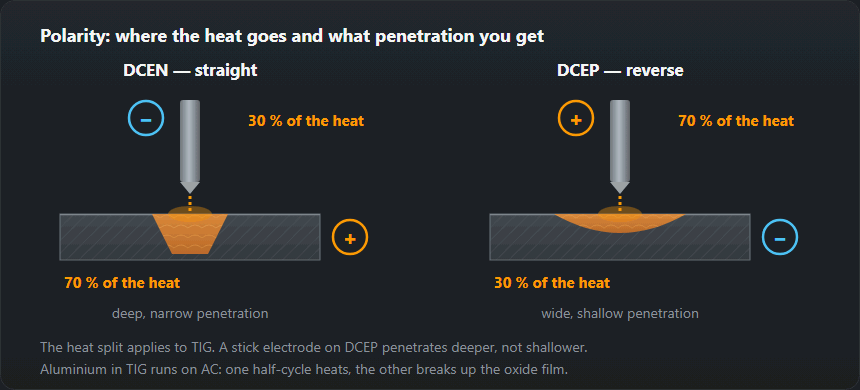
DC− for steel, stainless, titanium and copper: the electrode stays relatively cool and the heat goes into the work, so penetration is deep and the tungsten lasts.
AC for aluminium and magnesium, for the cleaning action: the electrode-positive half-cycle breaks up the oxide film. Modern inverters let you set the balance — more electrode-negative time for penetration, more electrode-positive for cleaning — and the frequency, which narrows or widens the arc cone.
DC+ is essentially never used: it puts the heat into the electrode and melts it.
| Mode | Metals | Why it is so |
|---|---|---|
| DC− (straight polarity) | Steel, stainless, titanium, copper | Most heat goes into the work, the tungsten stays cool, penetration is deep |
| AC (alternating) | Aluminium, magnesium and their alloys | The positive half-cycle breaks up the oxide film |
| DC+ (reverse polarity) | Practically never used | The tungsten overheats and melts away |
Tungsten and grinding
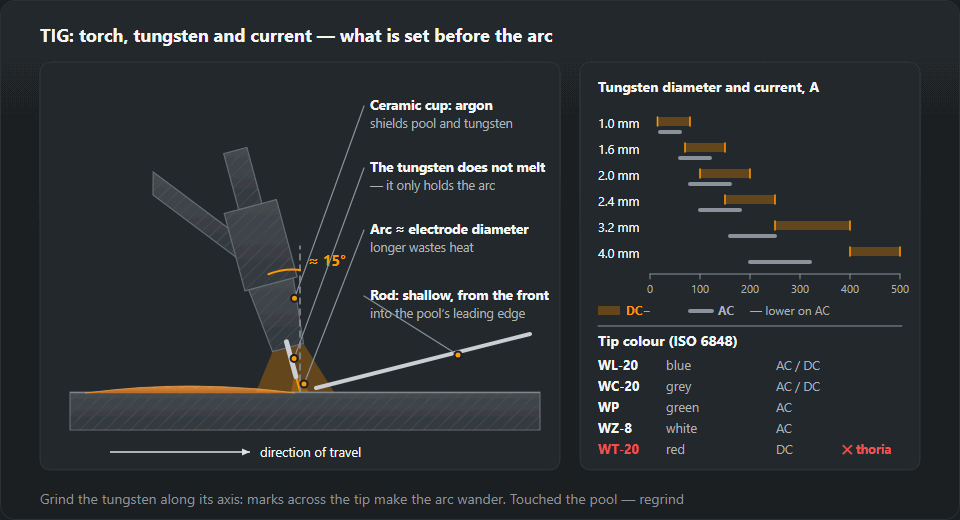
Lanthanated (blue) covers almost everything on both AC and DC. Pure tungsten (green) is the traditional AC choice and forms the balled end that suits it. Thoriated red electrodes are best avoided: the grinding dust is mildly radioactive and lanthanated types match their performance. Diameter and grind angle come from the current — the tungsten calculator gives both, along with the cup size and gas flow.
Grind along the axis. The grinding marks guide the arc, so marks running across the tip make the arc wander, and no amount of technique fixes it.

Gas and purging
Argon, 6 to 12 l/min, with a post-flow long enough to protect the tungsten and the cooling pool — a rough rule is one second per 10 A. Argon with 2 to 5 % hydrogen is used on austenitic stainless to raise the heat and brighten the surface, and on nothing else.
On stainless and titanium pipe the underside of the root needs its own shield, because a root run that oxidises turns grey and crumbly and is scrap. Titanium is unforgiving here: any straw or purple colour means the shielding was insufficient.
| Thickness, mm | Tungsten, mm | Current DC−, A | Filler, mm | Argon, l/min |
|---|---|---|---|---|
| 0.5–1.0 | 1.0–1.6 | 20–50 | 1.0–1.6 | 5–7 |
| 1.5–2.0 | 1.6 | 50–90 | 1.6 | 6–8 |
| 3.0 | 2.0–2.4 | 90–130 | 2.0–2.4 | 7–9 |
| 4.0–5.0 | 2.4 | 130–180 | 2.4–3.0 | 8–10 |
| 6.0–8.0 | 3.2 | 180–250 | 3.0–4.0 | 10–12 |
The full chart with wire feed speed, TIG, thin sheet and box section: MIG/MAG and TIG settings.
The technique
Arc length equal to about the electrode diameter — long arcs waste heat and widen the bead. The torch leans about 15° in the direction of travel; the rod comes in at a shallow angle from the front, dipped into the leading edge of the pool and withdrawn, without ever touching the tungsten. Touching the tungsten means stopping and regrinding: the contamination will not burn off, and it puts tungsten inclusions in the weld.
On thin stainless the failure mode is heat, not technique. Tack often, use copper backing where you can, and drop the current as the plate warms up. The practical settings are in how to weld thin sheet.
When to feed the rod and how fast to travel is set by the pool: the signs that it has spread and wetted both edges are covered on the weld pool page.
What it costs
Time. TIG deposits a fraction of what MIG/MAG does, and on a priced job that dominates everything else — feed both into the cost per metre and the gap is obvious. Which is the argument for using TIG where it earns its keep: the root run, the visible weld, the thin section and the material that tolerates nothing else.
Common mistakes and what to change
| Symptom | Cause |
|---|---|
| The tungsten turns blue, then black | Too little gas, a short post-flow, too much stick-out |
| Tungsten inclusions in the weld | The electrode touched the pool or the filler rod |
| A grey, spongy bead on stainless | Overheating, no root purge, contaminated argon |
| The arc wanders | Tungsten ground across, arc blow, contamination |
| The pool will not wet the aluminium | Not enough current, wrong AC balance, the oxide film still there |
Four more that show at once, with the fix:
- A spread-out, wide arc. The arc is too long — bring the torch down to one electrode diameter.
- A balled tungsten tip on DC. Too much current for the diameter, or the polarity is reversed — check the torch is on negative.
- Black specks in an aluminium weld. The rod end left the gas shield and oxidised; keep it in the gas stream between dabs as well.
- A crack in the crater. The arc was cut off abruptly — set a 2–5 s down-slope or ease off the pedal at the end of the weld.
What to set before the first arc
- Pre-flow — 0.5–2 s. The gas has to reach the joint before the arc strikes.
- Post-flow — about 1 s for every 10 A. At 150 A that is 15 s: that is how long the tungsten and the weld take to cool, and they need shielding the whole time.
- Arc start. HF (high-frequency, no contact) as standard; lift-arc — touch and lift smoothly — where sensitive electronics are nearby.
- AC balance — 60–70 % electrode-negative for ordinary aluminium; more electrode-positive when the surface is heavily oxidised.
- Down-slope — 2–5 s, so the crater does not crack.
TIG amperage by thickness — reading the table
The thickness table above works out at about 30–45 A per millimetre on DC−: 3 mm is 90–130 A, 6–8 mm is 180–250 A. The top of the range is for fillet and T-joints, where heat escapes into two plates at once; the bottom is for butt joints with a gap. Check the tungsten in the table against its current capacity — 1.6 mm carries about 70–150 A on DC−, 2.4 mm 150–250 A, 3.2 mm 250–400 A, less on AC — and go up a size if the current nears the top. Aluminium on AC needs 20–30 % more current and 2–4 l/min more argon than steel of the same thickness. Above 8 mm it is multi-pass work with a bevel.
Three worked settings
- 1.5 mm stainless, butt joint. The 1.5–2.0 mm row: 1.6 mm tungsten, 50–90 A, 1.6 mm rod, argon 6–8 l/min. Start in the lower half of the range, as the sheet heats quickly. On pipe add a root purge inside, 4–8 l/min, and a post-flow of 6–9 s at 60–90 A.
- 3 mm aluminium, fillet weld on AC. The 3.0 mm row gives 90–130 A for steel; add 20–30 % and you get about 110–170 A. Argon 7–9 l/min plus 2–4, so 9–13 l/min. Tungsten 2.4 mm, because 2.0 mm tops out around 160 A on AC.
- 6 mm steel, single-V butt. The 6.0–8.0 mm row: 3.2 mm tungsten, 180–250 A, 3.0–4.0 mm rod, argon 10–12 l/min. At 200 A the post-flow is about 20 s. In practice TIG often lays only the root and a faster process fills the joint.
What 141, 142 and 143 mean
The numbers come from ISO 4063: 141 is TIG with solid filler (rod or wire), 142 is TIG without filler, fusing the edges alone, and 143 is TIG with tubular (cored) filler. “141 TIG welding” in a job advert or a WPS therefore means ordinary welding with a rod. The same number appears in a welder’s qualification; what a given certificate covers — thicknesses, pipe diameters, positions — you can check with the ISO 9606 qualification range calculator.
Weld colour on stainless — what it says about the shield
The heat tint on stainless is a record of how well the gas protected the hot metal. Straw or light blue is normal. Grey, dull and powdery means the shield failed: too little flow, too short a post-flow, too much tungsten stick-out or a draught. The same goes for the underside — a root without purging comes out dark and brittle. On titanium even a straw or purple tint means the shielding was insufficient. Food and pharmaceutical pipework has stricter criteria than “looks fine”, and they are set by the job specification.
Which gas for which metal is covered in shielding gas selection; how much argon a shift uses is worked out by the gas consumption calculator.
Frequently asked questions
Why AC for aluminium?
Because of the oxide film. Aluminium oxide melts at about 2050 °C while the metal under it melts at 660 °C, so the film has to be broken up before anything can be welded. The electrode-positive half of the AC cycle does that — the cathodic cleaning action — while the electrode-negative half puts the heat into the work. The balance control decides how the cycle is split.
What is the weld turning grey and dull?
Oxidation from too little gas or too much stick-out. On stainless a straw or light-blue tint is normal; grey and powdery means the shield failed. Check the flow rate, the post-flow time and how far the tungsten protrudes from the cup — and on pipe, whether the root needs purging.
Do I need a foot pedal?
Not to learn, but it changes what you can do. Being able to drop the current as the plate heats up is what keeps the last 50 mm of a thin-sheet seam from blowing out, and it is how a crater is filled without leaving a crack in it.
What does 141 TIG welding mean?
141 is the process number in ISO 4063: TIG welding with solid filler, i.e. a rod or wire. 142 is TIG without filler and 143 TIG with cored filler. The number turns up in WPS documents and in a welder’s qualification designation.
What amperage for TIG welding 2 mm sheet?
For steel and stainless on DC−: 50–90 A, 1.6 mm tungsten, 1.6 mm rod, argon 6–8 l/min. 2 mm aluminium on AC needs 20–30 % more current.
What argon flow rate for TIG?
From 5–7 l/min on sheet up to 1 mm to 10–12 l/min on 6–8 mm, with 2–4 l/min more on aluminium. More is not better: too strong a stream draws in air.
Updated: