Welding process numbers to ISO 4063
111, 135, 141 — the process number replaces the name wherever a document has to be read regardless of language: on a WPS, on a welder qualification certificate, in a WPQR and on a drawing. The full table is below, with names and the international abbreviations.
Short answer
The numbers you meet most often:
- 111 — Manual metal arc welding with covered electrode (MMA · SMAW)
- 114 — Self-shielded tubular-cored arc welding (FCAW-S)
- 121 — Submerged arc welding with solid wire electrode (SAW)
- 131 — MIG welding with solid wire in inert gas (MIG · GMAW)
- 135 — MAG welding with solid wire in active gas (MAG · GMAW)
- 136 — MAG welding with flux-cored wire (FCAW)
- 138 — MAG welding with metal-cored wire (MCAW)
- 141 — TIG welding with solid filler (TIG · GTAW)
- 142 — Autogenous TIG welding, no filler (TIG)
- 311 — Oxy-acetylene welding (OAW)
How the number is built
The numbering is hierarchical and reads from the left. The first digit is the group: 1 arc, 2 resistance, 3 gas, 4 pressure, 5 beam, 7 other welding, 8 cutting and gouging, 9 brazing and soldering. The second digit narrows the group, the third names the individual process.
Take 135: 1 arc welding, 13
gas-shielded metal arc welding, 135 with solid wire in an active
gas. That is also why two-digit numbers turn up in paperwork: 13
in a WPQR means the qualification covered the whole subgroup rather than one
variant of it.

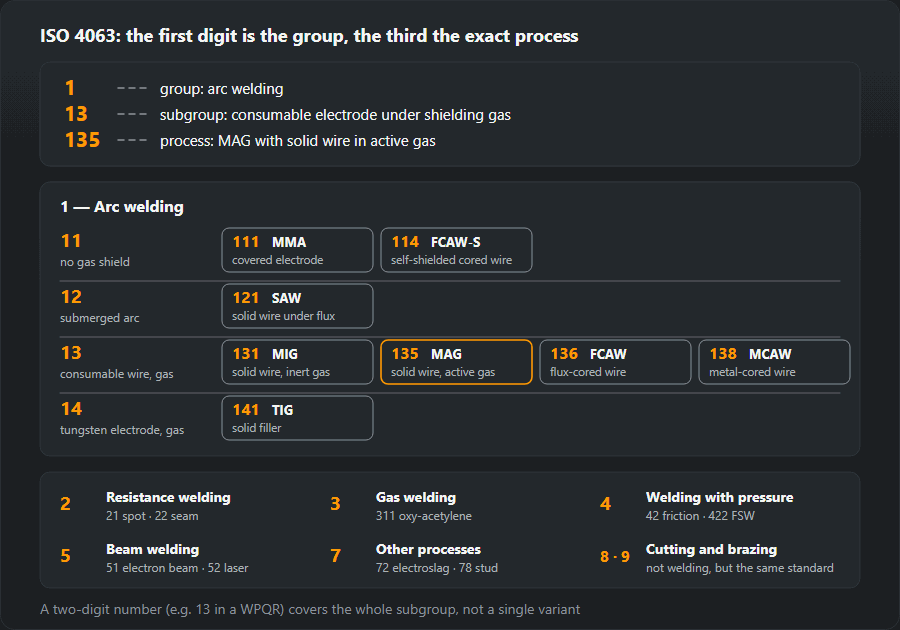
111, 131, 135, 136, 138, 141, 311: what each number means
These seven numbers account for most of what turns up on welder certificates and procedure specifications. Each block below says what the process is, where it is used and what the number limits on paper. The rule behind all of them is the same: a number covers its own process and nothing else.
111 — manual metal arc welding (MMA, SMAW)
Welding with a covered electrode. The arc burns between the electrode core and the work, and the coating turns into gas and slag that shield the pool. There is no cylinder and no wire feeder, which makes 111 the process for site assembly, repairs and work in the wind. The price is speed: every electrode means a stop, chipping the slag and a restart, and each restart is a place where a defect can start. In a qualification code, 111 covers covered-electrode welding only — not self-shielded wire, which is 114. Settings and electrode choice: MMA welding.
131 — MIG welding with solid wire (MIG, GMAW)
The same torch and feeder as MAG, but the gas is inert — argon, helium or a mixture of the two — so it takes no part in the reactions in the pool. That is what aluminium, copper and their alloys need: an active gas would oxidise them. Unalloyed steel is welded with 135 instead, and the gas is exactly what separates the two numbers. Welding machines are often labelled “MIG” whatever gas goes through them; the paperwork is not that relaxed, and a 131 test on aluminium says nothing about 135 on steel. Aluminium specifics: welding aluminium.
135 — MAG welding with solid wire
The workhorse of structural fabrication: solid wire under an active gas — argon with CO₂ (group M21 in ISO 14175) or pure CO₂. The wire is fed continuously, so a joint is welded without stopping to change electrodes, and there is no slag to chip, only spatter and a thin glassy film. On certificates for steelwork, 135 is the commonest process of all; on a WPS it comes together with the wire designation to EN ISO 14341 and the gas group. Settings by thickness: MIG/MAG welding.
136 — MAG welding with flux-cored wire (FCAW)
The wire is a tube filled with flux. At the same machine settings it melts faster than solid wire, because the current flows only through the thin sheath, and the slag it leaves supports the pool from below and from the sides — which is why 136 welds in position at currents where solid wire would run out of the joint. The costs are concrete: slag to remove between runs (left in, it becomes an inclusion), several times more fume, dearer wire. For certification 136 is a process of its own. More in flux-cored welding 136 and 138.
138 — MAG welding with metal-cored wire (MCAW)
Also a tubular wire, but filled with metal powder instead of flux. There is next to no slag, the surface comes out clean and deposition on long runs is high. It shapes the bead less than 136, so it forgives less in position, and it asks more of the gas. In the welder qualification code the filler field shows M — metal-cored wire — where solid wire would show S. Here ISO 9606-1 makes one of its few exceptions: a test on 135 covers 138 and a test on 138 covers 135, so switching between solid and metal-cored wire needs no new welder test. 136 is not part of that exception.
141 — TIG welding with solid filler (GTAW)
The arc burns from a non-consumable tungsten electrode in inert gas, usually pure argon, and filler rod is added by hand. The slowest of the seven and the cleanest: no spatter, no slag, full control of the pool. Hence where it is used — root runs on pipe, stainless steel, thin sheet, aluminium. Steel is welded on direct current with the electrode negative, aluminium on alternating current for its cleaning action on the oxide film. TIG without filler is a different number, 142. Settings and tungsten choice: TIG welding.
311 — oxy-acetylene welding (OAW)
No arc at all: the heat comes from an oxygen–acetylene flame and the filler rod goes into the pool by hand. The process survives where it heats more gently than an arc — sheet from 0.5 to 3 mm, small-bore pipework, repairs — and where there is no electricity. For steel the flame is set neutral. Oxy-propane welding is 312 and oxy-hydrogen 313; braze welding with the same torch is 971, a different process because the parent metal does not melt. Flame settings and filler diameter: gas welding.
135, 136 and 138: the difference
All three are MAG, and on the shop floor they are often run on the same machine. The difference is the wire, and with it the slag and the paperwork:
| No. | Wire | Gas | Slag | Typical use |
|---|---|---|---|---|
| 135 | Solid | Active | None | Structural work, the baseline |
| 136 | Tubular, flux core | Active | Yes, removed between runs | Heavier sections, positional work |
| 138 | Tubular, metal core | Active | Traces | Long runs where a clean cap matters |
| 114 | Tubular, self-shielded | None | Yes | Site work in wind, no cylinder |
131, 132 and 133 are the same trio under inert gas: MIG with solid, flux-cored and metal-cored wire. Two things follow for the documents. A WPS written for 135 does not become valid for 136 because the machine is the same — the process is an essential variable. And a welder certified on 135 who moves to flux-cored wire needs a 136 certificate; metal-cored 138 is the exception that ISO 9606-1 lets a 135 certificate cover. What a certificate covers is worked out in the qualification range calculator.
The three side by side, in the workshop and on paper: 135, 136 and 138 compared.
The table
1 — Arc welding
| No. | Process | Abbreviation |
|---|---|---|
| 11 | Metal arc welding without gas shield | — |
| 111 | Manual metal arc welding with covered electrode | MMA · SMAW |
| 112 | Gravity arc welding with covered electrode | — |
| 114 | Self-shielded tubular-cored arc welding | FCAW-S |
| 12 | Submerged arc welding | — |
| 121 | Submerged arc welding with solid wire electrode | SAW |
| 122 | Submerged arc welding with strip electrode | SAW |
| 125 | Submerged arc welding with tubular-cored electrode | SAW |
| 13 | Gas-shielded metal arc welding | — |
| 131 | MIG welding with solid wire in inert gas | MIG · GMAW |
| 132 | MIG welding with flux-cored wire | FCAW |
| 133 | MIG welding with metal-cored wire | MCAW |
| 135 | MAG welding with solid wire in active gas | MAG · GMAW |
| 136 | MAG welding with flux-cored wire | FCAW |
| 138 | MAG welding with metal-cored wire | MCAW |
| 14 | Gas-shielded arc welding with non-consumable tungsten electrode | — |
| 141 | TIG welding with solid filler | TIG · GTAW |
| 142 | Autogenous TIG welding, no filler | TIG |
| 143 | TIG welding with tubular-cored filler | TIG |
| 15 | Plasma arc welding | — |
| 151 | Plasma MIG welding | — |
| 152 | Powder plasma arc surfacing | — |
| 153 | Plasma arc welding with transferred arc | PAW |
| 185 | Magnetically impelled arc butt welding | MIAB |
2 — Resistance welding
| No. | Process | Abbreviation |
|---|---|---|
| 21 | Resistance spot welding | RSW |
| 22 | Resistance seam welding | RSEW |
| 23 | Projection welding | RPW |
| 24 | Flash welding | FW |
| 25 | Resistance butt welding | RBW |
| 291 | High-frequency resistance welding | HFRW |
3 — Gas welding
| No. | Process | Abbreviation |
|---|---|---|
| 31 | Oxy-fuel gas welding | — |
| 311 | Oxy-acetylene welding | OAW |
| 312 | Oxy-propane welding | — |
| 313 | Oxy-hydrogen welding | — |
4 — Welding with pressure
| No. | Process | Abbreviation |
|---|---|---|
| 41 | Ultrasonic welding | USW |
| 42 | Friction welding | FRW |
| 421 | Rotary friction welding | RFW |
| 422 | Friction stir welding (FSW) | FSW |
| 441 | Explosive welding | EXW |
| 45 | Diffusion welding | DFW |
| 48 | Cold pressure welding | CW |
5 — Beam welding
| No. | Process | Abbreviation |
|---|---|---|
| 51 | Electron beam welding | — |
| 511 | Electron beam welding in vacuum | EBW |
| 512 | Electron beam welding in air | EBW |
| 52 | Laser welding | — |
| 521 | Solid-state laser welding | LBW |
| 522 | Gas laser welding | LBW |
| 523 | Diode laser welding | LBW |
7 — Other welding processes
| No. | Process | Abbreviation |
|---|---|---|
| 71 | Aluminothermic welding | TW |
| 72 | Electroslag welding | ESW |
| 73 | Electrogas welding | EGW |
| 74 | Induction welding | IW |
| 78 | Stud welding | SW |
| 783 | Drawn arc stud welding with ceramic ferrule | SW |
| 784 | Short-cycle drawn arc stud welding | SW |
| 785 | Capacitor discharge stud welding | CD |
8 — Cutting and gouging
| No. | Process | Abbreviation |
|---|---|---|
| 81 | Flame cutting | — |
| 82 | Arc cutting | — |
| 821 | Air arc cutting | — |
| 822 | Oxygen arc cutting | — |
| 83 | Plasma cutting | PAC |
| 84 | Laser cutting | LBC |
| 86 | Flame gouging | — |
| 87 | Arc gouging | — |
| 88 | Plasma gouging | — |
9 — Brazing, soldering and braze welding
| No. | Process | Abbreviation |
|---|---|---|
| 91 | Brazing | B |
| 912 | Flame brazing | — |
| 916 | Induction brazing | — |
| 94 | Soldering | S |
| 97 | Braze welding | BW |
| 971 | Gas braze welding | — |
| 972 | Arc braze welding | — |
ISO 4063 holds around two hundred entries, some of which you meet once in a career. The table lists the processes that turn up in a workshop and in documents. If a number outside this list appears in your paperwork, its meaning still follows from the structure: the first digit always gives the group.
Where the number appears
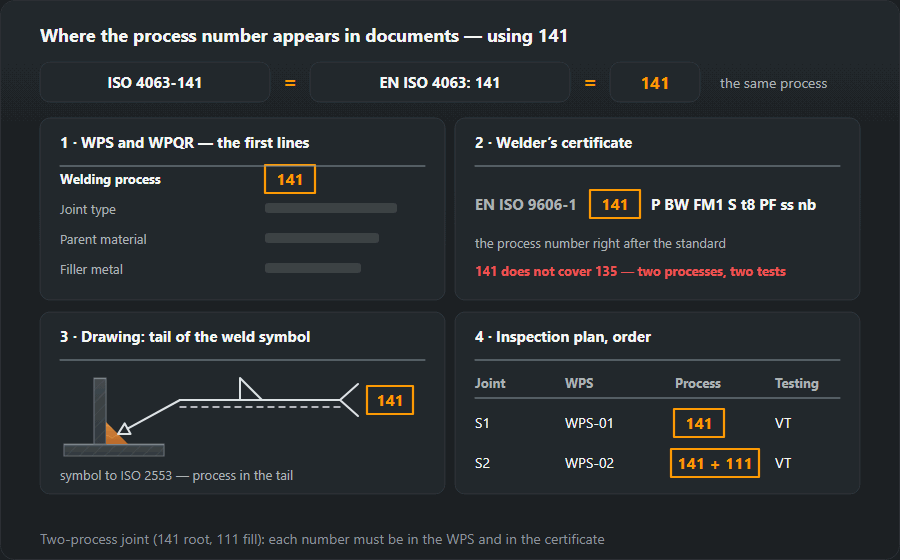
On the procedure specification. A WPS to EN ISO 15609-1 opens with the process number. It is an essential variable, so changing the process invalidates the specification and calls for a new procedure qualification.
On the welder certificate. In the qualification code to EN ISO 9606-1 the process number comes straight after the standard reference. An approval for 141 does not cover 135 — two processes, two tests, however well the welder handles both.
In the WPQR and in the order for welding work, where the number is the one entry nobody can read their own way: "semi-automatic" means different things in different shops, while 135 means the same thing everywhere.
What sits behind those numbers in practice is covered separately: MMA, MIG/MAG and TIG. How the whole qualification code is read — in the article on the EN ISO 9606 welder test.
How to read “ISO 4063-141” and the number in documents
“ISO 4063-141”, “EN ISO 4063: 141” and a bare “141” mean the same thing: process 141 from the ISO 4063 list. Besides the WPS, the WPQR and the certificate, the same number turns up in two less obvious places: in the tail of a weld symbol on a drawing to ISO 2553 (how the symbol is read is shown in reading welding symbols), and in inspection and test plans, where it ties each joint to its procedure.
When one joint is made with two processes — a TIG root and an MMA fill, say — each process carries its own number, and each has to be covered both by the procedure and by the certificate of whoever welds that part of the joint.

Common mistakes with process numbers
- Flux-cored wire on a 135 document. Flux-cored wire is 136. Swapping the spool without changing the WPS and the certificate takes the joint outside both. Metal-cored 138 is covered by a 135 welder certificate, but the WPS still has to name it.
- “MIG” for everything. Machines and adverts say MIG, but steel under an argon–CO₂ mixture is MAG, 135. 131 is inert gas.
- A two-digit number read as a process. “13” in a document is the whole subgroup of gas-shielded metal arc welding, not one more variant alongside 135.
- 114 taken for 111 or 136. Self-shielded wire has neither a coating nor a gas cylinder; it has its own number and its own test.
- 142 written as 141. TIG without filler — edge fusion on thin sheet — is 142, a number of its own. Which of the two was actually used is visible at once: either a rod went into the pool or it did not.
Frequently asked questions
What does 111 mean on a welder certificate?
Manual metal arc welding with a covered electrode — MMA, or SMAW in American usage. The number sits in the qualification code right after the standard reference and states which process the test was taken with, and therefore which process the welder is approved for.
What is the difference between 135, 136 and 138?
All three are MAG; the difference is the wire. 135 is solid wire, 136 is flux-cored wire (it leaves slag), 138 is metal-cored wire (almost no slag). On paper they are three separate processes. On a welder certificate 135 and 138 cover each other — an exception written into ISO 9606-1 — while 136 always needs its own test.
Are the process numbers the same in every country?
Yes — that is the whole point of ISO 4063. 141 means TIG with solid filler in a Polish WPS, in a German one and in a Spanish one alike, even though the name of the process reads differently in each. That is why welding paperwork carries the number rather than the name.
What is 311 welding?
Oxy-acetylene welding: the heat comes from an oxygen–acetylene flame, not from an arc, and the filler rod is fed in by hand. It is still used on thin sheet, small-bore pipe and repairs where there is no power. Oxy-propane welding is a different number, 312, and braze welding with the same torch is 971.
What is the difference between 131 and 135?
The gas. Both use solid wire and the same kind of torch, but 131 (MIG) runs under inert gas — argon, helium or their mixture — and is the process for aluminium and copper, while 135 (MAG) runs under active gas such as argon with CO₂ and is the process for steel. On a certificate they are two separate processes.
Does a 135 certificate let me weld with flux-cored wire?
No. Flux-cored wire under gas is 136 — a separate number and a separate test. (Metal-cored wire, 138, is the exception: ISO 9606-1 lets a 135 certificate cover it.) The machine and the torch may be the same, but on paper the process is an essential variable, and an inspector reads the number, not the equipment.
Updated: