Electrode and wire designations explained
Type the designation off the box — E7018, ER70S-6, E 42 5 B 42 H5 — and it gets pulled apart field by field, with each one explained. Below are the full code tables to EN ISO and AWS.
Try a ready one:
Works for covered electrodes and for wires, in both the European and the American notation. EN ISO designations are written with spaces, American ones run together.
Covered electrodes to EN ISO 2560
Read it left to right: the type letter, strength, impact toughness, chemistry, covering, deposition yield with the current, positions and hydrogen at the end. The first two figures are the ones that matter — they say which steel the electrode belongs to.
E 42 5 B 42 H5
| Code | Yield strength | Tensile strength Rm |
|---|---|---|
| 35 | 355 MPa | 440–570 MPa |
| 38 | 380 MPa | 470–600 MPa |
| 42 | 420 MPa | 500–640 MPa |
| 46 | 460 MPa | 530–680 MPa |
| 50 | 500 MPa | 560–720 MPa |
| Code | Impact 47 J at |
|---|---|
| Z | not required |
| A | +20 °C |
| 0 | 0 °C |
| 2 | −20 °C |
| 3 | −30 °C |
| 4 | −40 °C |
| 5 | −50 °C |
| 6 | −60 °C |
| Code | Covering |
|---|---|
| A | acid |
| C | cellulosic |
| R | rutile |
| RR | thick rutile |
| RC | rutile-cellulosic |
| RA | rutile-acid |
| RB | rutile-basic |
| B | basic |
| Code | Deposition yield | Current |
|---|---|---|
| 1 | ≤ 105 % | AC and DC |
| 2 | ≤ 105 % | DC only |
| 3 | 105–125 % | AC and DC |
| 4 | 105–125 % | DC only |
| 5 | 125–160 % | AC and DC |
| 6 | 125–160 % | DC only |
| 7 | > 160 % | AC and DC |
| 8 | > 160 % | DC only |
| Code | Welding positions |
|---|---|
| 1 | all positions |
| 2 | all except vertical down |
| 3 | flat and horizontal fillet |
| 4 | flat only |
| 5 | as 3 plus vertical down |
| Code | Hydrogen, ml/100 g |
|---|---|
| H5 | ≤ 5 ml/100 g |
| H10 | ≤ 10 ml/100 g |
| H15 | ≤ 15 ml/100 g |
Covered electrodes to AWS A5.1
Four digits after the letter E: the first two are the tensile strength in thousands of pounds per square inch, the third is the positions, the fourth is the covering together with the current. That is why E7018 and E6013 differ in more than strength.
E 70 1 8
| Code | Tensile strength Rm | |
|---|---|---|
| 60 | 430 MPa | 60 ksi |
| 70 | 490 MPa | 70 ksi |
| 80 | 550 MPa | 80 ksi |
| Code | Welding positions |
|---|---|
| 1 | all positions |
| 2 | flat and horizontal fillet |
| 4 | flat, horizontal, overhead and vertical down |
| Code | Covering | Current |
|---|---|---|
| 0 | cellulosic sodium | DC+ |
| 1 | cellulosic potassium | AC / DC+ |
| 2 | rutile sodium | AC / DC− |
| 3 | rutile potassium | AC / DC± |
| 4 | rutile with iron powder | AC / DC± |
| 5 | basic sodium | DC+ |
| 6 | basic potassium | AC / DC+ |
| 7 | oxide with iron powder | AC / DC± |
| 8 | basic with iron powder | AC / DC+ |
Solid wire: EN ISO 14341 and AWS A5.18
In the European notation the letter G is followed by strength, toughness, shielding gas and wire chemistry. The American ER70S-6 says the same thing more briefly: 70 ksi, solid wire, chemistry number six.
G 42 3 M21 3Si1 ER 70 S -6
| Code | Wire composition |
|---|---|
| 2Si | low silicon |
| 3Si1 | the standard one, silicon and manganese |
| 4Si1 | more silicon, a runnier pool |
| 2Ti | with titanium, for rusty plate |
| 3Ni1 | with nickel, toughness below zero |
| 2Mo | with molybdenum, creep resistant |
| Code | Shielding gas | Where it is used |
|---|---|---|
| I1 | Ar 100 % | TIG, MIG |
| M12 | Ar + 0.5–5 % CO₂ | 135 |
| M21 | Ar + 15–25 % CO₂ | 135 / 136 |
| C1 | CO₂ 100 % | 135 / 136 |
| Code | Wire composition |
|---|---|
| 2 | titanium and zirconium, for rusty plate |
| 3 | low silicon, less spatter |
| 4 | more manganese and silicon |
| 6 | highest silicon and manganese, the all-rounder |
| G | composition agreed with the maker |
Flux-cored wire and stainless electrodes
On flux-cored wire the letter T is followed by the core type — that decides whether the bead comes out smooth and how little hydrogen stays in the weld. On stainless electrodes the two digits after the dash are the covering and the current.
| Code | What it means |
|---|---|
| T-1 | rutile core, a smooth bead |
| T-5 | basic core, low hydrogen |
| T-4 | self-shielded, no gas, high deposition |
| 15 | basic, DC only |
| 16 | rutile, AC and DC |
| 17 | rutile-silicate |
E 42 3 B 32 H5 — an EN ISO 2560 designation taken apart

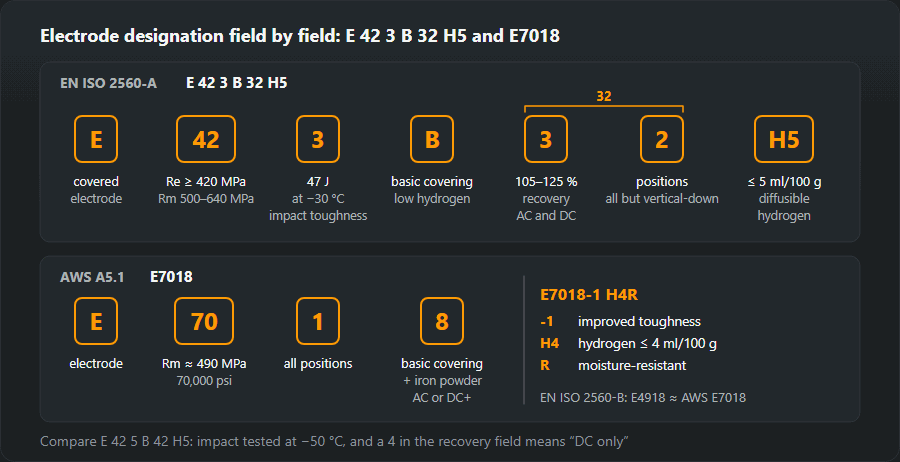
A covered-electrode designation to EN ISO 2560-A is read left to right,
and every field points to one of the tables above. Take
E 42 3 B 32 H5:
- E — covered electrode for manual metal arc welding (111).
- 42 — weld metal yield strength at least 420 MPa, tensile strength 500–640 MPa.
- 3 — 47 J impact energy reached at −30 °C.
- no chemistry symbol — unalloyed carbon-manganese weld metal; an alloyed electrode would carry a symbol such as 1Ni or Mo here.
- B — basic covering: low hydrogen, good toughness, needs dry storage.
- 3 — recovery 105–125 %, AC and DC.
- 2 — all positions except vertical down.
- H5 — diffusible hydrogen up to 5 ml/100 g of weld metal.
Compare it with the decoder's example, E 42 5 B 42 H5: same
strength and covering, but toughness at −50 °C, and the 4 in the recovery
place means DC only. Anyone with an AC transformer set cannot run it, although on
the box the difference is a single digit.
The A after the standard number (EN ISO 2560-A) means classification by
yield strength and 47 J impact. System B of the same standard classifies by
tensile strength and 27 J, and its designations look American:
E4918 is the counterpart of AWS E7018.
E7018, E6013, E7018-1 H4R: reading AWS A5.1 designations
In AWS the letter E is followed by four digits. The first two are the tensile strength in thousands of psi: 60 is about 430 MPa, 70 about 490 MPa. The third is the positions, the fourth the covering together with the current:
- E7018 — 490 MPa, all positions, basic covering with iron powder, AC or DC electrode positive. The standard choice for structural work.
- E6013 — 430 MPa, all positions, rutile potassium covering, AC and DC of either polarity. Easy to strike and forgiving of an uneven gap, but lower in toughness.
- E7016 — the same strength as E7018, basic potassium covering without iron powder, so it deposits more slowly.
Suffixes may follow: -1 on E7018 means improved toughness;
H4, H8 or H16 give the maximum
diffusible hydrogen in ml/100 g; R marks a
moisture-resistant covering. So E7018-1 H4R is a basic electrode
with improved toughness, no more than 4 ml of hydrogen, and resistant to
moisture pick-up.
G 42 3 M21 3Si1 and ER70S-6: MIG/MAG wires
A solid wire to EN ISO 14341-A starts with G, followed by strength, toughness, gas and composition:
- G — solid wire for gas-shielded welding.
- 42 — weld metal yield strength at least 420 MPa.
- 3 — 47 J impact at −30 °C.
- M21 — the gas used for the classification tests: Ar + 15–25 % CO₂. The same wire in pure CO₂ (C1) may give different properties.
- 3Si1 — composition: silicon and manganese, the commonest variant.
The American ER70S-6 says the same more briefly: ER — electrode or
rod, 70 ksi, S — solid, 6 — the composition with the highest silicon and
manganese. In the shop it is usually paired with G3Si1, but for acceptance what
counts is the wire's certificate. The
shielding gas selector
helps match the gas to the wire.
What else to check on the box
The designation describes the weld metal, not everything you need at the bench. Read these off the packaging too:
- diameter and length — e.g. 3.2 × 350 mm; the diameter sets the current, which the current calculator works out;
- the maker's current range and polarity — often narrower than the current digit in the designation alone suggests;
- re-drying conditions — temperature and time from the manufacturer for basic electrodes; without them the H5 on the box means nothing;
- the batch number — needed for acceptance documents (such as an EN 10204 3.1 certificate) and for complaints.
Covering types and how they behave are covered in the article on electrode coverings, and real brands with their designations in the electrode catalogue.
Common mistakes when reading designations
- ISO 42 read like AWS 70. In EN ISO 2560-A the number is yield strength in MPa/10; in AWS it is tensile strength in ksi. E 42 and E70 measure different things.
- Position digits mixed up. In ISO 1 is all positions and 3 is flat and horizontal fillet; in AWS 1 is also all positions, but 2 is flat and horizontal. Read each system with its own table.
- The current digit ignored. Even recovery digits (2, 4, 6, 8) in ISO mean DC only.
- E6013 on a load-bearing structure. A rutile electrode is pleasant to run, but critical joints get a basic one such as E7018.
- H5 without re-drying. The hydrogen figure applies to a dry electrode; after a night in a damp shop it is a different electrode.
What the designation will not tell you
The code describes the deposited metal, not your joint. It holds no plate thickness, no preheat, and no record of whether the electrode was baked — the current range, re-drying conditions and batch are read off the box, as listed above.
Frequently asked questions
What does E7018 mean?
Seventy ksi of tensile strength, about 490 MPa; the one means all welding positions; the eight means a basic covering with iron powder, on AC and DC. It is the everyday low-hydrogen electrode for structural work.
How does E6013 differ from E7018?
E6013 has a rutile covering: it strikes easily and forgives dirt and an uneven gap, but its impact toughness is lower. E7018 is basic and low-hydrogen — harder to run, yet the weld resists cracking. For load-bearing joints you take E7018.
What does H5 at the end of the designation mean?
Diffusible hydrogen in the deposited metal: no more than 5 ml per 100 g. The less hydrogen, the lower the risk of cold cracks. The figure only holds for a dry electrode — after a night in a damp shop it means nothing at all.
What does E 42 3 B 32 H5 mean?
A covered electrode to EN ISO 2560-A: weld metal yield strength at least 420 MPa, 47 J impact at −30 °C, basic covering, 105–125 % recovery on AC and DC, all positions except vertical down, and diffusible hydrogen of no more than 5 ml per 100 g of weld metal.
What is the EN ISO 2560 equivalent of E7018?
The closest is system B of that standard, which, like AWS, classifies by tensile strength: there E7018 corresponds to E4918, because 70 ksi is about 490 MPa. In system A, based on yield strength and 47 J impact, such an electrode carries the letter B (basic covering), but the strength class, toughness and recovery have to be read from the manufacturer's data sheet — there is no fixed one-to-one pair.
What does ER70S-6 mean?
A solid MIG/MAG wire to AWS A5.18: ER — electrode or rod, 70 — weld metal tensile strength of 70 ksi (about 490 MPa), S — solid, 6 — the composition with the highest silicon and manganese in the group, the most versatile option.
Updated: