How to choose MIG/MAG wire for steel, stainless and aluminium
Picking a MIG/MAG wire comes down to three decisions: the metal, how clean the surface and the gas are, and the diameter for the thickness. The code on the spool answers the first two. Here it is read for the job; the full field-by-field breakdown is in the designation table.
Short answer
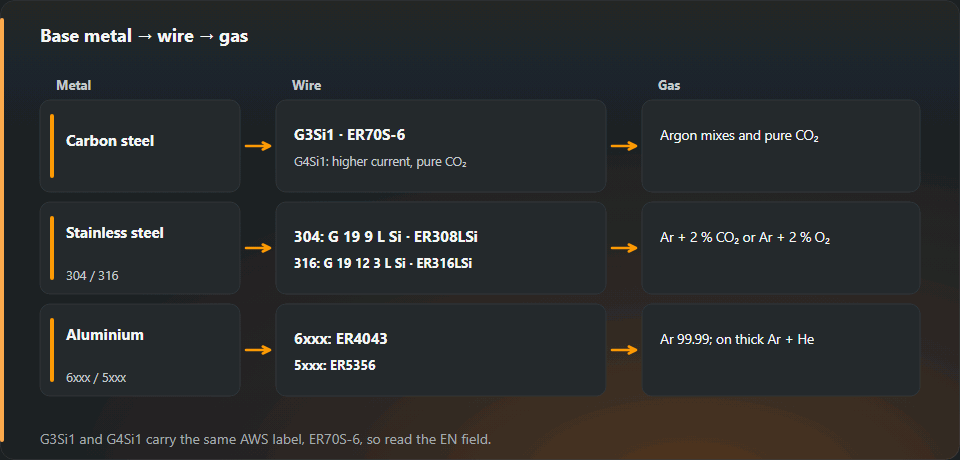
For carbon steel take G3Si1 (AWS ER70S-6), and move to G4Si1 for higher current, pure CO₂ or steel that is not quite clean. Both carry the ER70S-6 label in AWS terms, so read the EN field on the spool or the data sheet. Stainless steel: a low-carbon wire that matches the grade, 308LSi (G 19 9 L Si) for 304 and 316LSi (G 19 12 3 L Si) for 316. Aluminium: ER4043 for 6xxx alloys and a runnier pool, ER5356 for 5xxx and a stronger weld. The diameter follows the thickness: 0.8–1.0 mm wire at 110–150 A for 3 mm, 1.0–1.2 mm at 160–220 A for 5–6 mm.
Reading the code for a decision
Two systems name the same wires. In EN ISO 14341-A the code ends with the chemistry symbol: 2Si, 3Si1, 4Si1. The digit rises with the manganese content and Si1 marks the silicon level. In shop talk and on data sheets it is written with a G in front (G3Si1), because the full code starts with G, as in G 42 3 M21 3Si1. In AWS A5.18 the same wire is ER70S-6: ER for electrode or rod, 70 for the 70 ksi minimum strength, S for solid wire, and the last number for the chemistry.
Strength, impact and gas fields are read in the designation table. For choosing a wire the chemistry symbol matters most: it decides how the wire behaves on oxidised metal and in CO₂.

Carbon steel: 2Si, 3Si1, 4Si1
Manganese and silicon in the wire are deoxidisers: they bind oxygen from the pool, the surface and the gas. Pure CO₂, rust and scale supply more oxygen, so a wire with more of both copes better. On clean metal in an argon mix a wire with less gives a calmer arc. The table gives the typical analyses from maker data sheets, not the limits of the standard.
| Wire (EN ISO 14341-A) | AWS A5.18 | Typical Mn and Si, % | When to use it |
|---|---|---|---|
| 2Si | ER70S-3 | Less than 3Si1 | Clean, ground or pickled steel. Low silicon, less spatter, less margin on rust. Lincoln and ESAB list it for mixes and for CO₂. |
| 3Si1 (G3Si1) | ER70S-6 | Mn about 1.45, Si 0.85–0.9 | The standard wire. Argon mixes and pure CO₂; copes with light mill scale. |
| 4Si1 (G4Si1) | ER70S-6 | Mn about 1.7, Si 0.9–1.0 | More manganese: higher current, pure CO₂, steel that is not quite clean. Same AWS label as 3Si1. |
| 2Ti | ER70S-2, check the sheet | Titanium (and zirconium in AWS) | For rusty plate when grinding is not possible. The exact EN–AWS pair is on the maker’s sheet. |
3Si1 and 4Si1: the real difference is manganese. Typical analyses are about 1.45 % Mn and 0.9 % Si for 3Si1 (Böhler EMK 6, ESAB), and about 1.7 % Mn with 0.9–1.0 % Si for 4Si1 (Böhler EMK 8, Lincoln). Both fit the AWS A5.18 window for ER70S-6, which is 1.40–1.85 % Mn and 0.80–1.15 % Si. That is why one AWS name covers two EN wires: ER70S-6 on a spool does not tell you which one it is, the EN field or the data sheet does. If the job follows a WPS, the wire named there stays.
- Clean plate, argon mix, moderate current: G3Si1.
- Pure CO₂ or high current: G3Si1 works, G4Si1 gives more margin. The maker sheets of both list mixes and CO₂.
- Rust or scale left on the metal: more deoxidisers help against pores, but they do not replace grinding. Grind heavy rust to bright metal; see porosity and spatter.
Stainless steel, aluminium and galvanised steel
On stainless steel and aluminium the wire follows the base metal, not the thickness. The gases are those of the wire table on the MIG/MAG page.
| Metal | Wire: EN ISO / AWS | Gas | What to know |
|---|---|---|---|
| Stainless 304 | G 19 9 L Si · ER308LSi | Ar + 2 % CO₂ or Ar + 2 % O₂ | Low carbon, as the steel. The Si version wets the toes better and gives a flatter bead than plain L. |
| Stainless 316 | G 19 12 3 L Si · ER316LSi | the same | The steel carries molybdenum, so the wire must too: 308 on 316 is leaner than the steel. |
| Stainless to carbon steel | ER309L | the same | The wire is never leaner than the stainless side. Details on dissimilar joints. |
| Aluminium 6xxx | ER4043 (about 5 % Si) | Ar 99.99, Ar + He on thick | Runnier pool, better against hot cracking on 6xxx. The weld darkens after anodising. |
| Aluminium 5xxx | ER5356 (about 5 % Mg) | the same | Stronger weld, keeps the colour after anodising, stiffer wire that feeds more evenly. Not for service above 65 °C with more than 3 % Mg. |
| Galvanised steel | ER70S-6 or flux-cored | Ar + CO₂, extraction a must | Zinc fume and pores come first: welding galvanised steel. |
An LSi wire holds more silicon than the plain L wire; the pool is more fluid and wets the toes better (Lincoln Electric). Choose the filler to match the grade and never leaner than the steel, see welding stainless steel. Aluminium has its own comparison of ER4043 and ER5356 on welding aluminium.
When solid wire is not the answer: flux-cored
Flux-cored wire is for jobs where solid wire struggles: rust or scale that cannot be ground off, and wind, where self-shielded wire (114) needs no gas. It is designated with a T (for example T 46 4 P M21 2 H5), the polarity is on the label, and the stick-out is longer than for solid wire. It also needs more care in storage. When it pays back, and the 136 and 138 numbers, are on flux-cored wire 136 and 138.
Diameter from the thickness
The table is the settings table of the site. Thin sheet takes the thin wire; from 8 mm up the wire goes to 1.2 mm and above.
| Thickness, mm | Wire, mm | Current, A | Voltage, V |
|---|---|---|---|
| 0.8–1.0 | 0.6–0.8 | 40–70 | 15–17 |
| 1.5–2 | 0.8 | 70–110 | 17–19 |
| 3 | 0.8–1.0 | 110–150 | 19–21 |
| 5–6 | 1.0–1.2 | 160–220 | 22–25 |
| 8–10 | 1.2 | 220–280 | 26–29 |
| 12+ | 1.2–1.6 | 280–350 | 29–32 |
A 15 kg spool holds about 2,430 m of 1.0 mm wire and 1,690 m of 1.2 mm; a 5 kg spool of 0.8 mm holds about 1,270 m. The spool calculator gives the length and the arc minutes for your diameter, the wire feed calculator the feed for a chosen current, and the settings table the voltage and gas.
Keeping the wire clean and dry
- Keep the spool in its original sealed packaging until it goes on the machine. Reseal it after a longer pause (Lincoln Electric).
- Cover the spool on the feeder overnight, for example with a plastic bag (Hobart).
- Surface rust on the wire gives jerky feeding and pores: wire feeding problems, porosity.
- Vacuum-sealed stainless packs stay dry as long as the seal is intact (ESAB).
Standards and sources
- Designations: EN ISO 14341 (solid wire for gas-shielded welding of unalloyed and fine-grain steels) and AWS A5.18. The text of the standards is not quoted; the figures are typical analyses from the data sheets below.
- Böhler (voestalpine): data sheets EMK 6 (G3Si1, ER70S-6), EMK 8 (4Si1, ER70S-6), EAS 2-IG (Si) (G 19 9 L Si, ER308LSi) and EAS 4 M-IG (Si) (G 19 12 3 L Si, ER316LSi).
- Lincoln Electric: data sheets SuperArc G4Si1 (typical analysis and the ER70S-6 window), Filcord (2Si and ER70S-3), Murex 308LSi, and the storage guidance for solid wire.
- ESAB: Weld G3Si1 (typical analysis), OK Autrod 12.58 (G2Si and ER70S-3), the note on vacuum-packed stainless wire. Hobart Brothers: storage guidelines for mild steel solid wire.
- TWI: the table of equivalent European and American stainless filler designations (19 9 L with ER308L, 19 12 3 L with ER316L).
- This site: the settings table and wire table of MIG/MAG welding, the aluminium filler table, the spool table of the spool calculator.
Where no second source was found (silicon and manganese limits of 2Si and of the EN classes), no figure is given.
Frequently asked questions
Is G3Si1 the same as ER70S-6?
Usually the data sheet lists them together: Böhler EMK 6 is G3Si1 and ER70S-6. But the AWS class ER70S-6 also covers 4Si1 wires such as Böhler EMK 8. So a G3Si1 wire is normally an ER70S-6, while an ER70S-6 spool can be 3Si1 or 4Si1.
What is the difference between G3Si1 and G4Si1?
Mostly manganese: typically about 1.45 % in 3Si1 and about 1.7 % in 4Si1, with silicon close to 0.9–1.0 % in both. The extra manganese gives more deoxidation, which helps in pure CO₂, at higher current and on metal that is not quite clean.
Can I weld rusty steel with ER70S-6 wire?
Light surface rust and mill scale, yes: this wire carries more deoxidisers than ER70S-3. Heavy rust still needs grinding, otherwise pores and spatter follow. For plate that cannot be ground, titanium-bearing wire (ER70S-2, 2Ti) or flux-cored wire is the next step.
308LSi or 308L for MIG welding of stainless steel?
The Si version is the usual MIG wire: more silicon makes the pool more fluid and the bead flatter. The steel it is matched to is the same (304); the letters L for low carbon are in both.
ER4043 or ER5356?
ER4043 (about 5 % Si) for 6xxx alloys: a runnier pool and less hot cracking. ER5356 (about 5 % Mg) for 5xxx alloys: a stronger weld that keeps its colour after anodising, but it is not for service above 65 °C when the alloy has more than 3 % Mg.
Which wire diameter for 3 mm sheet?
Per the settings table, 0.8–1.0 mm wire at 110–150 A. Use the wire feed calculator for the feed speed at the chosen current.
Updated: