Heavy spatter when welding: what to check, in order
Heavy spatter means the arc is out of balance. In MIG/MAG it is most often a voltage that does not match the wire feed, too much stick-out or pure CO₂ in the cylinder; in MMA it is too much current, a long arc, damp electrodes or magnetic arc blow. Most of these cost nothing to check, so they come first.
Short answer
Work through the checks in this order: sound, stick-out, polarity, tip and nozzle, gas flow, clean metal, and only then the gas mixture. MIG/MAG: a steady crackle (short arc) or a steady hiss (spray) is right, irregular pops are not; keep the stick-out at 10–15 wire diameters; take voltage and feed from the settings row for your thickness (160–220 A at 22–25 V for 5–6 mm). MMA: stay inside the current range for the diameter (90–140 A for 3.2 mm), keep the arc about one electrode diameter long and dry basic electrodes before use. Some spatter is normal; large balls and popping are not.
Order of checks: cheapest first
Change one thing at a time, otherwise you will not know what helped. The order below goes from checks that take seconds to those that cost money.
- Listen to the arc and retune voltage against feed. Short arc should sound like steady crackling, spray like an even hiss.
- Measure the stick-out.
- Check polarity and the earth clamp.
- Look at the contact tip and the nozzle.
- Check the gas flow at the torch and the hose joints.
- Clean the metal and the wire.
- Change the gas mixture and the inductance.
- Change the mode (spray or pulse) or the machine.
For MMA the same logic: current and arc length first, then the electrodes, then the clamp and arc blow.
MIG/MAG: cause, check, fix
Each row is a cause, in the order above. The middle column is something you can do in a minute at the machine.
| Cause | How to check in a minute | What to do |
|---|---|---|
| 1. Voltage does not match the wire feed | Listen. Irregular popping, or a long hissing arc with big drops, means the voltage is too high for the feed. Harsh stuttering with the wire stubbing into the pool means it is too low. | Change the voltage, or the feed, in small steps until the crackle is even. Starting values for your thickness are in the settings table; the feed for a given current is in the wire feed calculator. |
| 2. Stick-out too long | Measure from the contact tip to the work. The target is 10–15 wire diameters: 10–15 mm for 1.0 mm wire, 12–18 mm for 1.2 mm. | Shorten it and keep it constant. A longer stick-out means less current at the same feed, a weaker gas shield and more spatter; too short, and spatter builds up in the nozzle and burns the tip. |
| 3. Polarity or earth clamp | Compare the socket the torch lead is in with the wire label. Touch the clamp after a few runs: warm means a poor contact; look for rust or paint under it. | Set the polarity the wire maker prints on the label (wires for 136 and 138 usually run electrode positive, many self-shielded 114 wires electrode negative: see flux-cored wire). Put the clamp on bright metal close to the joint. |
| 4. Worn contact tip | The hole has worn oval or is the wrong size for the wire; the wire arcs inside the tip, the arc wanders and the feed is jerky. | Replace the tip. If the feed is still jerky, check roller pressure and the liner: wire feeding problems. |
| 5. Nozzle full of spatter, gas flow off | Look into the nozzle. Read the flow at the torch, not at the cylinder, against 10–16 l/min for MAG. Listen for a leak at the hose joints. | Clean or replace the nozzle; set the flow in the range. In a draught do not turn the flow up: screen the work instead. Air in the shield also gives pores (porosity). |
| 6. Dirty metal or wire | Rust, mill scale, oil or paint on the edges; a rusty wire from a spool left open. | Grind to bright metal over the joint width, wipe the wire, keep the spool covered. |
| 7. Inductance set too low (machines with the knob) | The arc is crisp and harsh, the pool cold, small balls fly off in short arc. | Raise the inductance: the arc gets softer, the pool wetter and spatter drops. Too much makes the arc sluggish. |
| 8. Pure CO₂ or too much CO₂ in the mix | Read the cylinder label. CO₂ gives deeper penetration and more spatter than an argon mix. | If the job allows, switch to M21 (Ar + 15–25 % CO₂); check the choice in the shielding gas calculator, and quantity and cost in the gas calculator. Costs money, so after the free checks. |
| 9. Running in the globular band | Voltage at 22–26 V on CO₂ or a mix, large drops, balls beside the weld. The 5–6 mm row of the settings table (22–25 V) sits in this band. | Drop into short arc (16–22 V) or raise feed and voltage together into spray (from 26–28 V, argon-rich gas, flat position, metal from 5 mm). Pure CO₂ will not spray. On a pulse machine use the pulse program for the wire and gas. |
Related pages: the wire feed calculator, the settings table, wire feeding problems and MIG/MAG welding with the four transfer modes.
What the sound tells you in MIG/MAG
For 1.2 mm wire in Ar/18 CO₂ on 5 mm steel the starting point on this site is about 220 A (roughly 6.5 m/min of wire) at 24–25 V with a 12 mm stick-out. That is the top of short arc, on the edge of the globular band, so listen to the arc:
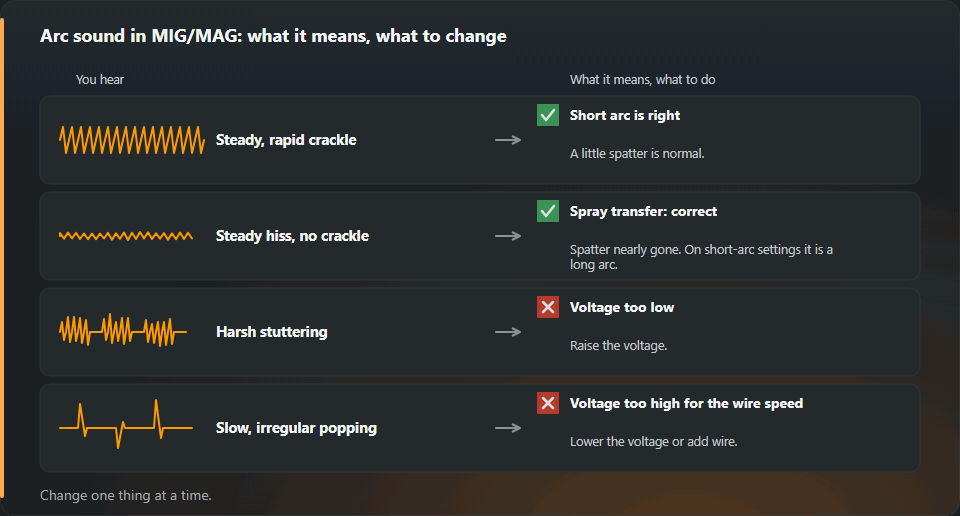
- Steady, rapid crackle (like frying bacon): short arc is right, a little spatter is normal.
- Slow, irregular popping: the voltage is too high for the wire speed; lower it or add wire.
- Harsh stuttering: the voltage is too low; raise it.
- Steady hiss with no crackle: in spray transfer this is correct, and the spatter nearly disappears; in short arc settings it is a long arc.

MMA: cause, check, fix
Basic coatings tend to spatter more than rutile ones. What you can change is current, arc, electrode condition and the field around the arc.
| Cause | How to check in a minute | What to do |
|---|---|---|
| 1. Current above the range for the diameter | Compare the dial with the range: 90–140 A for a 3.2 mm electrode. Heavy spatter, the electrode glowing red toward the end, undercut at the edges. | Bring the current down by 10–20 A or take a thinner electrode. The range for your diameter and position is in the electrode current calculator. |
| 2. Arc too long | The gap between the electrode and the plate is more than about one electrode diameter. The arc hisses and throws spatter far. | Shorten the arc to about one diameter. On an inverter add Arc Force, which pushes the current up when the arc shortens. |
| 3. Damp coating | The electrode crackles and pops, steam comes off the coating, the weld is porous. The pack was left open. | Dry it as the pack says. Basic electrodes: 300–400 °C for 1–2 h, no more than three times; rutile usually does not need it; cellulosic never. Details in the electrode drying table. |
| 4. Wrong current type or polarity | Basic electrodes on AC or on DC electrode negative: an unstable arc that spits. | Set DC with the electrode on plus, unless the pack allows AC. |
| 5. Magnetic arc blow | The arc bends sideways at the end of the seam or near the clamp, and the spatter grows there. | Move the clamp, weld toward a heavy tack, tilt the electrode against the blow, and use AC if the electrode allows it. |
| 6. Position and angle | The same current as in the flat position, but the weld is vertical or overhead and the arc has drifted longer. | In the vertical position cut the current by about 15 %, hold a short arc and keep the electrode angle steady. See MMA welding. |
| 7. Poor earth or a long thin cable | The clamp or a connector is warm; the arc is stable at the machine and unstable at the end of a long line. | Clean the contact down to metal, move the clamp closer, check the cable size for the current and length (why the electrode sticks gives the same checks). |
| 8. The electrode itself | Everything above is in order and the spatter stays coarse. Basic coatings spatter more than rutile ones. | Change the type only if the procedure allows it; otherwise accept the spatter and plan the cleaning. |
The current ranges come from the current calculator. Whatever the drying table says, the temperature printed on the pack comes first.
How much spatter is normal
Some spatter is normal, most of all in short arc on CO₂. What matters is its kind: small, even, easy to knock off is acceptable; drops larger than the wire, popping and clusters that fuse to the surface are a sign of imbalance. Spatter has the number 602 in ISO 6520-1; ISO 5817 gives no size for it, so whether it must be removed is set by the specification of the job (imperfection numbers). Anti-spatter spray or gel on the plate makes cleaning easier, but it treats the symptom, not the cause.
Where the figures come from
- Voltage bands of the transfer modes, the 5–6 mm settings row, stick-out and the 220 A example: the MIG/MAG page and the wire feed calculator.
- Gas flow 10–16 l/min and the mixtures: the gas table and the shielding gas calculator.
- Electrode current ranges and the 10–20 A reduction: the current table of the calculator.
- Drying temperatures and times: the drying table, which lists the ESAB, Böhler, Lincoln and Kobelco documents behind each row.
This page adds no figures of its own. Where the table does not give a number (for example how much a longer stick-out raises spatter), none is quoted.
Frequently asked questions
Why does CO₂ spatter more than a mix like M21?
Pure CO₂ is cheap and penetrates well, but it spatters, and in a mix the more CO₂ there is, the deeper the penetration and the more the spatter. An argon mix such as M21 (Ar + 15–25 % CO₂) gives a cleaner face and opens access to spray transfer. Check the choice in the shielding gas calculator.
Is some spatter normal in MIG/MAG?
Yes, especially in short arc on CO₂. Small, even spatter that comes off with a chisel is normal; large balls beside the weld, popping and a hiss on short-arc settings point to voltage that does not match the feed or to a stick-out that is too long.
The current is in the range, but the electrode still spatters. Why?
Look at the next causes in the table: a long arc, a damp coating, the wrong current type for the electrode, arc blow near the clamp or at the end of the seam. Dry basic electrodes first, because that is the cheapest check.
How do I dry electrodes that spatter?
As the pack says. As a guide, basic electrodes are dried at 300–400 °C for 1–2 h and no more than three times; rutile electrodes usually do not need it; cellulosic ones must never be dried. The full rows with sources are in the drying table.
Will a pulse machine stop spatter?
Largely. Pulsed MIG detaches one drop per pulse, so in the range where short arc and globular transfer spatter it gives a quiet arc with little spatter. It needs a good machine and the right program for the wire and gas, and the other checks (stick-out, tip, gas flow, clean metal) still apply. See MIG/MAG welding.
Updated: