Flux-cored arc welding 136 and 138
136 is MAG welding with flux-cored wire (FCAW), 138 is the same with metal-cored wire, and the self-shielded version that needs no gas is 114. Cored wire is the same machine and the same feeder with a different wire in it — and roughly twice the deposition at the same settings. The price is equally concrete: more fume and a dearer metre of wire.
What it is called
| What it is called | Name |
|---|---|
| In the standard (ISO 4063) | 136 — MAG welding with flux-cored wire; 138 — MAG welding with metal-cored wire |
| Process number | 136, 138 |
| International abbreviation | FCAW · MCAW |
| On the shop floor | Flux-cored welding 136 |
Three names for one thing. The welding procedure specification and the welder’s certificate carry the standard name with its number; the job advert and the shop floor use the abbreviation; an American drawing uses its own. All three are worth knowing: it is the same work, and it looks different on every piece of paper.
Short answer
"Cored wire" covers four different processes in ISO 4063, and confusing them costs later in the paperwork:
| No. | Wire | Gas | Slag | Where |
|---|---|---|---|---|
| 135 | Solid | Active | None | The baseline everything is compared with |
| 136 | Cored, flux core | Active | Yes | Heavier sections, positional work |
| 138 | Cored, metal core | Active | Traces | Long runs where a clean cap matters |
| 114 | Self-shielded cored | None | Yes | Site work and wind, where a gas shield will not stay |
The full table of process numbers — ISO 4063.
Where the deposition comes from
Cored wire is a tube filled with powder. Current runs through the tube alone, not through the whole cross-section, so current density in the metal is higher than in solid wire of the same diameter. The tip heats faster, melts faster, and deposition rises without touching the machine.
The second gain is in bead shape. Slag from a flux core supports the pool from underneath and from the sides, which is why 136 will weld positionally at currents where solid wire would simply run out of the joint. That is the usual reason a site fabrication shop switches to cored wire.
Gas and settings
136 and 138 run under active gas, most often argon with carbon dioxide. Straight CO₂ works too, but gives more spatter and a harsher toe. Choosing the mixture and the flow — the shielding gas calculator.
Stick-out is longer than with solid wire — typically 15–25 mm rather than 10–15. That follows from the same tube: a longer extension preheats the wire resistively, which here is wanted. Too short a stick-out gives an unstable arc and burnt contact tips.
Polarity depends on the wire, not on the process. Most 136 and 138 wires run electrode positive, but a good share of self-shielded 114 wires run the other way. The maker states it on the spool, and getting it wrong produces an arc that "will not settle" for reasons nobody can find in the settings.
What you pay
Fume. This is the main hidden cost. Cored wire produces several times more of it than solid — and on stainless the flux additionally stabilises hexavalent chromium. Extraction at source stops being a recommendation and becomes a condition of working; details in respiratory protection.
The wire itself. A kilogram of cored wire costs markedly more than solid. The arithmetic works out only when the time saved outweighs the material — that is, on heavier sections and long welds, not on small parts.
Chipping the slag on 136 is an extra operation and an extra place to go wrong: slag left between runs comes out as an inclusion (301).
When it does not pay
On sheet up to 3 mm — the deposition you are paying for is not wanted there and burn-through is easier. On short, numerous welds — the time goes into handling, not into melting. And anywhere without extraction: cored wire in an unventilated bay is the worst choice in this whole section.
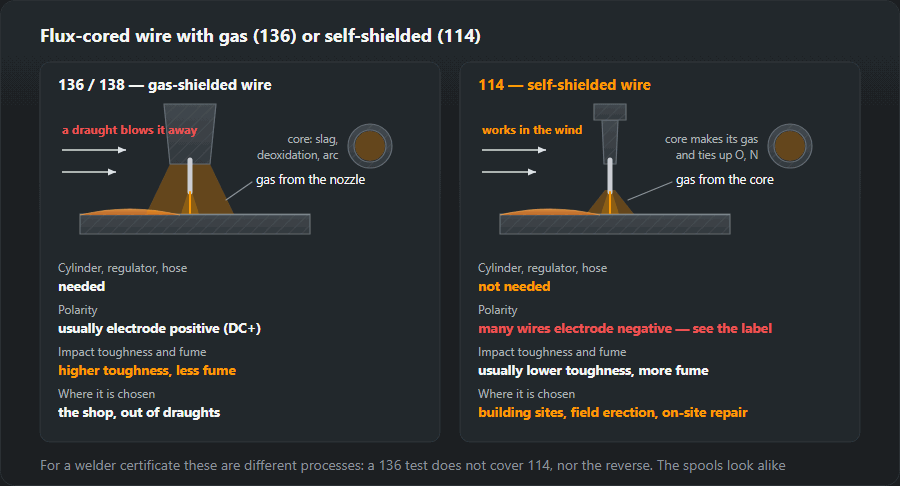
Gas-shielded or self-shielded flux-cored wire
Processes 136 and 138 are wire plus a cylinder: the gas from the nozzle does the shielding, while the core looks after the slag, deoxidation and a steady arc. Process 114 has no cylinder at all — its core holds ingredients that generate gas in the arc and additions that tie up oxygen and nitrogen from the air. The spools look the same, but the difference runs through the whole setup:
- Wind. A draught in the shop or on scaffolding blows away the gas shield of 136, while 114 works in the open. That is why self-shielded wire is the choice on building sites, for steel erection in the field and for on-site machinery repair.
- Equipment. With 114 there is no cylinder, regulator or gas hose — working from a lift or on a call-out, that is less to carry and less to keep an eye on.
- Weld quality. A 114 weld usually has lower impact toughness than a 136 weld, and there is more fume. For structures with a low-temperature toughness requirement you pick a wire with a certified class, not “any self-shielded wire”.
- Polarity. This is where most mistakes happen: 136 and 138 usually run electrode positive (DCEP), while many 114 wires run electrode negative (DCEN). Before fitting the spool, swap the leads inside the machine as the label says.
For a welder certificate these are different processes: a test passed on 136 does not cover 114, and the other way round. What each number covers — 135 vs 136 vs 138.

How to read a flux-cored wire designation
European wire is designated to EN ISO 17632, American wire to AWS A5.20. Take the wire our pWPS builder suggests for S355 steel, T 46 4 P M21 2 H5:
- T — tubular cored wire; solid wire has a G here;
- 46 — minimum yield strength of the weld metal, 460 MPa;
- 4 — 47 J impact energy verified at −40 °C;
- P — rutile core with fast-freezing slag, i.e. an out-of-position wire; R is rutile with slow-freezing slag, B a basic core, M metal powder (that is process 138);
- M21 — shielding gas, an argon–CO₂ mix; a self-shielded wire has the letter N in this place;
- 2 — positions: all except vertical down (1 means all, vertical down included);
- H5 — no more than 5 ml of diffusible hydrogen per 100 g of weld metal.
In the AWS form, for example E71T-1, the first digit is strength in thousands of psi (7 → 70 ksi, about 480 MPa), the second the positions (1 all, 0 flat and horizontal), T means tubular, and the number after the dash tells the shielding and usage: T-1 runs with gas, the T-8 and T-11 families are self-shielded. The full guide to electrode and wire codes — designation table.
Positions and slag: why 136 goes vertical up
Whether a wire can be run vertical and overhead is decided by the slag. Fast-freezing rutile (P) sets before the weld pool metal and acts like formwork: it holds liquid metal at a higher current than solid wire could manage in the same position. That is why a structural erector runs vertical-up with 136 wire at a current where solid 135 wire would have to drop to short-circuit transfer.
Slow-freezing rutile (R) and metal-cored wire (M, process 138) give a nicer bead but prefer flat and horizontal work. Basic wires (B) give the cleanest weld metal and the lowest hydrogen, but the slag is more fluid and positional welding takes skill. Before you set up a vertical joint, check the position digit in the designation — a wire marked “4” or “3” will not hold the pool on a vertical no matter how good the welder is. Vertical technique — vertical-up welding, PA–PG position codes — welding positions.
Technique: drag or push, stickout, drive rolls

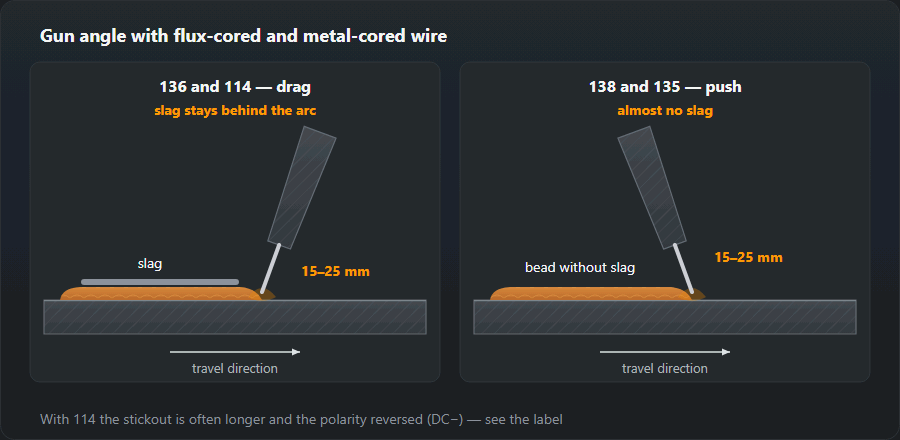
Slag-forming wires (136, 114) are dragged, just like a stick electrode: gun tilted back, arc aimed at the leading edge of the pool. If you push, the slag runs ahead of the arc and gets trapped under the bead. Metal-cored 138 is run like solid wire — a slight push, as there is almost no slag.
Keep the 15–25 mm stickout constant. Shorten it mid-bead and the resistive heating of the wire changes, so the arc goes harsh at once; pull it longer than specified and the bead turns cold and shallow, with porosity. For 114 manufacturers usually give an even longer stickout — the figure on the label wins.
Drive rolls. Tubular wire is soft: in a smooth V-groove roll it slips, and with more pressure it flattens, jams in the liner and burns back to the contact tip. For cored wire fit knurled rolls and tension them just enough to stop the slipping. Every reason for “the wire stops” — wire feed problems.
Multi-pass weld with 136 wire — the sequence
- Lay the root so its face is convex or flat — grooves along the toes become slag traps.
- After every pass knock the slag off with a chipping hammer and wire-brush the grooves along the bevel walls; rutile slag usually peels off by itself in flakes.
- Check the toes: grind out undercut or a sharp transition angle before the next pass — the next bead will not fill it, it will only cover it.
- Overlap each bead by roughly half of the previous one — a narrow bead between two neighbours gives the slag nowhere to float out.
- Keep the interpass temperature within the WPS: cored wire puts more metal in per pass, and the joint heats up faster than with 135.
Slag left between passes shows up on the radiograph as an inclusion (301) — you only see the defect after testing, and the repair means cutting the weld out.
Worked example: 10 kg of weld metal — 135 or 136
A joint that needs 10 kg of weld metal is, say, several metres of heavy butt weld on 20–30 mm plate. The figures come from the same data that drive the weld cost calculator:
| Process | Output, kg/h | Shop time, h | Wire to buy, kg | Gas, l |
|---|---|---|---|---|
| MAG, solid wire (135) | 3.2 | 3.1 | 10.8 | 730 |
| FCAW, flux-cored wire (136) | 4.2 | 2.4 | 11.8 | 640 |
For 10 kg of deposited metal. Output and efficiency come from the weld cost table; gas flows only while the arc burns, about 30 % of shop time.
Flux-cored wire finishes the job in 2.4 h instead of 3.1 h — 0.7 h saved on every 10 kg. On the other hand you have to buy 11.8 kg of it against 10.8 kg of solid wire, because part of the core mass goes into slag and fume, and every kilogram costs more. The sum is simple: if a welder hour with overheads costs more than the price difference of the wire for those 10 kg, flux-cored pays off. On short welds in thin sheet there are too few kilograms for the minutes saved to cover the dearer wire. How much metal a given groove takes — weld metal calculator.
Common flux-cored welding defects and how to spot them
- Porosity along the whole bead. Most often damp wire, too long a stickout or a draught with 136. With 114 — too short a stickout and too low a voltage. More detail — porosity in welds.
- Gas marks on the face — elongated dimples under the slag, “worm tracks”. A sign that gas could not escape before the slag froze: moisture in the wire, dirty plate, high wire speed at too low a voltage.
- Slag inclusions between passes. Pushing instead of dragging, grooves left uncleaned, beads too narrow in a deep groove.
- Lack of fusion from a cold arc. The deposition rate tempts you to travel fast; the bead looks tidy, but a break test shows no fusion into the sidewall. The check — a fillet break test before working on the structure.
- Burnback and jerky feed. Wire crushed in the rolls, too short a stickout, wrong polarity.
Storing flux-cored wire
The flux core picks up moisture from the air, and the hydrogen from that moisture ends up in the weld. Seamed wire (a tube folded from strip) is more sensitive than seamless wire, because the joint along its length lets air reach the powder. Keep the spool in its original packaging until the day it goes on the machine, and bag it or put it in a dry cabinet when it comes off overnight. Re-bake it only if the manufacturer allows it, and at their temperature — not every wire tolerates it. For H5 basic wires on critical structures the rule is strict: a spool left open for a week in an unheated shop no longer guarantees the hydrogen class on the label.
What next
The baseline it is measured against — MIG/MAG. How much filler a joint will take — deposit and run count. Process numbers in documentation — the ISO 4063 table.
Frequently asked questions
What is the difference between 136 and 138?
The core of the wire. In 136 it is flux: it leaves slag, which shields and shapes the bead but has to be chipped off. In 138 the core is metal powder: there is next to no slag and the surface comes out cleaner, but bead shaping is weaker and the demands on the gas higher. Both run under active gas.
Is self-shielded 114 wire worse?
Not worse, just for something else. 114 needs no cylinder, so it wins outdoors and in wind, where a gas shield would blow away anyway. You pay in fume and usually in impact toughness. In a still workshop, 136 with gas gives the better result.
Why does cored wire melt faster than solid?
Because current flows only through the thin sheath, not through the whole section. Current density in that sheath is higher than in solid wire of the same diameter, so the tip heats faster and the deposition rate rises — at the same machine settings.
Can you weld flux-cored without gas?
Only with self-shielded wire, which is process 114 — its EN ISO 17632 designation has the letter N where the gas symbol would be. Wires for 136 and 138 run without gas give a porous, brittle weld, because their core is not designed to protect the pool from the air.
What polarity is used for flux-cored wire?
Whatever the label says. Wires for 136 and 138 usually run electrode positive (DCEP), many self-shielded 114 wires electrode negative (DCEN). On a MIG machine that means swapping the gun lead and the earth lead on the terminals inside the case.
Do you chip slag between passes with flux-cored wire?
Yes, with 136 and 114 after every pass: knock the slag off with a hammer and wire-brush the grooves along the toes. Slag left behind becomes an inclusion (301) that only shows on a radiograph. Metal-cored 138 leaves just traces, a brush is enough.
How do I know if a flux-cored wire is all-position?
From the position digit in the designation: in EN ISO 17632 “1” means all positions and “2” all except vertical down; in AWS a second digit of “1” (e.g. E71T-1) means all positions and “0” flat and horizontal only. For vertical-up work the usual choice is fast-freezing rutile, letter P.
Updated: