Processes 135, 136 and 138: how they differ and what a certificate covers
Three numbers, one machine. 135, 136 and 138 are all MAG — active gas, the same feeder and torch — and only the wire sets them apart. But the wire decides the slag, the positions, the fume, how the WPS is written and whether your certificate covers the job at all.
Short answer
135 is solid wire with no slag — the reference point for the whole family. 136 is flux-cored wire: the slag shields and holds the pool, so it wins out of position and on thick sections, but it has to be chipped off and it makes the most fume. 138 is metal-cored wire: practically no slag, a clean face, best in PA and PB. On an ISO 9606-1 certificate 135 and 138 cover each other, while 136 needs a test of its own.

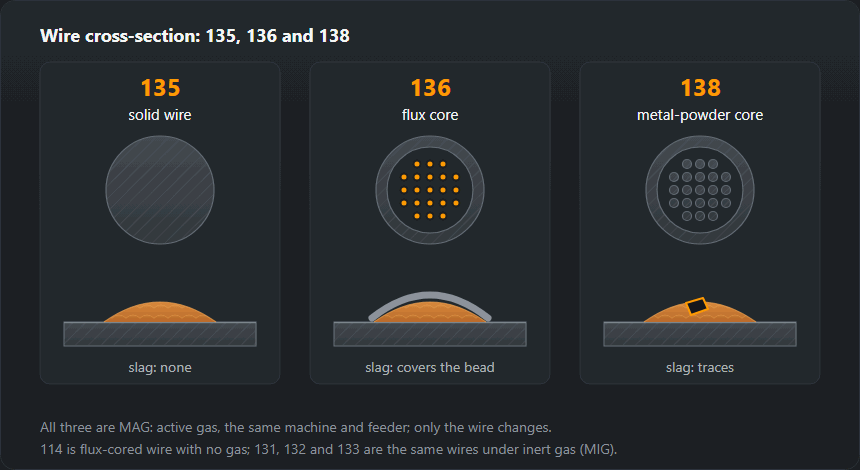
135 vs 136 vs 138 in one table
| Feature | 135 | 136 | 138 |
|---|---|---|---|
| Wire | solid | flux-cored | metal-cored |
| Gas | CO₂ or Ar + 15–20 % CO₂ | active: Ar + CO₂; pure CO₂ also works | active: Ar + CO₂; more demanding about the gas |
| Slag | none | covers the bead, must be chipped off | traces only |
| Out-of-position work | yes, with short-circuit transfer and lower current | its strength: the slag holds the pool up at higher current | mainly PA and PB — there is no slag to hold the pool |
| Wire stick-out | 10–15 mm | 15–25 mm | 15–25 mm |
| Wind and draughts | sensitive — the gas shield blows away | still needs shelter from the wind | still needs shelter from the wind |
| Fume | least of the three | most of the three | more than 135 |
| Where it wins | thin and medium sheet, series work, small parts | thick sections, structural erection out of position | long welds in PA/PB, a clean face, robot cells |
| Filler on the WPS (example for S355) | EN ISO 14341-A G 46 4 M21 4Si1 | EN ISO 17632-A T 46 4 P M21 2 H5 | EN ISO 17632, core type M |
| Filler letter on the ISO 9606-1 certificate | S | core letter: B, R, P, V, W, Y or Z | M |
Read the table across, not down: there is no “best” process, only the one that suits the joint. Stick-out and gas for 135 are the same values we give for MIG/MAG; the filler designations are examples for S355, identical to those in our pWPS generator.
135 — MAG with solid wire
The most common process in the shop and in job adverts. The wire is a solid rod, current flows through its whole cross-section and shielding comes from the gas alone — CO₂ or Ar + 15–20 % CO₂. There is no slag, so a wire brush between runs is enough.
135’s strength is versatility: from thin sheet in short-circuit transfer to thick joints in spray. Its weakness is out-of-position work at high current: without slag the pool wants to run, so vertical and overhead welds are made in short-circuit at lower current, which costs productivity. Settings by thickness are on the page MIG/MAG welding.
136 — MAG with flux-cored wire
The wire is a steel tube filled with flux. Current flows only through the tube wall, so current density is higher than in a solid wire of the same diameter and the wire melts off faster at the same settings. The flux turns into slag that covers the bead, protects it from above and — most importantly — supports the pool from below and at the sides.
That makes 136 the process for structural erection: in PF and PE it lets you weld at currents where solid wire would simply run. Wires with a fast-freezing rutile core (letter P in the designation) are made for positional work; basic cores (B) are chosen where toughness and low hydrogen matter.
You pay in three ways. Slag must be removed after every run — left between layers it becomes a slag inclusion (301). Fume is the heaviest of the three, so extraction at source is a condition of work, not an extra — see respiratory protection. Stick-out is longer: 15–25 mm instead of 10–15. When 136 pays for itself and when it does not is covered on the page flux-cored arc welding 136.
138 — metal-cored wire
The same tube, but filled with metal powder and alloying additions instead of flux. Deposition goes up for the same reason as with 136 — current flows through the wall — but there is almost no slag: at most a few small silicate islands on the face, as with solid wire.
Two things follow. First, 138 is convenient where welds are many and long: in PA and PB, on mechanised and robotic stations, where chipping slag after every run would waste time. Second, with no slag nothing holds the pool, so out of position 138 lacks 136’s advantage. It is more demanding about the gas than 136: the gas carries all of the pool protection.
Wind, gas and process 114
All three processes are gas-shielded, so all three are sensitive to draughts. 136’s slag protects the bead once it has solidified, but it does not replace the gas at the moment of welding — on an open site each of them needs a screen. If shelter is impossible, the right answer is not more gas flow but a different process: 114, self-shielded flux-cored wire that runs without a cylinder. The price is even more fume, and many 114 wires run on the opposite polarity to 136 — the maker prints it on the spool. The shielding gas calculator helps match gas to process.
The whole family: 114, 131, 132, 133
ISO 4063 numbers in group 13 follow a simple pattern: the second digit tells you the gas, the third the wire. 131–133 are MIG (inert gas), 135–138 are MAG (active gas), and endings 1/5 mean solid wire, 2/6 flux-cored, 3/8 metal-cored. 114 sits apart, in group 11, because it uses no gas at all.
| No. | Name to ISO 4063 | Abbreviation | Gas | In ISO 9606-1 |
|---|---|---|---|---|
| 114 | Self-shielded tubular-cored arc welding | FCAW-S | none | yes |
| 131 | MIG welding with solid wire in inert gas | MIG · GMAW | inert | yes |
| 132 | MIG welding with flux-cored wire | FCAW | inert | no |
| 133 | MIG welding with metal-cored wire | MCAW | inert | no |
| 135 | MAG welding with solid wire in active gas | MAG · GMAW | active | yes |
| 136 | MAG welding with flux-cored wire | FCAW | active | yes |
| 138 | MAG welding with metal-cored wire | MCAW | active | yes |
The last column shows whether the number is listed in the welder qualification standard for steels, ISO 9606-1. 132 and 133 are not — in practice they are rare. Every other process number is in the full ISO 4063 table.
How it is written on a WPS
On a welding procedure specification the process number has its own field and must match the wire on the station. Writing “135” for a flux-cored wire is not a typo: a WPS qualified for 135 does not cover 136. Across the three processes, four fields usually differ:
- Process: 135, 136 or 138 — as a number, not “MAG”.
- Filler: for 135 to EN ISO 14341, e.g.
G 46 4 M21 4Si1; for 136 and 138 to EN ISO 17632, e.g.T 46 4 P M21 2 H5— the letter after the numbers is the core type (P rutile, B basic, M metal). - Gas: the ISO 14175 designation, e.g. M21 for an argon–CO₂ mix or C1 for pure CO₂.
- Polarity and stick-out: 135 and 136 usually DC+, stick-out 10–15 and 15–25 mm respectively.
The pWPS generator drafts such a document with these fields filled for your thickness and material; how pWPS, WPQR and WPS differ is explained on the page WPS.
What an ISO 9606-1 certificate covers
The general rule is simple: one test covers one process, and a change of process means a new test. There are a few exceptions, and two matter for this family: changing from solid wire 135 to metal-cored wire 138 (or back) needs no new test, and a test made in dip (short-circuit) transfer with 131, 135 or 138 also covers the other transfer modes — but not the other way round.
| Test welded with | Covers | Does not cover |
|---|---|---|
| 135 | 135 and 138 | 136, 131, 114 |
| 138 | 138 and 135 | 136, 131, 114 |
| 136 | 136 only | 135, 138, 114 |
| 114 | 114 only | 136 and the gas-shielded processes |
| 131 | 131 only | 135 — a different process, even on the same machine |
| 131, 135, 138 in dip (short-circuit) transfer | the other transfer modes as well | not the other way round: spray does not cover dip |
Sources: ISO 9606-1:2012, clauses 4.2 and 5.2 (the official preview of the standard), and the DoaWise guide — both say the same. The range for flux-cored wire types (Table 5 of the standard) should be checked in the standard itself or with the examiner.
On the certificate code this shows in two places: the process number at the
start and the filler letter. An example for solid wire:
135 P BW FM1 S t10 PF ss nb; for a rutile flux-cored wire in the same
joint: 136 P BW FM1 P t10 PF ss nb — the first “P” means plate, the
second the core type. How to read the other fields is explained on the page
welder qualification
test EN ISO 9606, and the
qualification range
calculator works out the thickness and position range.
Which one to choose: five questions
- Which position? Vertical and overhead on thicker plate — 136. Flat and horizontal — 135 or 138.
- How thick and how long? Thin sheet and small parts — 135. Thick sections and long welds — 136 or 138, where the deposition pays back.
- Is there extraction? Without extraction at source, flux-cored wire is the worst choice of the three.
- What do the WPS and certificate say? A welder certified for 135 may weld 138 without a new test, but not 136.
- Is it windy? If you cannot put up a screen, none of the three; consider 114.
Common mistakes
- “It’s all MAG anyway.” The number on the WPS and the certificate must match the wire. An EN 1090 auditor will ask about it first.
- Slag left between 136 runs. It shows up on the radiograph as an inclusion and is the most common defect of the process.
- Too short a stick-out on cored wire. The arc is unstable and the contact tip burns.
- More gas instead of a screen. Excess flow causes turbulence and draws in air — porosity goes up, not down.
More on flux-cored wire itself, its cost and its fume — flux-cored arc welding 136. The basic variant and settings — MIG/MAG. All process numbers — the ISO 4063 table.
Frequently asked questions
What is welding process 136?
Under ISO 4063, 136 is MAG welding with a flux-cored electrode: the same machine and wire feeder as 135 and an active shielding gas, but the wire is a tube filled with flux. The flux forms a slag that protects and supports the weld pool — which is why 136 handles out-of-position work well — but the slag has to be chipped off after every run.
What is welding process 138?
138 is MAG welding with a metal-cored electrode. The tube is filled with metal powder instead of flux, so there is practically no slag and the weld face comes out as clean as with solid wire. It works best for long welds in the flat and horizontal positions (PA, PB) and in robot cells.
What is the difference between 135 and 136?
Only the wire: solid in 135, flux-cored in 136. The gas, machine and feeder can stay the same. 136 produces slag, more fume and needs a longer stick-out (15–25 mm instead of 10–15), but it is easier to run out of position at higher current. On paper they are two different processes and two different tests.
Does a 135 welder certificate cover 138?
Yes. ISO 9606-1 allows a change from solid wire 135 to metal-cored wire 138, or the other way round, without a new test. It does not cover 136: a change of process requires a new test, and 135 to 136 is not among the exceptions in the standard.
Does process 136 need shielding gas?
Yes, 136 runs under an active shielding gas, most often an argon–CO₂ mix; pure CO₂ also works. Flux-cored wire that runs without a cylinder is a separate process, 114 — self-shielded. In the wind, 136 needs shelter just as 135 does.
What are processes 131, 132 and 133?
They are the inert-gas (MIG) counterparts of 135, 136 and 138: 131 with solid wire, 132 with flux-cored wire, 133 with metal-cored wire. The welder qualification standard for steels, ISO 9606-1, lists only 131; 132 and 133 are not on that list.
Updated: