Oxy-acetylene welding 311
311 is the ISO 4063 number for oxy-acetylene welding (OAW): a flame of acetylene burning in oxygen melts the edges and the filler together, with no power needed. Below: tip size by thickness, gas use in l/h and pressures. The process that was supposed to disappear and did not. On thin sheet, on repairs and wherever there is no power, an oxy-acetylene flame still does what the arc cannot: it heats slowly and lets you watch the pool without hurrying.
What it is called
| What it is called | Name |
|---|---|
| In the standard (ISO 4063) | 311 — Oxy-acetylene welding |
| Process number | 311 |
| International abbreviation | OAW |
| On the shop floor | Gas welding 311 |
Three names for one thing. The welding procedure specification and the welder’s certificate carry the standard name with its number; the job advert and the shop floor use the abbreviation; an American drawing uses its own. All three are worth knowing: it is the same work, and it looks different on every piece of paper.
Where it still wins
- Sheet from 0.5 to 3 mm. The flame heats more gently than an arc, so burning through is harder, not easier.
- No electricity. Two cylinders and a torch work where a generator is not and will not be.
- Repairs and small-bore pipework, where a welding torch simply will not reach.
- Braze welding of cast iron and galvanised sheet — the same torch, a different process and a different number.
Number 311 is oxy-acetylene welding; 312 is oxy-propane, 313 oxy-hydrogen. The full list is in the ISO 4063 table.
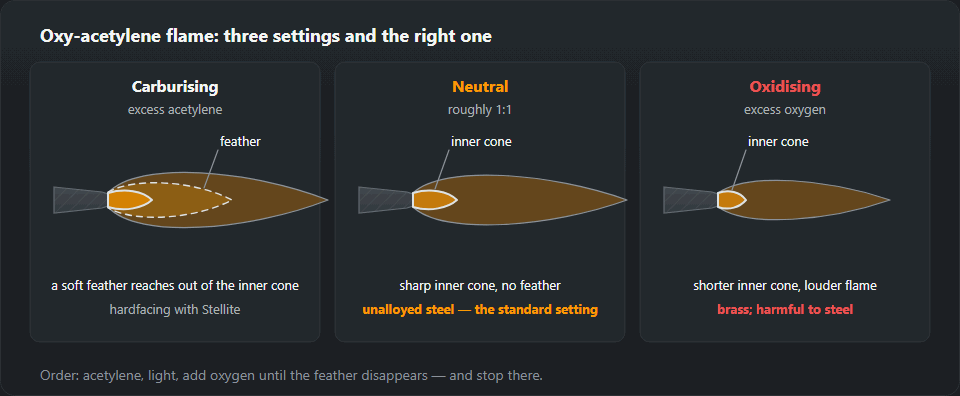
The flame: three settings, one correct
| Flame | How it looks | What for |
|---|---|---|
| Carburising excess acetylene |
A second, soft feather reaches out of the inner cone | Hardfacing alloys, stellite |
| Neutral roughly 1:1 |
A sharply drawn inner cone, no feather | Non-alloy steel — the default |
| Oxidising excess oxygen |
Shorter cone, louder and harsher flame | Brass; harmful on steel |
It is always set in the same order: open the acetylene, light it, add oxygen until the feather disappears. The point where it disappears is the neutral flame, and that is where you stop. For steel, anything else is a mistake rather than a style.

Filler and thickness
Filler diameter follows the rule d = s/2 + 1 — 2 mm sheet
takes 2 mm filler, 4 mm takes 3 mm. Filler that is too thick
draws heat out of the pool and gives adhesion rather than fusion — which looks
like a weld until someone bends it.
Up to 3 mm you weld leftward: the torch follows the filler, the flame runs over cold metal, penetration stays shallow. Above that, rightward: the flame runs over the finished bead, soaks it and gives deeper penetration. Changing direction is not a matter of comfort but a way of controlling how much heat goes in.
What this process never forgives
Acetylene is flammable and unstable under compression; oxygen does not burn itself but violently supports burning. Hence two rules with no exceptions: never handle an oxygen cylinder with greasy hands — oil under oxygen pressure ignites on its own — and flashback arrestors go on both regulators, not only on the acetylene side.
An acetylene cylinder works upright. Laid down, it gives off the acetone the acetylene is dissolved in, and the torch then behaves in ways no setting will explain. The rest of the rules — hot work and fire safety.
Torch tips: size by thickness and gas consumption
In oxy-acetylene welding (311) the flame output is set by the tip size, not by the valves. Each size has its own steel thickness range and its own gas consumption:
| Tip size | Steel thickness, mm | Oxygen, l/h | Acetylene, l/h |
|---|---|---|---|
| 1 | 0.5–1 | 90 | 80 |
| 2 | 1–2 | 170 | 155 |
| 3 | 2–4 | 300 | 280 |
| 4 | 4–6 | 550 | 510 |
| 5 | 6–9 | 800 | 730 |
| 6 | 9–14 | 1200 | 1100 |
| 7 | 14–20 | 1900 | 1750 |
Injector torch, oxygen at 2.5 bar, acetylene at 0.2–0.5 bar. Figures from torch suppliers’ tables (dieschweissprofis.de, ewo.de); a particular torch may differ — check its data plate.
Reading the table
Only a little more oxygen is used than acetylene — about 1.1 to 1 — and that is exactly the neutral flame from the table above. Consumption rises roughly in proportion to thickness: the tip for 4–6 mm burns more than six times the acetylene of the tip for 0.5–1 mm sheet. The torch valves fine-tune the flame within one tip; trying to throttle a big tip down for thin sheet ends in pops and flashback, and opening a small one up for thick steel ends in a cold, stuck-on weld instead of fusion.
Two worked examples
- 2 mm sheet, butt joint. Tip size 2 (1–2 mm): 155 l/h of acetylene and 170 l/h of oxygen. Filler by the rule d = s/2 + 1 = 2 mm, leftward (forehand) welding. Half an hour of flame is about 78 l of acetylene and 85 l of oxygen.
- 6 mm plate. Tip size 4 (4–6 mm): 510 l/h of acetylene, 550 l/h of oxygen. Filler 6/2 + 1 = 4 mm, rightward (backhand) welding, because above 3 mm the flame has to soak heat into the finished weld. At that draw a single acetylene cylinder is working hard — on large tips cylinders are manifolded together so that acetone is not carried over.
Pressures, shutting down and flashback
- Working pressures for an injector torch: oxygen about 2.5 bar, acetylene 0.2–0.5 bar. Acetylene is not raised above what the torch calls for — more pressure does not give a stronger flame, only more risk.
- Shutting down: acetylene valve on the torch first, then oxygen. After work, close the cylinder valves and bleed the hoses.
- Pops and backfires in the torch usually mean an overheated or dirty tip, too little flow or touching the pool. Shut the torch down, cool and clean the tip — do not carry on welding through the pops.
- Flashback — hissing and squealing in the handle — means closing the torch and cylinder valves at once. Go back to work only after finding the cause and checking the flashback arrestors on the regulators.
Mistakes you can see in the weld
- Sparking and a grey, porous weld on steel — an oxidising flame; add acetylene until the cone is sharp again, but without the second feather.
- Holes in thin sheet — too big a tip or dwelling too long in one place; go down a size, travel faster, tack more often.
- The weld sits on top of the edges — too small a tip or too thick a rod: the pool does not take in the edges and the rod melts in the flame instead of in the pool.
- Heavy distortion — the flame heats a wider zone than an arc; tack symmetrically and weld in short sections.
Gas or TIG for thin sheet
Both processes are slow and let you add filler separately. TIG gives a narrower heat-affected zone and less distortion, but it needs power and argon. The flame wins where there is no electricity, on repairs in the field and for braze welding with the same torch. The arc comparison is on the TIG welding page, and the numbers of related processes (312, 313, 971) are in the ISO 4063 table.
What next
Thin sheet by other methods — welding thin sheet. Process numbers and abbreviations — the ISO 4063 table. The arc alternative for the same repairs — MMA.
Frequently asked questions
What filler diameter should I take?
The rule is simple: d = s/2 + 1, where s is the sheet thickness in millimetres. For 2 mm sheet that gives 2 mm filler, for 4 mm it gives 3 mm. Filler that is too thick chills the pool and gives you a stuck-on bead instead of fusion.
How do you recognise a neutral flame?
By the inner cone. With excess acetylene a second, soft cone reaches out of it — that is a carburising flame. Backing the acetylene off until that feather disappears leaves a sharply drawn inner cone, and that is neutral. Backing off further gives an oxidising flame: shorter and noisier.
How does gas welding differ from braze welding?
By whether the parent metal melts. In welding (311) the edges and the filler melt together. In braze welding (971) the edges stay intact and the joint is held by a filler of lower melting point that wets them. That is why braze welding is used on cast iron and galvanised sheet, where melting the parent metal would do harm.
What oxygen and acetylene pressure for gas welding?
For an injector torch the makers’ tables give oxygen at about 2.5 bar and acetylene at 0.2–0.5 bar. Flame output is changed with the tip size, not by raising the acetylene pressure.
Which tip size for 2 mm sheet?
Size 2, made for 1–2 mm; it uses about 155 l/h of acetylene and 170 l/h of oxygen. With it, a 2 mm filler rod and leftward welding.
How much acetylene does a torch use per hour?
It depends on the tip: from about 80 l/h on the tip for 0.5–1 mm sheet, through 280 l/h for 2–4 mm, to 510 l/h for 4–6 mm. Oxygen use is about 10 % higher.
Updated: