How to prevent fires when welding: the hot work permit
Welding sparks reach around 1500 °C and travel ten metres. Most of the fires they start begin hours later, after the welder has packed up — which is why the rules are about what happens afterwards as much as during.
The hot work permit
Outside a designated welding bay, hot work in most industrial and construction settings needs a written permit. It is not bureaucracy for its own sake: the permit forces someone to walk the area and answer specific questions before the work starts.
A permit records what work is being done and where, what combustible material is within the danger zone and what has been done about it, what fire-fighting equipment is present, who is keeping the fire watch and for how long afterwards, and who signs the area off at the end.
Preparing the area

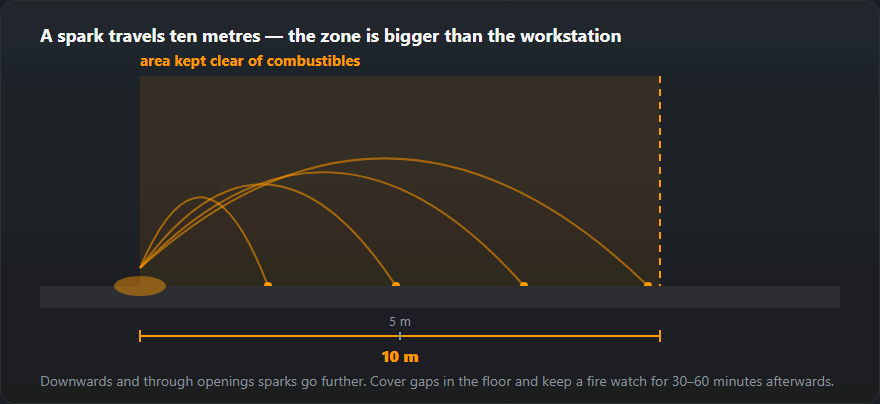
Ten metres in every direction is the working assumption. Within that radius: remove what can be moved, cover what cannot with fire blankets or metal sheet, and pay particular attention to the things nobody thinks of.
- Openings in the floor. Cable penetrations, drains, gaps under doors. A spark that goes through a hole lands somewhere you are not watching.
- Dust and lint. Accumulated dust on beams and ledges ignites readily and smoulders quietly.
- Insulation in cavities. Especially older mineral fibre with a paper facing, and any foam.
- The other side of the wall. Steel conducts heat: welding one face of a partition can ignite what is stacked against the other.
- Hydraulic hoses and cable trays above the work.
The fire watch
The single most important rule on this page: stay for at least an hour after the work is finished. A spark that lodges in dust or insulation smoulders before it flames, and the delay is typically between thirty minutes and several hours.
The fire watch is a person with nothing else to do and an extinguisher within reach, who checks not only the work area but the space below it and the far side of any wall that was welded.
Extinguishers
| Type | For | Not for |
|---|---|---|
| Water | Wood, paper, textiles | Live electrical equipment, liquids |
| Powder | Most situations, including electrical equipment | Confined spaces — it blinds you instantly |
| CO₂ | Electrical equipment, the welding set itself | Outdoors in wind; asphyxiation risk in confined spaces |
| Foam | Flammable liquids | Live electrical equipment |
Gas cylinders
Upright, secured with a chain, valves closed when not in use, and away from the heat and the spatter. An acetylene cylinder that has been knocked over needs standing upright for a considerable time before use, and one that has been in a fire is dangerous for hours afterwards because acetylene decomposes exothermically once it starts.
Never test for gas leaks with a flame. Soapy water, every time.
What the rules say: Poland, Germany, USA
In Poland the basis is § 36 of the Interior Ministry regulation of 7 June 2010 on fire protection of buildings. Before hot work the owner, manager or user of the site must assess the fire hazard at the work location, set the preventive measures, name the people responsible for preparing the area, running the work and securing it afterwards, let only authorised people do the work and brief them on the hazards. In an explosion hazard zone vapour and gas concentration must not exceed 10 % of the lower explosive limit. The regulation sets no form — in practice it is an internal zezwolenie na wykonanie prac pożarowo niebezpiecznych, a hot work permit whose template the site keeps in its fire safety instruction.
| Document | Written permit | Combustible-free zone | Watch after work |
|---|---|---|---|
| Poland, § 36 of the 2010 regulation | per the site instruction, usually a permit | work location and adjacent areas, no figure | inspection of the location and adjacent areas |
| Germany, DGUV Regel 100-500, ch. 2.26 | Schweißerlaubnis where combustibles cannot be removed | fire hazard area | fire watch during work, repeated checks over the following hours |
| USA, OSHA 1910.252 | — | 35 ft (10.7 m) | at least 30 min |
| USA, NFPA 51B, 2019 edition | hot work permit | — | at least 1 h, then up to 3 h of monitoring |
The practical rule that falls out of the table: a radius of about ten metres matches how far spatter travels, and half an hour of watch is the minimum, not good practice. On roofs, in insulation and in layered partitions the watch runs for hours — that is where a fire smoulders longest.
The permit, step by step
- Scope and time. The exact location (bay, grid line, level), the kind of work — welding, cutting, grinding — and the hours of validity. A permit for “the whole week, whole building” protects nothing.
- Survey of the surroundings. What is combustible within spark range, what is behind the wall and on the floor below, whether there are openings, cable trays, foam insulation.
- Measures. Remove combustibles, lay fire blankets and screens, close gaps, wet down a timber floor, agree the work with whoever runs the fire detection system.
- Extinguishers. Of the type that suits what may catch fire (see the extinguisher table above), on the spot before work starts, not “somewhere in the corridor”.
- People. Issuer, operative and fire watch — by name and with a signature.
- Close-out. Time work finished, time the watch finished and a signature after the final round. Without this part the permit is not closed.
How to run a fire watch after welding
A fire watch is not sitting next to an extinguisher; it is a round with a set route. It has to cover every place a drop of metal could have reached:
- the floor within spark range and the gaps between boards;
- the far side of the wall or partition you welded against — heat passes through steel and ignites what touches it on the other side;
- the level below when working on a slab, mezzanine or scaffold;
- cable trays, ventilation ducts and pipe insulation nearby.
Check by smell, by eye and with the back of the hand against the partition. A thermal camera, if the site has one, finds a fire in insulation before you can smell it. Log each round with the time on the back of the permit.
Worked example: cutting a bracket under a warehouse roof
The job: cut off with an angle grinder and re-weld a bracket 4 m up, with racking full of cardboard below and a sandwich-panel wall alongside.
- Zone: a radius of about 10 m on the floor around the work, and more directly below, because sparks from height fall in an arc.
- Cardboard racking in the zone: move it, and cover what cannot be moved with a fire blanket.
- Sandwich panel: the core may be combustible; a sheet-metal or blanket screen on the work side, and the far side of the wall checked during the watch.
- A fire watch with an extinguisher at the racking during the work; direct the spark stream from the cutting disc towards empty floor.
- A watch of at least an hour (the 30 min of OSHA is only the legal floor), and because of the sandwich panel a further round later on.
The most common mistakes
- A permit written after the event. The document is there to force the preparation, not to record it.
- The wrong extinguisher. Powder blinds instantly in a cramped room; CO₂ does nothing in the wind and can suffocate in a tight space — choose from the extinguisher table.
- The watch ending with the shift. The most dangerous hour is the one when nobody is left in the building.
- Synthetic clothing. It melts from spatter and sticks to the skin — see welding clothing.
Frequently asked questions
How far do sparks actually travel?
Up to about 10 metres horizontally from grinding and cutting, and considerably further downwards from work at height. The standard clearance in a hot work permit is 10 m in every direction, with anything combustible inside that radius removed or covered.
What is a fire watch and how long does it last?
Somebody whose only job is to watch for fire, with an extinguisher, during the work and for at least an hour afterwards (NFPA 51B; the US OSHA floor is half an hour). Most hot work fires start after everyone has gone home, from a spark that smouldered in dust or insulation for an hour.
Can I weld a container that held fuel if it is empty?
Empty is exactly the dangerous state: liquid fuel does not explode, its vapour does, and an "empty" drum is full of vapour in the right mixture. Cleaning, steaming and gas testing are mandatory, and even then this is specialist work. Drums that were “empty” go on killing welders.
How long must a fire watch last after hot work?
OSHA 1910.252 requires at least half an hour after welding or cutting ends. NFPA 51B in its 2019 edition asks for at least one hour, followed by up to three hours of monitoring. The Polish regulation requires an inspection of the location and adjacent areas without naming a time; on roofs and insulation the watch should run longer.
How far do combustibles need to be moved before welding?
Out of spark range, which is about 10 m horizontally — OSHA gives 35 ft, 10.7 m. Working at height the zone below is larger, and the far side of walls and the floor below are checked separately. Anything that cannot be moved is covered with a fire blanket.
What is a hot work permit called in Poland and Germany?
In Poland — zezwolenie na wykonanie prac pożarowo niebezpiecznych, issued by the owner, manager or user of the site under § 36 of the 2010 fire protection regulation. In Germany — Schweißerlaubnis, required by DGUV Regel 100-500 when combustibles cannot be removed from the fire hazard area.
Updated: