What PPE a welder needs and which standards it must meet
Four hazards, and the equipment for each is defined by a standard. What follows is what those standards require and where welders most often cut the corner.

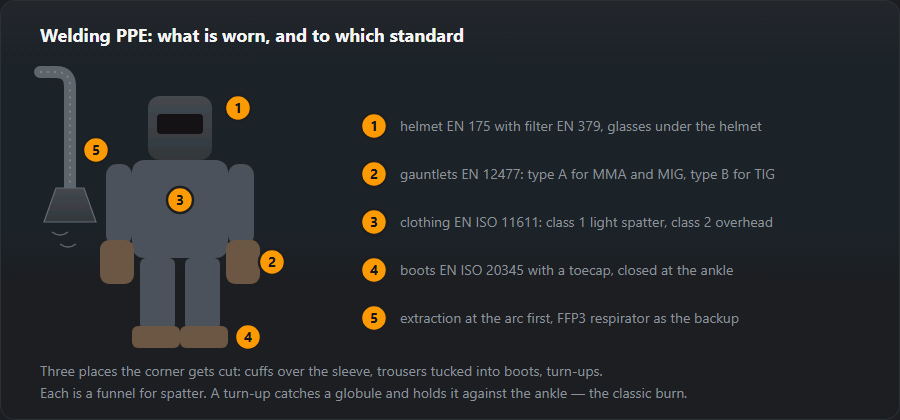
PPE for welding: the full list
| Item | Standard | What it protects against | The usual mistake |
|---|---|---|---|
| Welding helmet with filter | EN 175 + EN 379 | Ultraviolet and infrared from the arc, visible light, spatter, impact | The shade is never checked before the shift and a cracked cover lens is left in |
| Safety glasses under the helmet | EN 166 | Slag and abrasive fragments when grinding and chipping | Taken off under the helmet — but slag flies when chipping, not when welding |
| Welding gauntlets | EN 12477 (A / B) | Contact and radiant heat, spatter, minor cuts | Ordinary work gloves instead of welding ones; synthetic thread lets go along the seam |
| Welding clothing | EN ISO 11611 | Metal spatter and radiant heat from the arc | Synthetics underneath: they melt and stick to the skin |
| Leather apron and sleeves | EN ISO 11611 | Droplets falling during overhead welding | Welding overhead with no apron and no sleeves |
| Safety boots with a toecap | EN ISO 20345 | Falling metal, spatter, impact; rubber gives electrical insulation | Trousers tucked into the boot make a funnel for spatter |
| FFP3 filtering half mask | EN 149 — FFP3 | The particulate fraction of welding fume | A builders' FFP1 mask instead of FFP3 — welding fume is sub-micron |
| Powered air-purifying respirator (PAPR) | EN 12941 | Fume during long sessions and in confined spaces | Filters changed “when it starts to pull”, not on the hour counter |
| Earplugs or defenders | EN 352 | Noise from grinding and air tools, spatter in the ear canal | Worn only for grinding, though spatter goes into the ear overhead |
| Flame-retardant balaclava | EN ISO 11611 | Neck and ears from spatter and reflected heat | A fleece balaclava instead of a flame-retardant one |
Eyes: safety glasses and arc eye
The helmet itself — shell, filter, shade number — has its own section further down. Here, the two things people get wrong.
First, safety glasses under the helmet are not optional — the helmet comes up for chipping and grinding, and that is when the slag flies. Second, arc eye does not require welding: standing near someone else's arc without eye protection for a few minutes is enough, and the pain arrives six to twelve hours later. Details in welding helmet.
Hands
Gloves to EN 12477, in two types: type A for stick and MIG, heavier and less dexterous, and type B for TIG, thinner so you can feel the rod. Leather, stitched with heat-resistant thread — synthetic stitching fails and the glove comes apart along a seam.
Gauntlets long enough to go under the sleeve, not over it: a cuff worn over the sleeve is a funnel for spatter.
| Process | Glove type | Why |
|---|---|---|
| MMA, MAG | Thick, with a cuff up the forearm | Heavy spatter and high heat |
| TIG | Thin and supple | You need feel to feed the filler rod |
| Cleaning and fitting up | Ordinary work gloves | Welding gloves wear out fast on abrasives |
Body
Clothing to EN ISO 11611, class 1 for light spatter and class 2 for heavy work and overhead welding. Leather apron and sleeves over the top when welding overhead, where everything that falls, falls on you.
Trousers outside the boots, never tucked in. Pockets closed or absent. No turn-ups — a turn-up catches a globule of molten metal and holds it against the ankle, which is one of the classic welding burns.
Feet
Boots to EN ISO 20345 with a toecap, and — the part that matters for welding specifically — closed at the ankle with no laces exposed. Metatarsal protection where heavy material is handled. Rubber soles for electrical insulation, which matters more than most welders think: see electrical safety.
Lungs
Extraction at the arc is the primary control and PPE is the backup, in that order — the reasoning is in welding fume and ventilation. Where a respirator is needed, FFP3 for particulates, or a powered air-purifying respirator built into the helmet for long sessions and confined spaces.
A dust mask from a builders' merchant is not respiratory protection against welding fume. Welding fume particles are in the sub-micron range, which is exactly what FFP3 is rated for and FFP1 is not.
Covered separately and in detail
Three subjects on this page have pages of their own, because the standards, classes and markings do not fit into an overview: gloves and clothing, respiratory protection and the welding helmet.
Hearing
Not for the arc — for the grinding, chipping and the air tools that surround it. Earplugs also stop spatter entering the ear canal when welding overhead, which sounds like a small thing until it happens.
The numbers behind “wear hearing protection”: Directive 2003/10/EC sets a lower action value of 80 dB(A), at which the employer must make hearing protection available, an upper action value of 85 dB(A), at which it must be worn, and an exposure limit of 87 dB(A) measured under the protector. Grinding, air-arc gouging, plasma cutting and chipping slag on a steel structure are what push a welding bay past those values. Earplugs and ear defenders are tested to EN 352.
Head and face: helmet, filter and shade number
A welding helmet is two things under two standards. The shell, to EN 175, stops spatter, radiant heat and impact to the face. The filter protects the eyes: a passive glass of fixed shade to EN 169, an auto-darkening filter to EN 379. An auto-darkening filter is marked with something like “4/9–13”: shade 4 in the light state, 9 to 13 in the dark state. After it comes the optical class in four digits: 1/2/1/2 is a decent filter, 1/1/1/1 the best — the digits rate optical distortion, light diffusion, uniformity of shade across the lens and how much the shade changes with viewing angle.
The shade number follows the process and the current, not personal taste. On the same EN 169 thresholds that drive the welding shade calculator: MMA at 60 A needs shade 10, at 120 A shade 11, at 200 A shade 12. MAG at 180 A needs 12, TIG at 100 A 10, plasma cutting at 40 A 9. Aluminium in MIG is brighter than steel at the same current: at 250 A it is already shade 12.
The field check is simple: after the arc goes out there should be no afterimage. If there is, the filter is too light — go one shade darker. If you cannot see the weld pool at all, check the cover lens and the lighting of the bay before going lighter. Replace a scratched outer cover lens straight away: it scatters light and makes you work with your face closer to the arc.
Welding PPE by process: MMA, MAG, TIG, cutting, overhead
The same welder needs a different kit for MMA with basic electrodes than for TIG on thin sheet. The table puts the differences side by side: the shade comes from the same data as the calculator, the clothing class from Annex A of EN ISO 11611 and the glove type from EN 12477.
| Process | Shade (EN 169) at current | Gloves EN 12477 | Clothing EN ISO 11611 | Add |
|---|---|---|---|---|
| MMA, rutile electrode | 80 A → 10 · 140 A → 11 | type A | class 1 | safety glasses under the helmet for chipping slag |
| MMA, basic or cellulosic electrode | 100 A → 11 · 180 A → 12 | type A | class 2 | safety glasses, leather apron at higher currents |
| MAG steel (solid or flux-cored wire) | 120 A → 11 · 250 A → 12 | type A | class 2 | leather sleeves or apron, extraction at the arc |
| TIG steel and stainless | 40 A → 9 · 150 A → 11 | type B | class 1 | neck and wrists covered: strong UV, little spatter |
| MIG aluminium | 120 A → 11 · 250 A → 12 | type A | class 2 | collar closed, skin covered: the strongest UV |
| Manual plasma cutting | 40 A → 9 · 80 A → 10 | type A | class 2 | safety glasses, hearing protection |
| Air-arc gouging | 250 A → 11 · 400 A → 12 | type A | class 2 | ear defenders, leather apron, respiratory protection |
| Any process, overhead | as for the process | type A | class 2 | leather cape or jacket, cap under the helmet, earplugs |
MMA (stick)
Covered electrodes throw the most slag and spatter of all manual processes. Rutile electrodes fall in clothing class 1, basic and cellulosic ones in class 2 — that is how Annex A of the standard splits them. Type A gauntlets with a long cuff. The item most often forgotten: safety glasses under the helmet, because slag flies when the helmet is up for chipping.
MAG and flux-cored wire
MAG under CO₂ or mixed gas, and flux-cored wire even more so, means class 2 and type A gloves. Above about 200 A add leather sleeves or an apron: spatter hits the forearm faster than you can shake it off. Flux-cored wire also makes the most fume, so extraction at the arc is part of the kit, not an extra.
TIG
Almost no spatter, so class 1 and thin type B gloves in which you can feel the filler rod. The ultraviolet, on the other hand, is intense and clean, and the arc burns exposed skin within minutes: the neck, the wrist gap between glove and sleeve and the chest under an open collar are where TIG welders get their “tan”. On stainless there is chromium in the fume — what to breathe through is covered on welding respiratory protection.
Plasma cutting, oxy-fuel cutting and gouging
Annex A puts manual plasma cutting, oxy-fuel cutting and gouging in class 2. The stream of molten metal goes down and forward, onto legs and boots, and air-arc gouging is loud and smoky on top: ear defenders, a leather apron and respiratory protection are part of the basic kit. For oxy-fuel cutting the shade is chosen by oxygen flow rate, not current, which is why it is not in the table above.
Overhead welding
Everything that falls lands on the welder. Annex A names overhead work explicitly as a class 2 situation whatever the process. Add a leather cape or jacket, a welding cap or hood under the helmet (spatter in the hair and down the collar), gauntlets with the cuff under the sleeve, and earplugs — a globule in the ear canal is an injury that happens precisely when welding overhead. Technique is on overhead welding.
Worked example: choosing the kit step by step
Job 1. MAG fillet welds on 8 mm plate in a workshop, 180 A, part of it overhead.
- Filter: MAG at 180 A → shade 12. An auto-darkening filter with a 9–13 range covers it with room to spare.
- Clothing: MAG plus overhead work — class 2, with a leather cape for the overhead runs.
- Gloves: type A, cuff under the jacket sleeve.
- Boots: S3 with an HRO sole, laces covered, trousers outside.
- Ears and eyes: earplugs against overhead spatter, safety glasses under the helmet for cleaning the weld.
- Breathing: extraction at the arc; for a full shift, a powered helmet — details in welding fume and ventilation.
Job 2. TIG on 2 mm stainless tube, 70 A, at the bench. Filter: shade 10. Clothing class 1, but buttoned to the neck and closed at the wrists — the UV will burn skin before any spatter does. Type B gloves. Breathing: extraction plus at least FFP3, because stainless fume carries hexavalent chromium. Same boots as above: even in TIG the hot end of the filler rod ends up on a foot.
Welding boots: EN ISO 20345 and EN ISO 20349-2
The baseline is safety footwear to EN ISO 20345 — in practice S3 (toecap, penetration-resistant sole, water-resistant upper) with an HRO sole that tolerates hot surfaces. Welding also has a standard of its own: EN ISO 20349-2, footwear protecting against risks in welding and allied processes (as described by ISO and by the boot maker Elten). Boots tested for resistance to molten metal splash carry the marking WG. Whatever the marking, choose a boot with covered laces or a flap and quick release — a globule that gets inside has to come out within seconds.
Common PPE mistakes welders make
- Synthetics under the jacket. A polyester T-shirt or fleece under a good class 2 jacket: spatter burns through the jacket at one point, and molten synthetic spreads the burn over a palm's width. Cotton or wool underneath, socks included.
- Sleeves rolled up in the heat. The forearm takes UV and spatter, and the roll is a pocket for globules.
- Open pockets and trouser turn-ups. Any opening that faces up catches spatter and holds it against the body.
- A lighter in the pocket. A butane lighter under spatter is a small charge. It does not belong on a welder at all.
- Oily clothing. Oil and grease burn even when the fabric itself is flame-retardant.
- A polyester hi-vis vest on top. An ordinary vest melts; on site you need hi-vis that also meets EN ISO 11611.
- Grinding with the helmet up and no glasses. That is when things most often end up in an eye.
- Wet gloves. They stop insulating, and in the damp that is a route to electric shock — see electrical safety.
What PPE to wear in winter and outdoors
Warmth comes from layers of cotton and wool under the welding clothing, or from a winter jacket that itself carries EN ISO 11611 on the label. Synthetic thermal base layers and fleece are out for the same reason as the polyester T-shirt. Auto-darkening filters have an operating temperature: a decent one works from −5 °C, a good one from −10 °C (compared in welding helmet); below that it reacts more slowly, so keep the helmet under your jacket between welds. Change into dry gloves more often than in summer — snow and frost on leather are moisture.
What the employer has to provide
Across the EU the rule comes from Directive 89/656/EEC: personal protective equipment is provided by the employer free of charge, and the choice follows a risk assessment of the job. In the UK the Personal Protective Equipment at Work Regulations 1992 say the same, and the employer may not charge for it. The kit for welding follows from that assessment: helmet and filter, safety glasses, EN 12477 gloves, EN ISO 11611 clothing, safety boots, hearing protection, and respiratory protection wherever extraction is not enough. In Poland the same duty is article 2376 § 1 of the Labour Code, which also requires the employer to launder and repair it (article 2379 § 2).
Pre-shift check and when to replace
- Helmet: cover lens free of scratches and spatter, auto-darkening filter tested (test button, or a lighter flicked in front of the sensors away from the bay), battery, clean sensors.
- Gloves: no burn-through, seams intact, leather not hardened. Leather that has shrunk and stiffened from heat cracks and stops protecting.
- Clothing: no holes or thin patches, fastenings working, no oil stains. Washing and retirement criteria are on welding gloves and clothing.
- Boots: sole not melted, toecap not exposed, flap over the laces in place.
This page is for information: the specific PPE for a job and the requirements it must meet are set by the employer on the basis of the risk assessment for that workplace.
Frequently asked questions
Are ordinary work gloves good enough?
No. Welding gloves are tested to EN 12477 for heat, contact heat and radiant heat as well as mechanical strength, and ordinary gloves are not. Synthetic gloves are worse than none: they melt onto the skin, which turns a burn into a graft.
Why not a synthetic overall?
Because polyester and nylon melt at temperatures a spark reaches easily, and molten synthetic sticks to skin. Welding clothing is leather or flame-retardant cotton to EN ISO 11611, and the class on the label tells you which spatter level it was tested for.
Do I need a respirator if there is extraction?
Depends on the material and how good the extraction is. Local extraction at the arc is the primary control; a respirator is the backup. On stainless, on galvanised steel and in confined spaces, wear both — chromium(VI) has no safe exposure level worth arguing about.
What shade do I need for MMA, MIG/MAG and TIG?
It depends on the current. On the EN 169 thresholds: MMA over 80 and up to 175 A — shade 11, up to 300 A — 12; MAG on steel over 100 and up to 175 A — 11, up to 300 A — 12; TIG over 40 and up to 100 A — 10, up to 175 A — 11. If you see an afterimage when the arc stops, the filter is too light.
What PPE must an employer provide for welding?
Everything the risk assessment for the job calls for, free of charge (Directive 89/656/EEC; in the UK the PPE at Work Regulations 1992): helmet and filter, safety glasses, EN 12477 gloves, EN ISO 11611 clothing, safety boots, hearing protection, and respiratory protection where extraction is not enough.
What does WG mean on welding boots?
That the boot has been tested for resistance to molten metal splash under EN ISO 20349-2, the footwear standard for welding and allied processes. Such boots also meet the basic safety footwear requirements of EN ISO 20345.
What PPE should welders wear in winter?
Layers of cotton and wool under the welding clothing, or a winter jacket with EN ISO 11611 on the label. No fleece and no synthetic thermals — they melt. Check the auto-darkening filter’s operating temperature: a decent one works from −5 °C, a good one from −10 °C.
Updated: