Overhead welding: how to run it so the pool does not drip
Overhead is the most awkward position of all: the molten metal is held up by surface tension alone, and everything surplus falls on the welder. The whole technique comes down to one thing — keep the pool small.
When you have to weld overhead
When the part cannot be turned: pipework fitted in place, beams and columns in a structure, repairs under a machine. In a workshop it is almost always cheaper to roll the job over than to weld above your head — on site there is no such choice.
How to run it
Take the current about 20 % below the flat position (the calculator multiplies the range by 0.8) and a thinner electrode, usually 2.5 or 3.2 mm. The arc must be very short: a long arc means a dripping pool. Run narrow beads, straight or with a small weave, and never dwell in the middle. Hold the electrode nearly square to the plate with a slight drag angle.
Guide settings, current 20 % below the flat position
| Thickness, mm | Electrode diameter, mm | Current, A |
|---|---|---|
| 1–2 | 1.6 | 30–50 |
| 1.5–3 | 2.0 | 40–65 |
| 2–4 | 2.5 | 55–80 |
| 3–5 | 3.0 | 65–105 |
| 3–6 | 3.2 | 70–110 |
| 6–12 | 4.0 | 105–150 |
Overhead welding technique, step by step
Stance and bracing
Stand slightly to one side of the joint, not under it: your head has to be out of the vertical line along which droplets, spatter and slag fall. A weld running along your body is run away from you or towards you, with the head shifted half a step sideways.
Brace the arm with the electrode holder: elbow against your side, forearm on the scaffold, free hand on a fixed part of the structure. An unsupported arm stretched overhead soon starts to shake, and overhead every tremor lengthens the arc. Drape the lead over your shoulder or tie it to the structure so its weight does not drag the holder down.
Electrode angles: travel angle and work angle
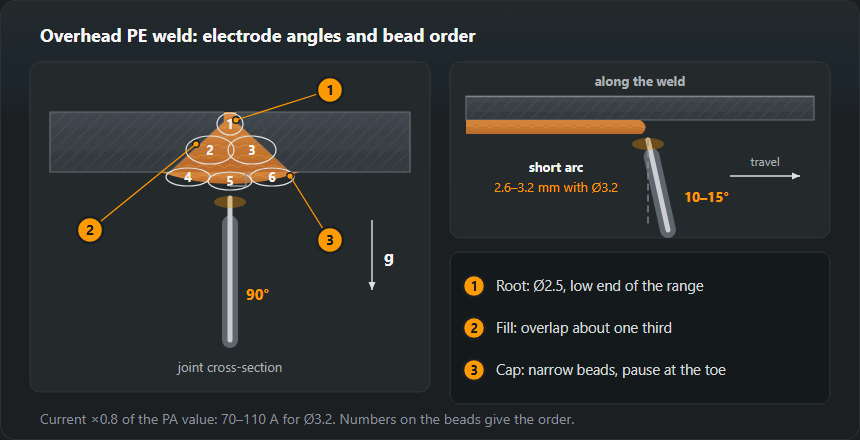
Work angle (across the joint): on a PE butt joint the electrode stands square to the plate, at 90°, so the arc melts both edges evenly. In a PD fillet it sits on the bisector, about 45° to both legs.
Travel angle: tilt the top of the electrode 10–15° from perpendicular towards the direction of travel, a drag angle as in the other positions. With more tilt the arc gets longer even though the tip is right at the plate, and the pool starts to sag.
Short arc and amperage: worked example for a 3.2 mm electrode
The calculator's arc length is 0.8–1.0 times the electrode diameter, which for 3.2 mm is 2.6–3.2 mm. Overhead, stay at the lower end: the tip almost touches the pool and the arc sounds like an even, quiet crackle.
Amperage is worked out from the flat-position range. For 3.2 mm the current table gives 90–140 A, middle 115 A. The overhead factor is 0.8: rounded to 5 A that makes 70–110 A, middle 90 A. A basic electrode gets a further ×1.05, so 75–120 A, middle 95 A. The table on this page is worked out with the same factor, so its 3.2 mm row shows the same 70–110 A. Start in the middle and correct by watching the pool.
The electrode current calculator does the same conversion: choose the overhead position and the coating type and the range is recalculated.
Travel speed and weave
Set the speed by the pool, not by the clock: the pool should keep one width and tie into both edges. Too slow and the metal gathers into a drop and sags; too fast and the bead is narrow, high and undercut along the sides.

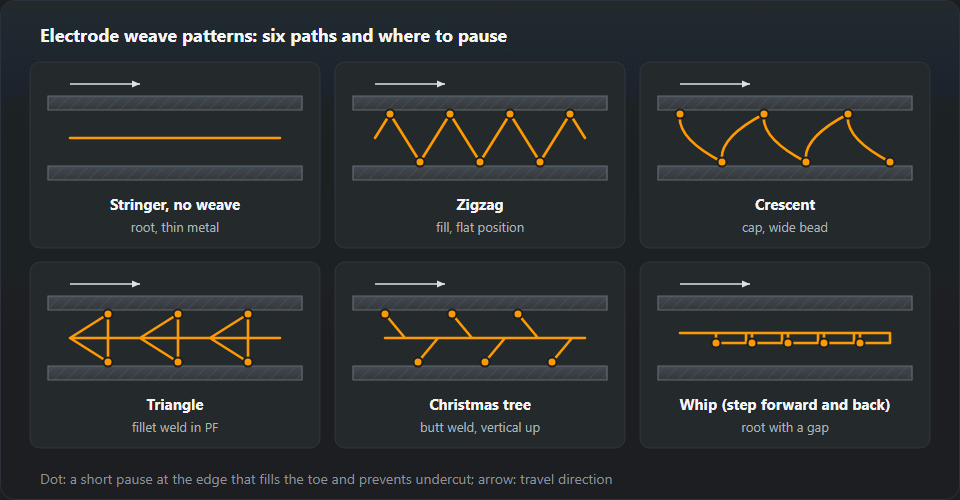
Of the six movements in the diagram, three are useful overhead: a straight stringer for the root and thin plate, a narrow zigzag for fill passes, and the whip when the pool starts to overheat — the electrode moves ahead for an instant, the metal freezes, and it comes back. Pause at the edges, never in the middle — a fraction of a second at each end of the weave so the edge fills and no undercut is left.
Multi-pass overhead welds with narrow beads
- Root — 2.5 or 3.2 mm electrode, lower part of the range, straight stringer or small zigzag. Drive the arc into the gap so that penetration shows on the back side, which overhead is the top.
- Fill — beads side by side, each overlapping the previous one by about a third, as in a horizontal weld. The first goes against one edge and the next rests on it.
- Cap — several narrow beads instead of one wide one; run the last one along the edge with a short pause so it leaves no undercut.

Which electrode for overhead welding
Basic (B; E7018 in AWS terms) is the first choice for load-bearing overhead welds: its dense slag freezes quickly and props the pool up, and the weld metal is low in hydrogen (H5–H10). It needs DC electrode positive (DC+) and a dry coating — bake it at 300–350 °C for 2 h before use.
Rutile (R; E6013) strikes more easily and runs on AC and DC, but its slag is more fluid and the pool runs. Overhead it works in small diameters, on thin plate and on non-critical joints.
MIG/MAG welding overhead
With a wire feeder, overhead is run in short-circuit transfer: 16–22 V, the arc goes out and re-strikes 50–200 times a second, and the pool is cold and small. The MIG/MAG settings table gives a practical limit: for 3 mm plate, 0.8–1.0 mm wire at 110–150 A and 19–21 V stays within short arc, while the setting for 5–6 mm (22–25 V) is already outside it. So thick plate overhead is filled with thin wire (0.8–1.0 mm) on the lower-row setting, in more passes; pulsed MIG is the alternative where the machine has it. Keep the stick-out short and the gas argon-rich — pure CO₂ throws droplets far too big to hold overhead. More on transfer modes in the MIG/MAG welding guide.
Safety in the overhead position
Sparks and droplets fall straight onto the welder, so the jacket is buttoned to the throat, sleeves go over the gauntlets and trouser legs over the boots. Add a neck cape to the helmet. This is the one position where spatter finds its way into a collar and a sleeve — that is where the burns come from.
What to wear for overhead work
A cotton jacket is not enough overhead: you need a leather jacket, or at least leather sleeves and a bib, a hood or cape that tucks under the helmet over the neck and shoulders, long-cuff gauntlets and a skull cap under the helmet. Chest pockets closed — a falling droplet stays in an open pocket. Trousers without turn-ups. Cover your ears with plugs or the hood: overhead, spatter gets in there too. More on materials on the welding clothing page.
Reading the bead: defects and what to adjust
- Sagging, “icicles”, overlap. Frozen drops hanging under the weld, the face bulging downwards, excess metal rolled over the toes. The pool was too big: take off 5–10 A, shorten the arc, travel faster or switch to the whip.
- Undercut. An unfilled groove along the toe; overhead it is often on both sides. Causes: too much current, long arc, no pause at the edges, travelling too fast. Take off 10–20 A, keep the arc short and pause for a fraction of a second at each end of the weave.
- Lack of root penetration. Unfused edges or an open gap on the back side; an unfused band on the fracture of a test piece. Usually the current was dropped “for fear of dripping”, or the electrode is too thick for the gap. Go back to the middle of the range, use 2.5 mm for the root and push the arc deeper into the gap.
- Slag inclusions. Dark, glassy spots and lines on a fracture or after grinding, usually at the edges between beads. Causes: slag not fully removed, a strongly convex previous bead, a cold or long arc that lets slag run ahead of the pool. The cure is thorough cleaning, grinding humps down and a little more current within the range.
- Porosity. Pores on the face or in a break test: the shielding was blown away or the electrode was damp. Overhead it shows at once.
Practice: from overhead fillet to butt joint
- Overhead padding. A 6–8 mm plate tacked above your head, 3.2 mm electrode. Lay straight beads side by side, each overlapping the last by a third. Target: the same width along the whole electrode and not a single drop on the face.
- Overhead T-joint, PD. Two plates tacked as a tee, the horizontal leg above your head. First a single bead, then three (root and two fill beads). Technique and angles for this joint are in the overhead fillet weld (PD) guide. Test: break the piece with a hammer — the root must show no unfused band and no slag.
- PE butt joint on plates. Two plates with a V preparation, on a backing strip or with a gap, tacked horizontally overhead. Root with 2.5 mm, fill and cap with 3.2 mm in narrow beads. Assessment: even penetration along the whole length on top, a face without undercut or icicles; ideally also a break or bend test on strips cut across the weld.
Designation and qualification
Overhead is PE to EN ISO 6947 (overhead fillet is PD), 4G and 4F in the American system. A qualification passed in PE covers the easier positions, which is why an overhead test counts for more than a flat one.
Frequently asked questions
What current for overhead welding?
About 20 % below the flat position: the calculator multiplies the range by 0.8. For a 3.2 mm electrode that gives 70–110 A — the same row as in the table on this page. Too little current is just as harmful: you get lack of root penetration.
Which electrodes are used overhead?
Basic ones work best: their slag freezes quickly and props the pool up. Rutile electrodes run and drip, so overhead they are limited to thin sizes on thin material.
Does an overhead qualification cover other positions?
Largely yes: PE is a difficult position and under EN ISO 9606-1 it covers the easier ones. The exact range is worked out from the test details, because it also depends on the joint type and the thickness.
What is overhead welding?
Welding with the joint above the welder and the electrode pointing up: PE for a butt joint and PD for a fillet in EN ISO 6947, 4G and 4F in the American system. The pool is held by surface tension alone, so the current is about 20 % below the flat position, the arc is short and the beads are narrow.
What electrode size for overhead welding?
2.5 mm for the root and plate up to about 3 mm, 3.2 mm for fill and cap. The table allows 4.0 mm only from 6 mm plate, and electrodes thicker than 4 mm are practically not used overhead: the pool gets too heavy.
Why does overhead welding leave icicles?
The pool is too big and too hot: the metal does not freeze before it gathers into a drop. Take off 5–10 A, shorten the arc, travel faster and narrower, and when the pool overheats, whip the electrode ahead of it for an instant.
Updated: