The flat position PA: why turning the part pays
PA is the benchmark every other position is measured against: the highest current, a pool that settles by itself, and one and a half to two times the output. Which is why the real skill here is not in the hands but in the fixturing — turning the part.
Short answer
The flat position PA means the highest current and a pool that settles by itself: a 4.0 mm electrode on 8 mm plate runs at 130–190 A (middle 160 A), a 2.5 mm one on 3 mm plate at 70–100 A (about 85 A). Hold the electrode at 70–80° to the surface with a 10–15° tilt in the travel direction. A fillet laid in the boat gives a 10–12 mm leg in one run against 8 mm in PB. For 3–12 mm plate a V of 50–70° with a 1–2 mm root face is enough, and for 12–40 mm an X. The settings table is below.
When PA, and why it is worth fighting for
PA is available whenever the part can be laid down or rolled with the weld facing up. A fillet in PA is set in the boat: the T is tilted so the corner faces up at 45°, and the pool fills it symmetrically on its own. The difference from PB is not technique but money: the same welder with the same electrode lays a 10–12 mm leg in one run in the boat against 8 mm in PB, and travels faster. A positioner, or even a pair of stands, pays for itself on the first batch.

How to run it
Hold the electrode at 70–80° to the surface with a 10–15° tilt in the direction of travel: the arc then pushes the slag behind it instead of driving it under the pool. Take the current from the top of the range — in PA the pool does not run, so the margin goes into penetration and speed. Travel steadily, without pauses: the mistake here is not letting it run but overheating it. In the boat the electrode sits on the bisector of the corner, that is at 45° to both legs.
Guide settings: PA is the base the other positions are derived from
| Thickness, mm | Electrode diameter, mm | Current, A |
|---|---|---|
| 1–2 | 1.6 | 40–60 |
| 1.5–3 | 2.0 | 50–80 |
| 2–4 | 2.5 | 70–100 |
| 3–5 | 3.0 | 80–130 |
| 3–6 | 3.2 | 90–140 |
| 6–12 | 4.0 | 130–190 |
| 10–20 | 5.0 | 180–250 |
| 16+ | 6.0 | 230–320 |
How to read the table: two examples
The table leads from plate thickness to electrode diameter and current band. The flat factor is ×1.0, so the same figures appear in the general current and diameter table, and every other position is worked down from them.
8 mm plate. Row 6–12 mm: 4.0 mm electrode, 130–190 A, middle 160 A. At this thickness the top-of-band rule applies: start above the middle and work towards 190 A until the toes begin to undercut. Arc length 0.8–1.0 × diameter, i.e. 3.2–4.0 mm. For comparison, the same electrode would get 125–180 A in PB and 110–160 A vertical — which is where the productivity difference comes from.
3 mm plate. Two rows fit: 2.5 mm (2–4 mm, 70–100 A) and 3.0 mm (3–5 mm, 80–130 A). The top-of-band rule does not apply here — below 4 mm it burns through. Take 2.5 mm and the middle of the band, 85 A, arc 2.0–2.5 mm. For thinner sheet see welding thin metal.
The exact current with the coating correction comes from the current calculator, where PA is the base value.
Butt joint preparation in PA
- I (square edge) — ≤ 3 … 4 mm, gap 0–3 mm: the gap alone gives penetration.
- V — 3 … 12 mm, angle 50–70°, root face 1–2 mm, gap 1–4 mm. The standard choice with access from one side.
- X (double V) — 12 … 40 mm, angle 50–60°. Easiest in PA: the part is turned over and both halves are welded flat.
Dimensions for a given thickness come from the groove calculator.
How much goes in one run
In the boat a 10–12 mm leg goes down confidently in a single run — twice what the overhead fillet allows and noticeably more than PB. That is the real gain of the position. The ceiling is set not by running but by heat input: a wide bead in one pass overheats the heat-affected zone and pulls the part. Beyond 12 mm you split it into runs not because the pool would run, but to hold the heat input down.
In the boat or PB: a comparison

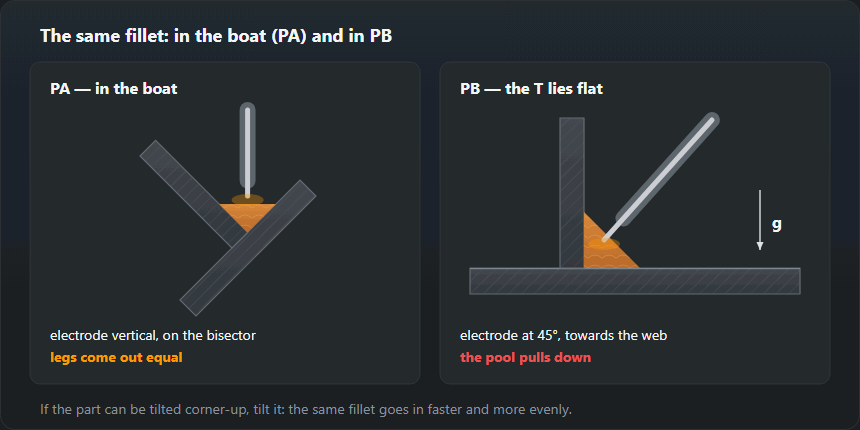
In the boat the electrode stands vertical on the bisector and the pool spreads evenly onto both plates — there is no need to fight gravity with the angle. In PB the same T lies flat, the pool pulls onto the bottom plate and the legs have to be evened out by hand. An example from the fillet calculator table: for a = 5 mm the leg is z = 7.1 mm, area 27.5 mm², 0.22 kg of weld metal per metre — the same amount of metal in both positions, but it goes in faster and more evenly in the boat. PB technique is in fillet welding in PB, and the a-to-z conversion in the fillet size calculator.
In practice the part is set in the boat on two trestles or in a jig made from angle, tacked on both sides and turned for each bead. Long beams are turned once per side — and it is still faster than running the whole weld in PB.
What to weld it with
Everything works in PA: rutile, basic, flux-cored wire, MAG in spray transfer. That is exactly why the position is chosen for critical welds — the consumable is dictated by the metal and the requirements, not by convenience. A basic electrode shows its full worth here: the best penetration and the cleanest deposit, whereas overhead it is taken out of necessity. For MAG, flat is the only position where spray transfer is available without reservations.
MAG and TIG in the flat position
MAG in spray transfer — from the MIG/MAG settings table: 8–10 mm plate — 1.2 mm wire, 220–280 A, 26–29 V, gas 16–18 l/min; 12+ mm — 1.2–1.6 mm wire, 280–350 A, 29–32 V, gas 18–20 l/min. Settings like these will not work vertical or overhead: the pool is large and fluid. Torch pushing at 10–15°, constant stickout. More in the MIG/MAG guide.
Flat TIG is the easiest place to learn feeding the rod: for 3.0 mm sheet the TIG table gives a 2.0–2.4 mm tungsten, 90–130 A (DCEN) and 7–9 l/min of argon. Details in the TIG guide.
Spotting faults in a flat weld
- Excess weld metal (502) — easy in PA because nothing runs off. Under ISO 5817, for a 12 mm wide weld the limit is 2.2 mm at level B, 2.8 mm at C and 4 mm at D. Fix: travel faster or use a thinner electrode for the cap.
- Slag running ahead of the pool — the arc starts riding on slag and a section shows inclusions. Too slow, or the electrode too upright: bring back the 10–15° drag.
- Burn-through at the root — top-of-band current on plate under 4 mm, or too wide a gap. Drop to the middle of the band, close the gap, travel faster.
- Distortion — in PA it is easy to lay down more metal than needed. Stagger the welds, tack more closely, and size the weld to the drawing, not "with a margin".
- Pores — rarer than in any other position: the pool stays liquid longer and the gas has time to escape. Where they do appear, look for dirt on the edges or a lost gas shield, not at the position.
Designation and qualification
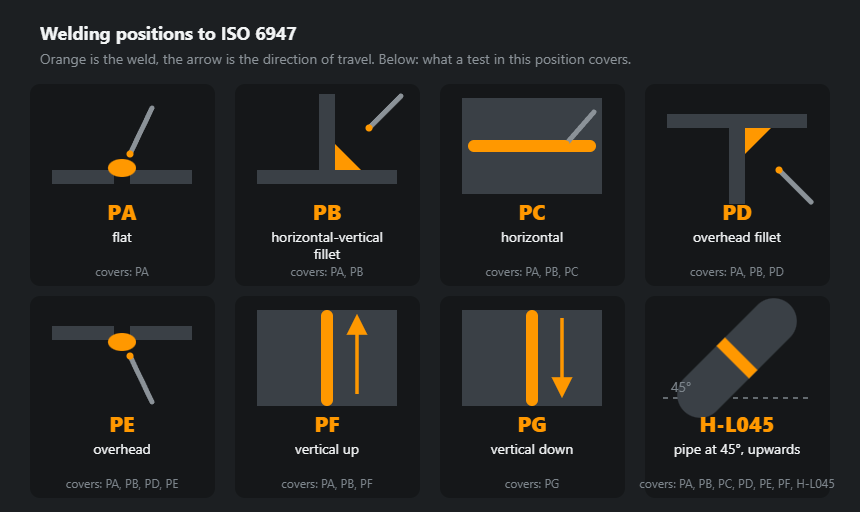
PA to EN ISO 6947, 1G for a butt weld and 1F for a fillet in the American system. A test in PA covers PA only — the narrowest certificate there is. That is why people usually do not sit the test flat: a PF butt covers PA and itself (with a supplementary fillet test piece, also fillets in PA, PB and PF), and a pipe at H-L045 covers every butt position except downhill. Flat is what you take when the shop genuinely welds in nothing else.
Practice and qualification
- Straight beads on plate. 8–10 mm plate, 3.2 mm electrode, current from the middle of the band (115 A). Goal: even width and ripple, no dips at the start and crater.
- Pad welding. Beads side by side, each overlapping the last — teaches constant speed and clean slag removal.
- V joint with backing. Root, fill, cap; then section it and check the fusion.
- T in the boat. One bead, legs checked with a gauge, then a fracture test.
A PA test under EN ISO 9606-1 covers only PA. A PF test covers PA, PF — which is why, for the same cost, vertical is taken more often. All positions side by side are in the welding positions overview, and the range for your data comes from the qualification range calculator.
Frequently asked questions
What is welding in the boat?
It is a fillet weld set into position PA: the T is tilted so the corner faces up at 45°. The pool fills the corner symmetrically, the leg comes out even without effort, and a single run lays 10–12 mm instead of 8 in PB. If the part can be tilted, tilt it.
What current should I use flat?
The top of the range for your electrode diameter: the pool does not run, so the margin goes into penetration. One caveat — the rule works from 4 mm thickness upwards. On thin sheet the top of the range burns through.
Why are there fewer pores in PA?
The pool stays liquid longer and the gas has time to reach the surface. Overhead and vertical the pool is kept small and freezes quickly, so with the same dirt on the edges porosity is more likely.
Is it worth taking the test in the flat position?
Only if the shop welds in nothing else. PA covers itself alone, while PF for the same test fee opens PA and PF for butt welds, and PA, PB and PF for fillets. The certificate costs the same and covers two to three times as much.
What current for a 4 mm electrode in the flat position?
The table gives 130–190 A (plate 6–12 mm), middle 160 A. In PA, from 4 mm thickness up, use the upper part of the band because the pool does not run. On thin plate stay at the middle.
Which electrode for 3 mm plate in the flat position?
2.5 mm: the table gives 70–100 A for 2–4 mm plate; start at the middle, 85 A. The top of the band on 3 mm risks burn-through.
Is a fillet "in the boat" PA or PB?
PA. A T tilted so the corner faces up is the flat position; PB is the same T lying flat with the weld running horizontally along the corner.
Updated: