Electrode coatings: rutile, basic and cellulosic
The coating is not packaging. It shields the arc, forms the slag, stabilises the arc electrically and carries alloying elements into the weld — change it and you change the process.
What the coating does
Four jobs at once. It decomposes into gas that pushes air away from the arc, which is why MMA works outdoors. It forms slag that floats on the pool, shapes the bead and slows the cooling. It stabilises the arc with easily ionised elements — potassium, sodium — so that the arc restrikes at every AC zero crossing. And it alloys the deposit, adding manganese, chromium or nickel that the core wire does not contain.
The four types
| Coating | EN ISO | Current | Slag | Hydrogen | Where it is used |
|---|---|---|---|---|---|
| Rutile OK 46.00, ER 146 | R, RR, RC | AC / DC± | Lifts by itself | High | General fabrication, repairs, learning |
| Basic OK 48.00, EB 150 | B | DC+ as a rule | Dense, has to be chipped | Low (H5–H10) | Loaded joints, thick section, frost |
| Cellulosic OK 22.45 | C | DC+ / AC | Thin | Very high | Pipeline root runs, downhill welding |
| Acid — | A | AC / DC | Comes away easily | Medium | Non-critical joints, flat position, now uncommon |
Rutile
Titanium dioxide based. Easy striking and restriking, a soft quiet arc, a smooth bead and self-lifting slag. Works on AC, which matters on older transformer sets. The trade-off is hydrogen content and lower impact toughness, so rutile electrodes belong on brackets, frames and repairs rather than on a pressure vessel.
The RC and RR variants are worth knowing: RR has a thick coating and gives a flatter, wider bead, while RC is a rutile-cellulosic mix that will run downhill.
Basic
Calcium carbonate and fluorspar. The deposit has the highest toughness and the lowest hydrogen of the common types, and that is the whole reason the type exists: hydrogen is one of the three ingredients of cold cracking, discussed in cracks in welds.
Everything about handling a basic electrode follows from moisture. It absorbs water from the air within hours, so it is baked at 300–350 °C for two hours and then kept in a quiver at 100–150 °C. An electrode that has spent the night on the bench is not a low-hydrogen electrode any more, whatever the box says. In the preheat calculator that difference is worth a whole hydrogen scale step — often 30 °C of preheat.
It also runs a harsher arc and needs DC+, and it will not tolerate a long arc. Welders who dislike basic electrodes are usually welding with too long an arc and too little current.
Cellulosic
Organic cellulose that burns to hydrogen and carbon monoxide, giving a violent, deeply penetrating arc. That is what makes it the pipeline root electrode: it will cut through a root gap and can be run downhill at speed.
The one rule that surprises people: never dry a cellulosic electrode. The moisture in the coating is a working ingredient, and a dried-out cellulosic electrode simply stops behaving correctly. The hydrogen level is high by design, which is why the fill and cap runs on pipeline work are often made with basic electrodes instead.
Reading the designation
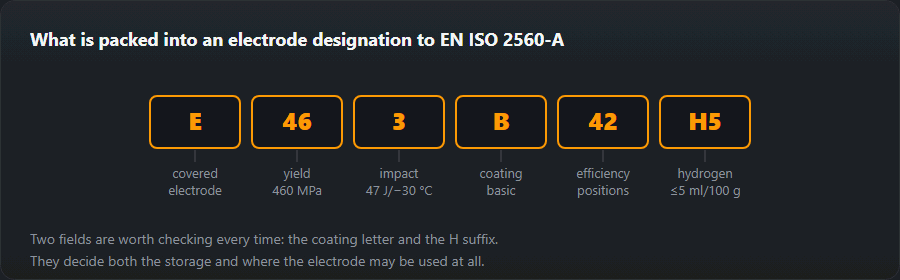
An EN ISO 2560-A code such as E 46 3 B 42 H5 reads:
E covered electrode, 46 the strength class — minimum yield strength of the weld
metal 460 MPa, 3 impact class (47 J at −30 °C), B basic coating,
4 the weld metal recovery and type of current, 2 the positions, H5 hydrogen not exceeding 5 ml/100 g. The two fields
worth checking every time are the coating letter and the H suffix.

Specific grades with their currents, diameters and baking temperatures are in the electrode catalogue.
| Symbol | What it means |
|---|---|
E | Covered electrode for manual arc welding |
46 | Minimum yield strength of the weld metal, 460 MPa |
3 | Impact energy 47 J at −30 °C |
B | Coating type: basic |
42 | Deposition efficiency and type of current |
H5 | Hydrogen no more than 5 ml per 100 g |
AWS equivalents
| Designation | Coating | Current | Equivalent by type |
|---|---|---|---|
E6013 | Rutile | AC / DC± | OK 46.00 |
E7018 | Basic, low-hydrogen | AC / DC+ | OK 48.00 |
E6010 | Cellulosic | DC+ | OK 22.45 |
E6011 | Cellulosic | AC / DC+ | — |
Drying and storage
| Coating | Temperature | Time | Storage afterwards |
|---|---|---|---|
| Rutile | 70–120 °C | 1–2 h | A dry place; the sealed packet is usually enough |
| Basic | 300–350 °C | 2 h | Quiver at 100–150 °C; an opened packet goes back to the oven |
| Cellulosic | no more than 70–80 °C | — | Sealed packet — drying is not allowed |
| Acid | 100–150 °C | 1 h | A dry place |
Rutile or basic: point by point
- Striking. Rutile strikes easily, restrikes too. A basic rod leaves a cup on the tip that has to be knocked off, and is best struck ahead of the weld and brought back into the crater.
- Current. Rutile — AC or DC of either polarity. Basic — as a rule DC+.
- Slag. Rutile slag lifts by itself; basic slag is dense and has to be chipped between runs.
- Hydrogen and cracking. Rutile puts a lot of hydrogen into the weld, basic very little (H5–H10). On thick section, hardenable steels and in frost that is the deciding point.
- Toughness. A basic E 46 3 B guarantees 47 J at −30 °C. Rutile grades usually carry a more modest figure — see the second designation below.
- Storage. Rutile needs a dry place and 70–120 °C if it has got damp. Basic is baked at 300–350 °C and kept in a quiver at 100–150 °C.
- The welder's hand. Rutile forgives a long arc and dirty steel. Basic wants a short arc and clean metal: a long arc with it means porosity.
A second designation: E 38 0 RC 11
This one is printed on a lot of general-purpose rods. Read against EN ISO 2560-A (Tables 1A, 2A, 5A and 6A of the standard; checked also against Elga's guide to it):
E— covered electrode for manual metal arc welding.38— weld metal yield strength at least 380 MPa.0— 47 J impact energy at 0 °C. Compare with the “3” of the basic rod: −30 °C.RC— rutile-cellulosic coating.- First
1— recovery up to 105 %, AC and DC. - Second
1— all positions, vertical-down included.
The same tables explain the “42” of the first example: 4 —
recovery 105–125 % and DC only, 2 — all positions except
vertical-down. There is no hydrogen symbol on E 38 0 RC 11: rutile
grades usually do not carry one.
Which rod: five situations
- A fence, a carport, a frame on a home inverter. Rutile, 2.5–3.2 mm. Current from the current calculator.
- A 12 mm beam splice, a loaded joint. Basic, baked, on DC+. Root with a thinner rod, fill with 4 mm.
- Working in frost. Basic: low hydrogen and toughness below zero. Plus a check on whether preheat is needed.
- A pipeline root, downhill. Cellulosic, DC+ or AC; never baked.
- Only an AC transformer set. Rutile or acid; a basic rod on AC will stick unless the packet allows AC.
If the rod still sticks, the step-by-step check is in why the electrode keeps sticking, and the consumption calculator works out how many rods a weld takes.
Frequently asked questions
Which coating for a beginner?
Rutile. It strikes on the first try, runs on AC or DC, forgives a long arc and the slag lifts off almost by itself. Learning on basic electrodes teaches bad habits, because the fight to keep the arc lit hides everything else that is going wrong.
How do I know if an electrode is damp?
By how it behaves: a basic electrode that spits, crackles irregularly and leaves fine surface porosity has taken up moisture. There is no reliable way to tell by looking, which is why critical work uses a heated quiver rather than judgement.
Can I dry electrodes in a kitchen oven?
For a rutile electrode that got slightly damp, gently, yes. For basic electrodes on a critical joint, no: the specification asks for a controlled two hours at 300–350 °C, and a domestic oven neither reaches nor holds that. Cellulosic electrodes must never be dried at all.
Can basic electrodes be run on AC?
As a rule, no: a basic coating is designed for DC with the electrode positive, and on AC the arc is unstable and the rod sticks. Some E7018 brands are approved for AC as well — the packet says so. If the packet shows DC+ only, an AC transformer set will not do.
What does RC mean in an electrode designation?
A rutile-cellulosic coating under EN ISO 2560-A. It strikes like a rutile rod but holds a vertical better thanks to the cellulose. Alongside it you will find R — rutile, RR — thick rutile, RB — rutile-basic, B — basic, C — cellulosic.
Updated: