Catalogue of covered electrodes
Common electrode designations in one table: coating, current type, EN ISO and AWS classification, diameters and baking conditions. The search filters as you type — by designation, classification or purpose.
Classifications and baking conditions vary between manufacturers and between editions of the standards. This table is for orientation and for finding a substitute; the definitive figures are on the packet and in the batch certificate. Where the numbers disagree, they are right and we are not.
Nothing found. Try another word, or browse the sections instead.
Carbon steel — rutile
| Designation | Coating | Current | Classification | Ø, mm | Baking | Note |
|---|---|---|---|---|---|---|
| ANO-21 | R | AC / DC± | E 43 0 R(C) 11 | 2.0–4.0 | 70–100 °C | a common choice for learning |
| ANO-4 | R | AC / DC± | E 46 0 RR 12 | 3.0–5.0 | 70–100 °C | runs reliably on AC |
| MR-3 | R | AC / DC± | E 46 0 RR 12 | 2.5–5.0 | 70–100 °C | a common choice for learning |
| OZS-12 | R | AC / DC± | E 46 0 RR 12 | 2.5–5.0 | 70–100 °C | |
| ESAB OK 46.00 | RC | AC / DC± | E 42 0 RC 11 | 1.6–5.0 | 70–100 °C | runs reliably on AC |
| ESAB OK 43.32 | RR | AC / DC± | E 42 0 RR 12 | 2.0–5.0 | 70–100 °C | |
| Lincoln Omnia 46 | RC | AC / DC± | E 42 0 RC 11 | 2.0–4.0 | 70–100 °C |
Carbon steel — basic
| Designation | Coating | Current | Classification | Ø, mm | Baking | Note |
|---|---|---|---|---|---|---|
| UONI 13/45 | B | DC+ | E 42 4 B 20 | 2.5–5.0 | 350–400 °C | low hydrogen, for critical joints |
| UONI 13/55 | B | DC+ | E 50 4 B 20 | 2.5–5.0 | 350–400 °C | keeps its impact toughness in the cold |
| OZS-18 | B | DC+ | E 50 4 B 20 | 3.0–4.0 | 250–350 °C | low hydrogen, for critical joints |
| ESAB OK 48.00 | B | DC+ | E 42 4 B 42 H5 | 2.0–5.0 | 350 °C | low hydrogen, for critical joints |
| ESAB OK 53.70 | B | AC / DC+ | E 42 5 B 12 H5 | 2.5–4.0 | 330–370 °C | root run on pipelines |
| Böhler FOX EV 50 | B | AC / DC+ | E 42 5 B 42 H5 | 2.5–5.0 | 300–350 °C | keeps its impact toughness in the cold |
| Lincoln Basic 7018 | B | AC / DC+ | E 42 4 B 42 H5 | 2.5–5.0 | 250–350 °C | low hydrogen, for critical joints |
Cellulosic — pipe and downhill
| Designation | Coating | Current | Classification | Ø, mm | Baking | Note |
|---|---|---|---|---|---|---|
| VSC-4 | C | DC+ | E 42 2 C 21 | 3.0–4.0 | — | root run on pipelines |
| ESAB OK 22.45 | C | DC+ | E 38 3 C 21 | 2.5–4.0 | — | do not bake: the moisture in the coating is intended |
| Lincoln Pipeliner 6P+ | C | DC+ | E 6010 | 3.2–4.0 | — | root run on pipelines |
Stainless steel
| Designation | Coating | Current | Classification | Ø, mm | Baking | Note |
|---|---|---|---|---|---|---|
| OZL-8 | R | DC+ | E 19 9 R 12 / E308-16 | 2.0–4.0 | 150–200 °C | |
| CL-11 | B | DC+ | E 19 9 Nb B 20 / E347-15 | 2.0–4.0 | 150–200 °C | stabilised, against intergranular corrosion |
| ESAB OK 61.30 | R | AC / DC+ | E 19 9 L R 12 / E308L-17 | 1.6–4.0 | 350 °C | |
| ESAB OK 63.30 | R | AC / DC+ | E 19 12 3 L R / E316L-17 | 1.6–4.0 | 350 °C | |
| ESAB OK 67.60 | R | AC / DC+ | E 23 12 L R / E309L-17 | 2.0–4.0 | 350 °C | dissimilar joints, steel to stainless |
| Böhler FOX CN 23/12-A | R | DC+ | E 23 12 L R / E309L | 2.5–4.0 | 150–200 °C | dissimilar joints, steel to stainless |
Cast iron
| Designation | Coating | Current | Classification | Ø, mm | Baking | Note |
|---|---|---|---|---|---|---|
| OZCh-2 | R | DC+ | Cu-Ni | 3.0–4.0 | 100–150 °C | cold welding of cast iron, in short runs |
| CCh-4 | B | DC+ | Fe-V | 3.0–4.0 | 150–200 °C | with preheat at 400–600 °C |
| ESAB OK 92.18 | B | DC+ | E Ni-CI | 2.5–4.0 | 150–250 °C | cold welding of cast iron, in short runs |
| UTP 86 FN | B | DC+ | E NiFe-CI | 2.5–4.0 | 150–250 °C | cold welding of cast iron, in short runs |
Hardfacing and wear resistance
| Designation | Coating | Current | Classification | Ø, mm | Baking | Note |
|---|---|---|---|---|---|---|
| T-590 | R | AC / DC± | — | 3.0–5.0 | 150–200 °C | deposit hardness 55–60 HRC |
| T-620 | R | AC / DC± | — | 4.0–5.0 | 150–200 °C | deposit hardness 55–60 HRC |
| ESAB OK 84.58 | B | DC+ | E Fe8 | 3.2–5.0 | 200 °C | deposit hardness 55–60 HRC |
Creep-resistant steels
| Designation | Coating | Current | Classification | Ø, mm | Baking | Note |
|---|---|---|---|---|---|---|
| CL-39 | B | DC+ | E CrMo1 B | 3.0–4.0 | 350–400 °C | needs preheat and tempering |
| CU-5 | B | DC+ | E CrMo1 B | 3.0–4.0 | 350–400 °C | needs preheat and tempering |
| ESAB OK 76.18 | B | DC+ | E CrMo1 B 42 H5 | 2.5–4.0 | 300–350 °C | needs preheat and tempering |
Non-ferrous metals
| Designation | Coating | Current | Classification | Ø, mm | Baking | Note |
|---|---|---|---|---|---|---|
| OZA-1 | A | DC+ | Al 99.5 | 3.0–5.0 | 150–200 °C | |
| OZA-2 | A | DC+ | Al-Si | 3.0–5.0 | 150–200 °C | |
| ESAB OK 96.20 | A | DC+ | E Al Si 12 | 2.5–4.0 | 150–200 °C | |
| ESAB OK 94.25 | B | DC+ | E Cu Sn A | 3.0–4.0 | 150–200 °C |
The codes in the table
| Code | Coating | Behaviour |
|---|---|---|
| R | Rutile | Easy striking, even bead, self-lifting slag, runs on AC |
| B | Basic | Low hydrogen, tough deposit, wants DC+ and dry storage |
| C | Cellulosic | Deep penetration, heavy spatter, downhill welding, never bake |
| A | Acid | Straightforward welds in the flat position |
| RC, RA, RB | Mixed | A compromise between the properties of two types |

Choosing a substitute
Electrodes are interchangeable by three parameters, not by name. Check them in this order.
- Strength class. The first figures of the classification — 42, 46, 50 — are the minimum yield strength of the deposit in tens of MPa. Substitute equal or higher, never lower.
- Impact class. The digit after the strength class gives the test temperature: 0 is 0 °C, 2 is −20 °C, 3 is −30 °C, 4 is −40 °C. On winter site work this is the parameter that matters most.
- Coating type. A basic electrode cannot be replaced by a rutile one on a critical joint: different hydrogen content, different ductility of the deposit.
Only after those three do the practical differences matter: how the arc feels, how the slag releases, whether it will run on AC, and what it costs. Feed the consumption into the electrode consumption calculator before ordering, and the price into the cost per metre if the job is being quoted.
Storage
Rutile electrodes tolerate a dry store and are largely forgiving. Basic electrodes need an unopened packet or a heated cabinet, a bake after exposure at the temperature in their row — 300–400 °C for most basic grades here — for one to two hours, and a quiver at 100–150 °C on the job. Cellulosic electrodes want ordinary dry storage and no baking at all. Stainless electrodes take up moisture as readily as basic ones and are baked at the temperature in their row: 150–200 °C for OZL-8 and CL-11, 350 °C on the ESAB sheets.
How to read a row of the catalogue
Every row answers the six questions you ask at the supplier's counter. Take two neighbouring rows from the basic group, because these are the ones people confuse most often:
- ESAB OK 48.00 — coating B, current DC+, classification E 42 4 B 42 H5, diameters 2.0–5.0 mm, baking 350 °C.
- UONI 13/55 — coating B, current DC+, classification E 50 4 B 20, diameters 2.5–5.0 mm, baking 350–400 °C.
Both are basic, but they are not the same electrode. UONI has the higher strength class (50 against 42); the impact class is the same (4, tested at −40 °C), but OK 48.00 guarantees H5 hydrogen. Both show DC+ in the “Current” column: neither is a choice for an AC transformer, and both need a rectifier or an inverter with the electrode holder on the positive pole. The baking differs too: 350 °C for OK 48.00, 350–400 °C on the UONI passports. The “Note” column hints at the typical use, but the decision is made on the classification.
Equivalents: ESAB, Lincoln, Böhler and ex-USSR grades side by side
The table below is the same set of catalogue rows, sorted by job. Electrodes in one row share the coating type and purpose; whether they are equivalent on a particular joint is decided by comparing classifications with the three steps above. The second column holds grades sold across Eastern Europe (ANO, MR, UONI, OZL) that you will meet on Polish and Ukrainian sites.
| Group | ANO, MR, UONI, OZL… | ESAB | Lincoln | Böhler / UTP |
|---|---|---|---|---|
| General rutile | ANO-21, ANO-4, MR-3, OZS-12 | OK 46.00, OK 43.32 | Omnia 46 | — |
| Basic low-hydrogen | UONI 13/45, UONI 13/55, OZS-18 | OK 48.00, OK 53.70 | Basic 7018 | FOX EV 50 |
| Cellulosic for pipe | VSC-4 | OK 22.45 | Pipeliner 6P+ | — |
| Stainless 308L / 347 | OZL-8, CL-11 | OK 61.30 | — | — |
| Stainless 316L | — | OK 63.30 | — | — |
| Dissimilar 309L | — | OK 67.60 | — | FOX CN 23/12-A |
| Cast iron | OZCh-2, CCh-4 | OK 92.18 | — | UTP 86 FN |
| Hardfacing | T-590, T-620 | OK 84.58 | — | — |
| Creep-resistant CrMo | CL-39, CU-5 | OK 76.18 | — | — |
The closest pair in the catalogue is OK 48.00 and Lincoln Basic 7018: identical classification E 42 4 B 42 H5; they part ways on current — Basic 7018 reads AC / DC+ in the table, OK 48.00 DC+ only. Böhler FOX EV 50 has the same strength class but impact class 5 — on winter work that is ten degrees more margin in test temperature — and it runs on AC. In the stainless group the substitute follows the deposit chemistry: 308L will not replace 316L, because it lacks the molybdenum that 1.4404 parent metal contains.
If your welder is AC only
An old transformer without a rectifier narrows the choice to rows whose “Current” column starts with AC. In this catalogue that is the whole rutile group (ANO-21, ANO-4, MR-3, OZS-12, OK 46.00, OK 43.32, Omnia 46), three basic electrodes (OK 53.70, FOX EV 50, Basic 7018), the ESAB stainless OK 61.30, OK 63.30 and OK 67.60, and the hardfacing T-590 and T-620. OK 48.00, UONI, OZS-18, the cellulosic electrodes, OZL-8, CL-11, FOX CN 23/12-A and the cast-iron electrodes show DC+ only: on AC the arc keeps going out and the rod freezes to the work. If a correct electrode still sticks, the causes are in why the electrode sticks.
Worked selection examples
A gate from 40×40×2 box section on an inverter
Structural steel, a non-critical joint, a welder without much practice. A rutile coating is enough: ANO-21 or OK 46.00. On a 2 mm wall take the smallest diameter in the row — 2.0 mm for ANO-21, 1.6–2.0 mm for OK 46.00. Bake only if the packet has got damp: 70–100 °C.
An S355 beam, 12 mm plate, winter erection
The yield strength of S355 is 355 MPa, so class 42 (420 MPa) has a margin. Outdoor work in frost calls for impact class 4 or 5, and 12 mm calls for low hydrogen. Choice: OK 48.00 or FOX EV 50, 3.2 or 4.0 mm. Bake to the table before the shift, then keep them in a quiver at 100–150 °C next to the joint. Whether preheat is needed, the preheat calculator will tell you.
A mild-steel bracket onto 1.4301 sheet
A dissimilar joint: a 308L deposit gets diluted against carbon steel and loses its resistance. The right group is 309L — OK 67.60 or FOX CN 23/12-A. Why that one is explained in welding dissimilar steels.
A cracked cast-iron housing
Without a furnace for preheat, the cold method remains: OK 92.18 (E Ni-CI) or UTP 86 FN (E NiFe-CI), 2.5–3.2 mm, runs a few centimetres long, peening every bead. CCh-4 in the table needs the whole part preheated to 400–600 °C — a workshop job, not a site one. Details are in welding cast iron.
Baking by group — reading the column
| Group | Baking in the catalogue | What to do in practice |
|---|---|---|
| Rutile | 70–100 °C | Only after they get damp |
| Basic | 250–400 °C (OK 48.00 — 350 °C, UONI — 350–400 °C) | After every opened packet, 1–2 hours per the packet, then the quiver |
| Stainless | 150–350 °C (ESAB — 350 °C) | Keep dry like basic ones |
| Cast iron | 100–250 °C | Per the row of the specific grade |
| CrMo | 300–400 °C | Like basic, with a quiver |
| Cellulosic | — | Never bake |
Two hours at 350 °C for OK 48.00 and at 300–350 °C for FOX EV 50 come from the manufacturer data sheets. For UONI 13/45 and 13/55 the SpetsElektrod passports give 350–400 °C for 1 hour (1–2 hours for 13/55) and ESAB-SVEL 350–400 °C for 2 hours. Not every plant agrees: MEZ (Magnitogorsk) gives 250–300 °C for 1 hour for its UONI-13/55 — which is why the packet label outranks this table. Lay the rods loose in the oven, out of the carton and the film. The number of re-bake cycles is limited by the manufacturer, so write the date of every bake on the packet.
Common mistakes and how to spot them
- Rutile instead of basic on a beam. The weld looks neat and the fault only shows as a crack. The one defence is to check the coating letter in the classification before welding.
- Basic rods from a packet opened a week ago. Pores on the surface and in the fracture, a spitting arc. The pattern and the causes are in weld porosity.
- Baking cellulosic rods. The arc loses its dig and the root stops penetrating through.
- Substituting by name. “7018” on the box says nothing about the impact class — read the EN ISO classification too.
Frequently asked questions
What can I use instead of OK 48.00 if the store is out?
The exact match in the catalogue is Lincoln Basic 7018 — the same E 42 4 B 42 H5 classification. Böhler FOX EV 50 (E 42 5 B 42 H5) is a substitute with margin: the same strength class, impact class 5 (−50 °C instead of −40 °C), and it also runs on AC, whereas the current ESAB data sheet lists OK 48.00 for DC+ only. UONI 13/55 is stronger, impact class 4, and runs on DC+ only. Match the strength class and the impact class in the designation, not the brand name.
What does E 42 5 B 42 H5 mean?
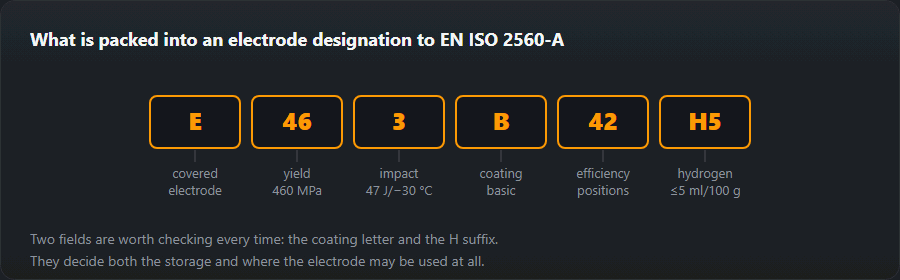
E — covered electrode, 42 — yield strength 420 MPa, 5 — impact energy 47 J at −50 °C, B — basic coating, 4 — weld metal recovery of 105–125 % and the current the electrode was classified on (DC), 2 — positions: all except vertical down, H5 — hydrogen no more than 5 ml/100 g. The two digits after B are two separate fields in EN ISO 2560-A, not one number. The full breakdown is in electrode and wire designations.
Why is there a dash in the baking column for cellulosic electrodes?
Because they must not be baked like basic ones. The moisture in a cellulosic coating is part of how it generates its shielding gas: bake it out at high temperature and the electrode stops working properly. The most it will take is gentle warming to 70–80 °C.
How do I read stainless electrode designations?
The EN ISO 3581 classification names the deposit chemistry: E 19 9 L R is 19 % chromium, 9 % nickel, low carbon (L) and a rutile coating — AWS E308L-17 (OK 61.30). E 19 12 3 L is 316L with molybdenum (OK 63.30), E 23 12 L is 309L for steel-to-stainless joints (OK 67.60), and E 19 9 Nb is niobium-stabilised, E347.
Which basic (7018-type) electrodes run on AC?
In this catalogue three: OK 53.70, Böhler FOX EV 50 and Lincoln Basic 7018 — their current column reads “AC / DC+”. The current ESAB data sheet lists OK 48.00 for DC with the electrode positive, the same as UONI 13/45, UONI 13/55 and OZS-18.
How long should basic electrodes be baked?
The manufacturer sheets give 2 hours at 350 °C for OK 48.00 and at 300–350 °C for FOX EV 50; the UONI 13/45 and 13/55 passports (SpetsElektrod, ESAB-SVEL) give 350–400 °C for 1–2 hours. After baking the rods go into a quiver at 100–150 °C and are taken out as needed. Rutile rods are baked only when damp, at 70–100 °C.
Updated: