12Х18Н10Т: the GOST stainless and its AISI 321 / 1.4541 match
12Х18Н10Т (transliterated 12Kh18N10T, often written 12X18H10T) is a titanium-stabilised austenitic stainless steel to GOST 5632-72. Its closest grades are 1.4541 (X6CrNiTi18-10) to EN 10088 and AISI 321; the old Polish name is 1H18N9T.
Short answer
The 12Х18Н10Т equivalent is 1.4541 / X6CrNiTi18-10 / AISI 321. ISO/TR 15608 group 8.1. It welds without preheat, with interpass up to 150 °C; the usual filler is niobium-stabilised 347 type (E 19 9 Nb), because titanium burns out in the arc. GOST allows up to 0.12 % carbon, EN only 0.08 % — check the certificate before calling it 321.
Grade card
| Designation and standard | 12Х18Н10Т · GOST 5632-72 |
|---|---|
| Closest equivalent | X6CrNiTi18-10 (EN 10088-2) |
| Material number | 1.4541 |
| GOST | 12Х18Н10Т |
| AISI / ASTM | 321 |
| PN | 1H18N9T |
| ISO/TR 15608 group | 8.1 — austenitic stainless, subgroup with Cr ≤ 19 % |
| Weldability (equivalents table) | good, keep heat input low |
The EN, GOST, AISI/ASTM and PN rows come from the steel grade equivalents table. An equivalent is the closest grade, not an identical one.
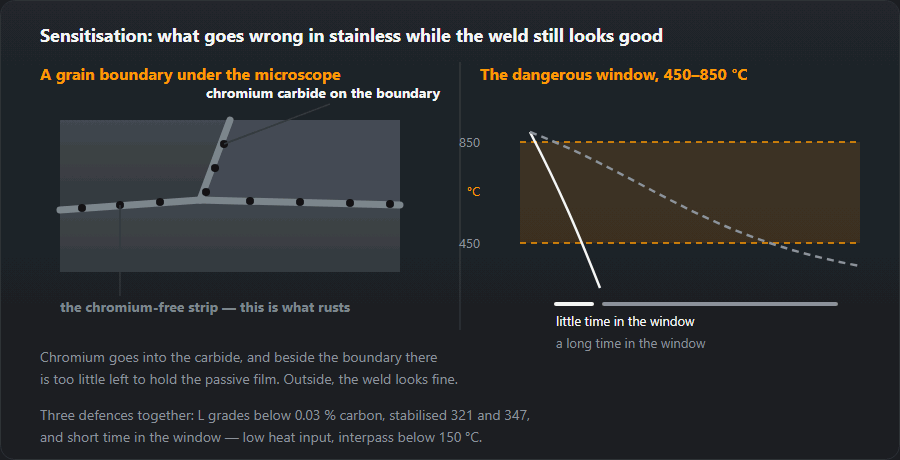
The GOST name reads: 12 — carbon in hundredths of a per cent (up to 0.12 %), Х18 — about 18 % chromium, Н10 — about 10 % nickel, Т — titanium. Titanium ties up carbon so that chromium carbides do not form at the grain boundaries during welding. The sister grade 08Х18Н10Т has carbon up to 0.08 % and is closer to 1.4541 by the numbers.

12Х18Н10Т chemical composition, % by mass
| Element | 12Х18Н10Т | 1.4541 |
|---|---|---|
| C | ≤ 0.12 | ≤ 0.08 |
| Mn | ≤ 2.0 | ≤ 2.00 |
| Si | ≤ 0.8 | ≤ 1.00 |
| P | ≤ 0.035 | ≤ 0.045 |
| S | ≤ 0.020 | ≤ 0.015 |
| Cr | 17.0–19.0 | 17.0–19.0 |
| Ni | 9.0–11.0 | 9.0–12.0 |
| Ti | 5·C–0.8 | 5·C–0.70 |
Source: 12Х18Н10Т — GOST 5632-72, tab. 1; 1.4541 — compraco, alloyfyi, gsalloy (EN 10088-2).
Mechanical properties
| Property | 12Х18Н10Т |
|---|---|
| σт (Rp0.2), MPa | ≥ 205 |
| σв (Rm), MPa | ≥ 530 |
| δ5 (A), % | ≥ 40 |
Source: GOST 5582-75, tab. 1.
Thin sheet to GOST 5582-75 after softening treatment (quenching from 1050–1080 °C).
The table gives the sheet properties of GOST 5582-75 itself; for 1.4541 to EN 10088-2 take the figures from the certificate of the product form you buy.
Carbon equivalent: CE, CET and the CEV limit
CE and CET describe hardening of ferritic steels in the heat-affected zone. Austenite does not harden, so neither CE nor a preheat from that formula applies here. What counts is the ferrite in the weld (see the Schaeffler diagram) and keeping the time between 450 and 850 °C short.
Preheat and interpass temperature
No preheat. Interpass no higher than 150 °C, as for other austenitic stainless steels: they conduct heat worse than carbon steel, and the heat stays at the weld.
Filler metal
| Process | Filler | Gas |
|---|---|---|
| 111 — stick (MMA) | E 19 9 Nb B / E347-15 — ЦЛ-11 | — |
| 141 — TIG | Св-08Х19Н10Б · ER347 | Ar |
| 135 — MAG, solid wire | Св-08Х19Н10Б · ER347 | Ar + 2 % CO₂ |
Titanium burns out in the arc and does little to stabilise the weld metal, so a niobium-stabilised 347 filler is used: ЦЛ-11 electrodes (E 19 9 Nb B / E347-15), Св-08Х19Н10Б wire (Metinvest lists it for 12Х18Н10Т) or ER347. For a joint to carbon steel, use 309L.
How to weld it
- Clean tools for stainless only.
- Little heat: current lower than on carbon steel, short runs.
- Interpass up to 150 °C.
- Back purge with argon on pipe and tanks.
- Pickle and passivate heat tint (more in welding stainless steel).
Substituting the equivalent: what changes in the paperwork
Ordering 1.4541 instead of 12Х18Н10Т: check carbon on the certificate. GOST allows up to 0.12 % C, so a GOST heat may lie outside the 1.4541 range; the reverse swap, 1.4541 for 12Х18Н10Т, keeps within the GOST limits for carbon, chromium and titanium.
Replacing 321 with 304 for service at elevated temperature is not neutral: without titanium the steel is more exposed to sensitisation. In the WPS, write the EN grade and group 8.1.
Where the figures come from
- GOST 5632-72, tab. 1
- GOST 5582-75, tab. 1
- Metinvest, 12Х18Н10Т
- compraco, alloyfyi, gsalloy — 1.4541
- ISO/TR 15608:2013, tab. 1 (later ISO/TR 15608:2017; replaced by ISO 15608:2025)
Figures from distributor and manufacturer datasheets are for information; for a given delivery, the EN 10204 3.1 certificate decides. CE, CET and preheat are calculated when the page is shown, with the same formulas as the calculators.
Frequently asked questions
What is the equivalent of 12Х18Н10Т in AISI and ASTM?
AISI 321 (UNS S32100), EN 1.4541 / X6CrNiTi18-10; the old Polish name is 1H18N9T. It is the closest grade, not identical: GOST allows up to 0.12 % carbon, EN up to 0.08 %.
What is the composition of 12Х18Н10Т?
Per GOST 5632-72, Table 1: C up to 0.12 %, Si up to 0.8 %, Mn up to 2.0 %, Cr 17.0–19.0 %, Ni 9.0–11.0 %, Ti from 5×C to 0.8 %, S up to 0.020 %, P up to 0.035 %.
Which filler for 12Х18Н10Т?
A niobium-stabilised 347 type: ЦЛ-11 electrode (E 19 9 Nb B / E347-15), Св-08Х19Н10Б wire or ER347. Titanium from the parent metal largely burns out in the arc, so a titanium filler would leave the weld unstabilised.
Is 12Х18Н10Т the same as 304?
No. 304 (1.4301) has no titanium; 12Х18Н10Т is stabilised with titanium and corresponds to 321. The unstabilised GOST counterpart of 304 is 08Х18Н10.
What strength does 12Х18Н10Т sheet have?
GOST 5582-75 gives, after quenching from 1050–1080 °C: tensile strength at least 530 MPa, yield at least 205 MPa, elongation at least 40 %.
Updated: