Weldability of steel: what it is, ISO/TR 15608 groups, carbon equivalent and preheat
“Good weldability” is shorthand. Weldability is not a figure on the mill certificate; it is what happens when three things meet: the steel’s composition, the thickness and restraint of the joint, and the welding procedure. Below is how to assess it in practice — from the material group, through the carbon equivalent, to an actual preheat temperature, with figures from this site’s calculators.
Short answer
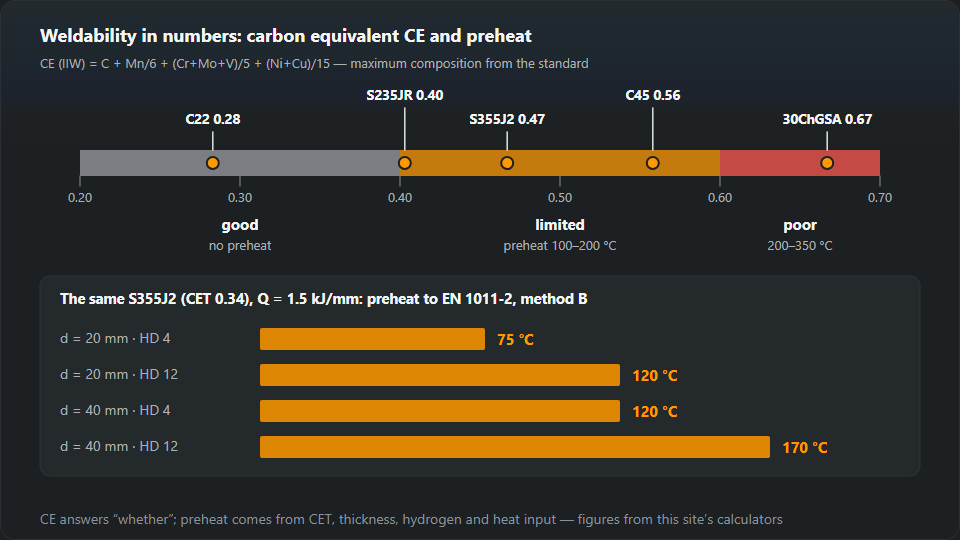
Weldability is the ability of a steel to give a joint with the required properties under a given procedure. The first check is the carbon equivalent CE: up to 0.40 — good (no preheat), 0.40–0.60 — limited (preheat 100–200 °C, low-hydrogen electrodes), above 0.60 — poor (200–350 °C, maintained during welding, post-weld heat treatment). The exact preheat comes from CET, thickness, hydrogen and heat input to EN 1011-2. For paperwork (WPS, qualifications) the steel is assigned to an ISO/TR 15608 group: S235 is 1.1, S355 is 1.2, austenitic stainless is 8.

What weldability means
Weldability has three ingredients, and each can be spoiled separately:
- Material. Chemical composition decides whether the HAZ hardens as it cools. Carbon matters most, followed by manganese, chromium, molybdenum, vanadium, nickel and copper.
- Design. Thick plate draws heat away faster than thin sheet, and a restrained joint does not let the weld shrink freely. The same steel as 5 mm sheet and as 40 mm plate is two different cases.
- Procedure. Hydrogen from the consumable, heat input, preheat, run sequence and post-weld treatment. A good procedure can weld a “difficult” steel; a bad one can spoil an “easy” one.
That is why the answer to “can this be welded?” is almost always “yes — provided…”. The rest of the page is about those provisos.
What spoils weldability
In carbon and low-alloy steels the main enemy is cold (hydrogen) cracking. It needs three things at once: a hard, hardened HAZ, diffusible hydrogen in the weld and stress. Remove any one and the cracking stops — hence preheat (slower cooling, less martensite, more time for hydrogen to escape), baked low-hydrogen electrodes and a sensible welding sequence. A hydrogen crack can appear hours after welding, so visual inspection straight after the job does not always catch it. More in weld cracks.
Other materials have other weak points: austenitic steel — hot cracking and loss of corrosion resistance; cast iron — excess carbon and brittleness; galvanised steel — a coating that boils off. We come back to them below.
Steel groups to ISO/TR 15608
ISO/TR 15608 is a technical report that sorts materials into groups for welding purposes. Welder qualification ranges (ISO 9606-1 test) and procedure qualification (WPS, WPQR) are built on these groups. The figures in the “boundary” column are those that agree in two open sources: the ISO/TR 15608:2017 preview pages and the ped-online.com summary; where there is no second source, the group is described in words.
| Group | Type of steel | Boundary | What it means for welding |
|---|---|---|---|
| 1.1 | Unalloyed and low-alloy steels of low yield strength (e.g. S235) | ReH ≤ 275 N/mm² | Usually no preheat on thin plate; work out CET on thick sections |
| 1.2 | Structural steels of medium strength (e.g. S355) | 275 < ReH ≤ 360 N/mm² | Preheat needed on thicker sections and with damp electrodes |
| 1.3 | Normalised fine-grain steels of higher strength (e.g. S460N) | ReH > 360 N/mm² | Preheat more often than in 1.2, low-hydrogen consumables |
| 1.4 | Weathering steels | — | Filler with matching atmospheric corrosion resistance |
| 2 | Thermomechanically rolled fine-grain steels | 2.1: 360 < ReH ≤ 460 · 2.2: ReH > 460 N/mm² | Low CE for high strength; keep heat input within limits |
| 3 | Quenched and tempered or precipitation-hardened (not stainless) | 3.1: 360 < ReH ≤ 690 · 3.2: ReH > 690 N/mm² | Narrow window of heat input and preheat; only with a procedure |
| 4–6 | Creep-resisting Cr-Mo(-V) steels | — | Preheat and usually post-weld heat treatment per the WPS |
| 7 | Ferritic, martensitic and precipitation-hardened stainless | — | Martensitic grades harden and crack — preheat, temper |
| 8 | Austenitic stainless (e.g. 304, 316L) | 8.1: Cr ≤ 19 % · 8.2: Cr > 19 % | No preheat; hot cracking and sensitisation — keep heat input low |
| 9 | Nickel steels for low temperatures | — | Filler and toughness per the WPS |
| 10 | Austenitic-ferritic stainless (duplex) | 10.1: Cr ≤ 24 % · 10.2: Cr > 24 % | Watch the ferrite balance and heat input |
| 11 | As group 1 but with higher carbon | 11.1: 0.30 < C ≤ 0.35 · 11.2: ≤ 0.5 · 11.3: ≤ 0.85 % | Hard HAZ — preheat, low-hydrogen filler |
How to read it: group 1 is defined by yield strength up to 460 N/mm² and composition limits (including C ≤ 0.25 %, Si ≤ 0.60 %, Mn ≤ 1.8 %); within the group, the subgroup follows the specified minimum yield strength of the product standard. Group 11 is steel within the other group 1 limits but with 0.30 to 0.85 % carbon (subgroups in the table). A group is a label for documents — calculating preheat needs the composition from the actual certificate, not the group number.
Carbon equivalent CE
CE reduces the whole analysis to one number: how much “carbon” the steel contains once the effect of the other elements on hardenability is converted. The IIW formula — the one our carbon equivalent calculator uses:
CE = C + Mn/6 + (Cr + Mo + V)/5 + (Ni + Cu)/15
| CE (IIW) | Weldability | What to do |
|---|---|---|
| up to 0.40 | Good | No preheat needed, ordinary electrodes |
| 0.40–0.60 | Limited | Preheat 100–200 °C, low-hydrogen electrodes, baked |
| above 0.60 | Poor | Preheat 200–350 °C, keep it warm while welding, stress relief afterwards |
Examples at the maximum composition of the product standard (as the calculator’s table works them out): C22 — about 0.28, S235JR — about 0.40, S355J2 — about 0.47, C45 — about 0.56, 30ChGSA — about 0.67. These are cautious figures: a real cast is usually below the maximum, so the CE of an actual S355J2 heat often comes out well under 0.47. That is why decisions are made on the 3.1 certificate analysis, not on the standard.
CET and preheat temperature
CE tells you whether the steel will be awkward. How many degrees of preheat is EN 1011-2 method B, with its own equivalent CET = C + (Mn + Mo)/10 + (Cr + Cu)/20 + Ni/40. Our preheat calculator works it out from four inputs: CET, thickness, diffusible hydrogen HD and heat input. Examples for S355J2 (CET 0.34) at 1.5 kJ/mm:
- 20 mm, baked basic electrodes (HD 4) — 75 °C;
- 20 mm, rutile electrodes (HD 12) — 120 °C;
- 40 mm, HD 4 — 120 °C;
- 40 mm, HD 12 — 170 °C.
For S460N (CET 0.42) at 40 mm it is already 185 °C with HD 4 and 230 °C with HD 12. Two things stand out: hydrogen weighs as much as doubling the thickness, and a higher-strength grade “costs” several tens of degrees. The method has limits — CET 0.20–0.50, thickness 10–90 mm, HD 1–20 ml/100 g, heat input 0.5–4.0 kJ/mm; outside them the calculator warns rather than quietly carrying on.
A worked assessment
S355J2 plate, 40 mm thick, butt weld, basic electrodes.
- Group. S355 is group 1.2 to ISO/TR 15608. That goes on the WPS and is checked against the welder’s qualification range.
- CE from the certificate. At the maximum composition it would be about 0.47 — the limited band. From the cast analysis, work out the real CE in the calculator.
- CET. Take 0.34 — the value the preheat calculator offers for S355J2.
- Hydrogen. Basic electrodes baked at 300–350 °C for 2 hours and kept in a quiver — HD 4.
- Heat input. 1.5 kJ/mm, worked out from current, voltage and travel speed in the heat input calculator.
- Result. Preheat 120 °C. The calculator also gives the interpass range: from 120 °C up to about 250 °C — above that, toughness drops in ordinary structural steels.
Use rutile electrodes (HD 12) on the same joint and the preheat rises to 170 °C. That is usually a stronger argument for basic electrodes than any other.
Steels that weld badly — and why
High-carbon and hardenable steels
C45, 30ChGSA, spring and tool steels, group 11 and the quenched and tempered steels of group 3. Carbon and alloying elements produce hard martensite in the HAZ. CE 0.56 (C45) is the top of the limited band; 0.67 (30ChGSA) is in the poor band, with preheat of 200–350 °C, maintained during welding, and post-weld heat treatment. HAZ hardness is checked by hardness testing — our hardness converter translates HV, HB and HRC. Group 3 steels are never welded by feel: they have a narrow window of heat input and preheat and need a qualified procedure.
Stainless steels
Austenitic grades (group 8) are welded without preheat but with low heat input. Their problems are hot cracking when the weld lacks ferrite, and sensitisation to intergranular corrosion if overheated. Weld metal composition is read from the Schaeffler diagram — our chromium and nickel equivalent calculator shows which region the weld lands in; the target is a few per cent ferrite, not as much as possible. Martensitic grades (group 7) behave more like hardenable steels: they harden, so they need preheat and tempering. Joining stainless to carbon steel is a separate topic — dissimilar steels.
Cast iron
Cast iron has several times the carbon of steel, and in grey iron it is present as graphite. When welded, the zone next to the weld turns white and cracks. There are two routes: hot — the whole casting heated to 500–600 °C and cooled slowly — or cold, in short runs with nickel electrodes. Details and electrode choice in welding cast iron.
Galvanised steel
The steel under the coating usually welds well — the zinc is the problem. It boils off in the arc, causing porosity and spatter, and the fume brings on metal fume fever: flu-like symptoms in the evening after work. Grind the coating off at the weld, use local extraction, and stop if symptoms appear. The rules are in welding fume and ventilation. After welding, protect the joint with zinc-rich paint, because the coating has been destroyed.
Common mistakes in judging weldability
- CE from the standard instead of the certificate. The maximum analysis overstates CE; a real cast can be noticeably better — or worse, if the steel is of unknown origin.
- Using the ISO/TR 15608 group to set preheat. Group 1.2 covers steels of very different CE; the temperature comes from the composition.
- Ignoring thickness. A steel that needs no preheat as 8 mm sheet will certainly need it as 40 mm plate.
- Rutile electrodes on a thick, restrained joint. HD 12 hydrogen raises the preheat by several tens of degrees.
- Preheating with “a quick pass of the torch”. What counts is the temperature through the full thickness on both sides of the joint, measured with a temperature crayon or thermometer.
- Treating unknown steel as S235. Scrap, old structures and machine parts may be hardenable steel; then assume preheat and low-hydrogen electrodes.
Sources for the material groups: the ISO/TR 15608:2017 preview pages (standards.iteh.ai, Table 1) and the ISO/TR 15608 group summary on ped-online.com. CE, CET and preheat temperatures are calculated with the formulas of this site’s calculators.
Frequently asked questions
What is weldability?
The ability of a steel to produce a welded joint with the required properties under a given procedure and design. It depends on chemical composition (above all carbon and the elements that raise hardenability), on the thickness and restraint of the joint, and on the process: hydrogen from the consumable, heat input and preheat. The same steel can weld easily as thin sheet and need preheat as thick plate.
How do you check the weldability of a steel?
The quickest way is the carbon equivalent CE (IIW): CE = C + Mn/6 + (Cr+Mo+V)/5 + (Ni+Cu)/15, from the mill certificate. Up to 0.40 weldability is good, 0.40–0.60 limited (preheat 100–200 °C, low-hydrogen electrodes), above 0.60 poor. The actual preheat temperature is worked out from CET, thickness, hydrogen and heat input to EN 1011-2.
Does S355 need preheat?
It depends on thickness and hydrogen. For S355J2 with CET 0.34 and a heat input of 1.5 kJ/mm, EN 1011-2 method B gives about 75 °C at 20 mm with basic electrodes (HD 4) and about 120 °C with rutile ones (HD 12); at 40 mm it is 120 and 170 °C. Thin sheet usually needs none.
Is C45 (AISI 1045) weldable?
Yes, with restrictions. At the maximum composition of the standard its CE is about 0.56 — the top of the limited band. It needs preheat, low-hydrogen electrodes and slow cooling; critical parts get a post-weld temper. In ISO/TR 15608, steels with more than 0.30 % carbon fall into group 11.
What does group 1.2 mean in ISO/TR 15608?
Steels with a specified minimum yield strength above 275 and up to 360 N/mm² within the group 1 composition limits — typically S355. Group 1.1 is yield strength up to 275 N/mm² (e.g. S235), 1.3 is normalised fine-grain steel above 360 N/mm². Groups define the range of welder and procedure qualification; they are not used to calculate preheat.
Why is stainless steel welded without preheat?
Austenitic stainless (e.g. 304, 316L) does not harden the way carbon steel does, so martensite in the HAZ is not the risk. Its problems are different: hot cracking when the weld metal has too little ferrite, and loss of corrosion resistance if it is overheated. So it is welded with low heat input, and the filler is chosen to leave a few per cent of ferrite in the weld.
Updated: