Heat tint on stainless steel welds
Heat tint is a thin oxide film that grows on stainless steel next to a weld. Its colour shows how hot the surface got: on 18/8 steel in air pale straw appears at about 290 °C, brown at 390, blue at 540–600 and grey above 700 °C. Under the coloured oxide the surface has lost chromium, so from brown onwards the joint is pickled.
Short answer
Pale straw and gold are usually tolerated; brown, purple and blue are pickled; grey scale is ground off and then pickled. How much colour a job may keep is set by the job specification, not by the colour itself. Inside hygienic tube the reference is AWS D18.2 with ten levels from 10 to 25 000 ppm oxygen in the purge; AWS D18.1 rejects level 4 and above in the as-welded condition unless the owner agrees otherwise.
Heat tint colour chart: colour, temperature, what to do
The colours are interference colours of a transparent oxide, like oil on water. The film thickens with temperature and time, and the colour moves along the scale from straw towards blue and grey.

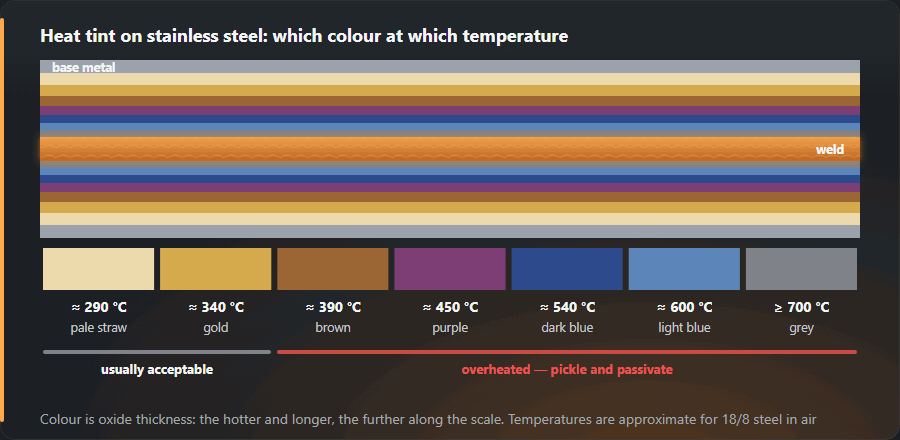
| Colour | Temperature | What it means | What to do |
|---|---|---|---|
| pale straw | about 290 °C | the thinnest visible oxide; the surface underneath has lost little chromium | usually acceptable; on hygienic or chemical work, as the specification says |
| gold | about 340 °C | thin oxide, still close to the bare surface | usually acceptable; remove where the specification or the appearance requires it |
| brown | about 390 °C | oxide thick enough to leave a chromium-depleted layer beneath it | pickle with paste or in a bath, then rinse |
| purple | about 450 °C | thicker oxide, more chromium drawn out of the surface | pickle; check the gas cover and heat input |
| dark blue | about 540 °C | thick oxide; corrosion resistance clearly reduced | pickle; on the root side, improve the purge |
| light blue | about 600 °C | very thick oxide from long time at high temperature | pickle; brushing alone is not enough |
| grey | above 700 °C | heavy oxide scale; inside an unpurged tube the root turns black and granular (“sugaring”) | brush or grind the scale off, then pickle; a sugared root is normally rejected and rewelded |
The temperatures are a guide for 18/8 (1.4301, 304) heated in air. Longer heating gives the same colour at a lower temperature; a good gas shield shifts it the other way. Steels with a different chromium content colour at different temperatures, so the chart is not a thermometer.
Why heat tint matters
Stainless steel resists corrosion because of a passive film, a few nanometres of chromium oxide. When the weld area is heated in air, chromium diffuses into the growing coloured oxide, and the metal right under it is left with less chromium than the rest of the sheet. That layer is where pitting and crevice corrosion start, especially with chlorides: on a food line, in a swimming pool hall, near the sea. A clean-looking weld with brown tint can show rust spots within weeks.
This is a surface problem, separate from sensitisation in the HAZ (carbides at the grain boundaries, see welding stainless steel), although both come from too much heat.
How much heat tint is acceptable
There is no single limit. ISO 6520-1 gives temper colour its own imperfection number, 610 (weld imperfection numbers), but how much of it is allowed is set by the product or contract specification. On structural and decorative work straw and gold are usually left, anything from brown is pickled. For hygienic tube the reference is a photo chart:
| AWS D18.2 sample | O₂ in the purge gas, ppm | AWS D18.1:2009, as welded |
|---|---|---|
| No. 1 | 10 | acceptable |
| No. 2 | 25 | acceptable |
| No. 3 | 50 | acceptable |
| No. 4 | 100 | not acceptable unless agreed by owner and fabricator |
| No. 5 | 200 | not acceptable unless agreed by owner and fabricator |
| No. 6 | 500 | not acceptable unless agreed by owner and fabricator |
| No. 7 | 1 000 | not acceptable unless agreed by owner and fabricator |
| No. 8 | 5 000 | not acceptable unless agreed by owner and fabricator |
| No. 9 | 12 500 | not acceptable unless agreed by owner and fabricator |
| No. 10 | 25 000 | not acceptable unless agreed by owner and fabricator |
The ten samples are welds on 316L tube made with increasing oxygen in the backing gas; 304L colours the same way. The acceptance level is written in the specification as a sample number, not as ppm, because the colour also depends on other things: moisture in the gas or on the surface and hydrocarbons make it darker, hydrogen in the backing gas makes it lighter, and the surface finish changes how it looks. Under AWS D18.1:1999 the limit was sample 5; the 2009 edition moved it to 4. The pharmaceutical standard ASME BPE used the D18.2 chart until the 2009 edition and since 2012 has its own charts for mechanically polished and electropolished tube.
How to prevent heat tint
- Purge the root. Ar or N₂+H₂ at 4–8 l/min inside the tube or behind the plate, and enough purge time before the arc starts; on the D18.2 chart 100 ppm oxygen is already sample 4, beyond the D18.1 limit. Gas choice — shielding gas selector.
- Trailing shield on long seams and with TIG on sheet: the hot metal behind the pool stays under argon.
- Less heat. Lower heat input (heat input calculator) and an interpass temperature below 150 °C (interpass temperature) shrink the coloured band.
- A clean surface. Oil, marker and fingerprints darken the tint.
- Post-flow long enough that the crater cools under gas.
How to remove heat tint: pickling and passivation
- Mechanical cleaning. A stainless-only wire brush, non-woven pad or fine flap disc takes off the colour. It does not always remove the chromium-depleted layer, so where corrosion matters it is followed by pickling.
- Pickling. Paste or gel on the weld, a bath or a spray, usually nitric and hydrofluoric acid, for the time the manufacturer gives. It dissolves the oxide and the depleted layer.
- Electrochemical cleaning. A brush or pad with an electrolyte and current — common for TIG welds on visible surfaces, where paste would dull the finish.
- Rinse with plenty of low-chloride water; acid residue causes corrosion of its own.
- Passivation. Nitric or citric acid (ASTM A967) rebuilds the passive film faster; in air it forms on its own within hours to days.
- Check. An even matt surface with no rainbow edge and no rust specks.
Pickling acids burn and hydrofluoric acid is toxic through the skin: acid-resistant gloves, face shield, ventilation (welding PPE). The sequence for a workshop is also on welding stainless steel.
Frequently asked questions
What temperature causes blue heat tint on stainless steel?
On 18/8 steel heated in air, dark blue at about 540 °C and light blue at about 600 °C. Pale straw starts at about 290 °C, brown at 390. These are guide values: longer heating gives the same colour at a lower temperature.
Is straw-coloured heat tint acceptable?
Usually yes on structural and decorative work. On hygienic tube the limit comes from the specification: AWS D18.1 accepts levels 1–3 of the D18.2 chart in the as-welded condition. From brown onwards the surface is pickled.
Does heat tint reduce corrosion resistance?
Yes. The coloured oxide draws chromium out of the metal beneath it, and that depleted layer pits first, especially with chlorides. Removing the colour alone is not enough — the depleted layer has to go too, which is what pickling does.
How do I remove heat tint from stainless steel?
Pickling paste or gel on the weld (nitric and hydrofluoric acid), rinsing with low-chloride water and, if the specification asks for it, passivation with nitric or citric acid. Electrochemical cleaning does the same on visible TIG welds without dulling the finish. A stainless brush alone may leave the depleted layer.
How much oxygen in the purge gives a clean root?
On the AWS D18.2 chart, 50 ppm corresponds to sample 3, the last one D18.1 accepts as welded; 100 ppm is sample 4. Purge with Ar or N₂+H₂ at 4–8 l/min and measure oxygen before welding rather than relying on time.
Updated: