Aluminium weight calculator
Sheet, flat bar, round bar, tube and hollow section in aluminium alloys. The calculator opens on aluminium already — pick the shape and enter the dimensions.
Short answer
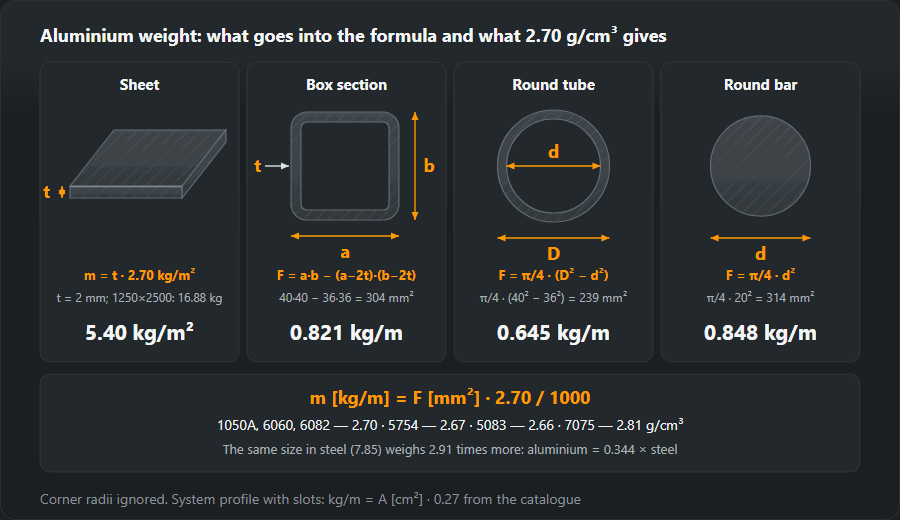
Mass per square metre of aluminium sheet is thickness in millimetres
times 2.70 kg. For sections and bars the same formula applies as
for steel, with the other density: m = F · 2.70 / 1000 kilograms
per metre with cross-sectional area F in mm².
How to calculate aluminium weight: formula and examples
Aluminium weight is worked out exactly as for steel, only with a different density: mass per metre = cross-sectional area in mm² × 2.70 / 1000 kilograms, and for sheet, thickness in mm × 2.70 kg/m². Four examples from everyday orders:
- 2 mm sheet, 1250×2500: 3.125 m² × 5.40 kg/m² = 16.88 kg — one person can carry it, awkwardly.
- 40×40×2 box section: 40·40 − 36·36 = 304 mm² → 0.821 kg/m, a 6 m length about 4.9 kg.
- 40×2 round tube: π/4·(40² − 36²) = 239 mm² → 0.645 kg/m.
- Ø20 round bar: π/4·20² = 314 mm² → 0.848 kg/m.
The steel conversion works both ways: aluminium weighs 0.344 of steel of the same size, steel 2.91 times as much. If you know the mass of a steel section from a table, multiply by 0.344 and you have aluminium of exactly the same cross-section.

Aluminium stock sizes: weight per metre
The most commonly bought sizes of every shape in one table. Masses come from the cross-section and a density of 2.70 g/cm³, without corner radii — the same way the calculator above works.
| Product | Size, mm | kg/m (sheet: kg/m²) | 6 m length, kg |
|---|---|---|---|
| Sheet | 1 | 2.70 | — |
| Sheet | 2 | 5.40 | — |
| Sheet | 3 | 8.10 | — |
| Box section | 20×20×2 | 0.39 | 2.33 |
| Box section | 40×40×2 | 0.82 | 4.92 |
| Box section | 60×40×3 | 1.52 | 9.14 |
| Round tube | 20×2 | 0.31 | 1.83 |
| Round tube | 40×2 | 0.64 | 3.87 |
| Round tube | 50×3 | 1.20 | 7.18 |
| Angle | 20×20×2 | 0.21 | 1.23 |
| Angle | 40×40×3 | 0.62 | 3.74 |
| Flat bar | 20×3 | 0.16 | 0.97 |
| Flat bar | 40×4 | 0.43 | 2.59 |
| Round bar | 10 | 0.21 | 1.27 |
| Round bar | 20 | 0.85 | 5.09 |
Each shape also has its own page with a full size table: aluminium box section, aluminium tube and aluminium sheet with a sheet count conversion — the full list is at the bottom of the page.
Density of aluminium alloys
| Alloy | Typical use | ρ, g/cm³ | 1 m² × 1 mm |
|---|---|---|---|
| 1050A | Commercially pure aluminium, sheet, cladding | 2.70 | 2.70 kg |
| 3003 | Pressed sheet, heat exchangers | 2.73 | 2.73 kg |
| 5083 | Welded structures, tanks, boat hulls | 2.66 | 2.66 kg |
| 5754 | Structural sheet, corrosion resistance | 2.67 | 2.67 kg |
| 6060 | Extruded profiles, light structures | 2.70 | 2.70 kg |
| 6082 | Structural profiles and plate, higher strength | 2.70 | 2.70 kg |
| 7075 | Aerospace, loaded parts, not weldable | 2.81 | 2.81 kg |
How much the alloy changes the weight shows best on one 1500×3000×5 sheet: in 5083 it weighs 59.85 kg, in 6082 60.75 kg, in 7075 63.23 kg — 4.1 % more than at 2.70. For quoting and haulage 2.70 is plenty; the difference only matters on large 7075 runs or when settling by the kilogram.
Aluminium sheet weight: table by thickness and sheet size
Aluminium sheet weight comes from its area: length (m) × width (m) × thickness (mm) × 2.70 kilograms. For example, a 1500×3000 mm sheet 3 mm thick is 4.5 m² × 8.10 kg/m², about 36.5 kg. For the usual sheet sizes the weight is already in the table below, and the calculator above works out any size and number of sheets.
| Thickness, mm | 1 m², kg | 1000×2000, kg | 1250×2500, kg | Steel of same thickness, kg/m² |
|---|---|---|---|---|
| 0.5 | 1.35 | 2.7 | 4.2 | 3.9 |
| 0.8 | 2.16 | 4.3 | 6.8 | 6.3 |
| 1.0 | 2.70 | 5.4 | 8.4 | 7.9 |
| 1.5 | 4.05 | 8.1 | 12.7 | 11.8 |
| 2.0 | 5.40 | 10.8 | 16.9 | 15.7 |
| 3.0 | 8.10 | 16.2 | 25.3 | 23.6 |
| 4.0 | 10.80 | 21.6 | 33.8 | 31.4 |
| 5.0 | 13.50 | 27.0 | 42.2 | 39.3 |
| 6.0 | 16.20 | 32.4 | 50.6 | 47.1 |
| 8.0 | 21.60 | 43.2 | 67.5 | 62.8 |
| 10 | 27.00 | 54.0 | 84.4 | 78.5 |
| 12 | 32.40 | 64.8 | 101.3 | 94.2 |
| 15 | 40.50 | 81.0 | 126.6 | 117.8 |
| 20 | 54.00 | 108.0 | 168.8 | 157.0 |
Aluminium extrusions: weight from the catalogue, and why there is no strength here
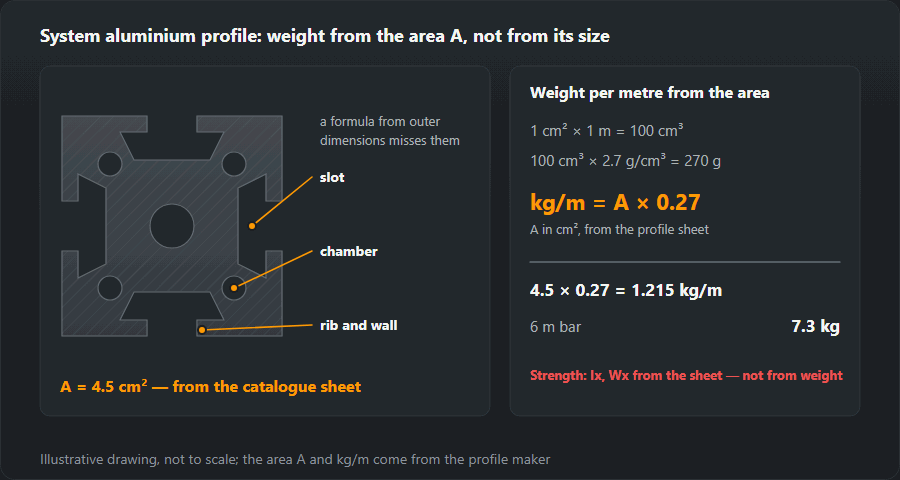
This aluminium weight calculator handles shapes with a regular cross-section: tube, box section, angle, flat bar, round bar and sheet. System profiles — slotted framing, window and curtain-wall sections — have chambers, slots and ribs that no formula based on outside dimensions can capture. They are extruded to each producer's own catalogue, so there is no aluminium counterpart of the IPE or UPN tables.
For those, weight comes from the cross-sectional area A on the data sheet: kg/m = A[cm²] × 0.27 (1 cm² × 1 m is 100 cm³, and 100 cm³ of aluminium weighs 270 g). A profile of 4.5 cm² therefore weighs 1.215 kg/m, a 6 m length 7.3 kg. If the catalogue gives mass per metre directly, use that.
Strength is a separate calculation. Whether a profile will carry the load does not follow from its weight. You need the second moment of area Ix (deflection) and the section modulus Wx (stress) — both on the data sheet — and the load case. Aluminium structures are designed to EN 1999-1-1 (Eurocode 9); welded load-bearing members must allow for the softened heat-affected zone, so they need a structural engineer, not a weight calculator.

Common mistakes when working out aluminium weight
- Steel density out of habit. A calculator left on steel gives an answer 2.91 times too high — check the material field.
- Box section formula for a system profile. A slotted 40×40 framing profile weighs nothing like a 40×40×2 tube — take A from the catalogue.
- 7075 "like any alloy". The zinc-bearing alloy is 4.1 % heavier than 2.70; on a tonne of plate that is 41 kg.
- Bore instead of outside diameter. A 40×2 tube is 40 mm outside; the same trap is covered in the steel tube weight calculator.
- Comparing with steel at equal load. An aluminium structure needs a bigger section, so the weight saving is less than 2.9 times — see the questions at the bottom of the page.
Why less mass does not mean easier work
Aluminium weighs 2.9 times less than steel but welds nothing like it, and the lightness can mislead. Three things change straight away:
Thermal conductivity is about four times that of steel. Heat leaves the pool immediately, so you start with more current than on steel of the same thickness — and the longer welding goes on, the hotter the part gets and the more the current has to come down. That is the opposite of the habits built on steel.
The oxide layer, Al₂O₃, melts at around 2050 °C while the aluminium beneath melts at 660 °C. Without removing the oxide with a stainless brush and breaking it up with the arc (AC in TIG, positive electrode in MIG) the weld comes out with inclusions whatever the settings.
No colour change before melting: aluminium does not glow red and does not warn you that it is about to collapse. Telling "still cold" from "already burnt through" comes from practice, not from watching the colour.
The full procedure is in welding aluminium; the mass of steel products in the metal weight calculator and the sheet metal weight calculator.
A calculator for each shape
This calculator does every shape, but when you already know what you came for it is quicker to open the page for that shape: it starts on it and carries a table of the common sizes.
| Calculator | What it works out |
|---|---|
| Aluminium sheet | The weight of aluminium sheet from 1 to 10 mm thick: kilograms per square metre, cross-section and a calculator for any sheet size. |
| Aluminium box section | The weight of aluminium box section: twelve common sizes from 15×15×2 to 80×80×4 with the mass per metre and a calculator for any section. |
| Aluminium tube | The weight of round aluminium tube from 12×1 to 80×3: cross-section, kilograms per metre and a calculator for any diameter and wall. |
| Aluminium angle | The weight of aluminium angle from 15×15×2 to 80×80×6: cross-section, kilograms per metre and a calculator for any leg and thickness. |
| Aluminium flat bar | The weight of aluminium flat bar from 15×2 to 100×10: cross-section, kilograms per metre and a calculator for any width and thickness. |
| Aluminium round bar | The weight of aluminium round bar from 6 to 50 mm: cross-section, kilograms per metre and a calculator for any diameter. |
Frequently asked questions
How much does 2 mm aluminium sheet weigh per square metre?
5.4 kg. The rule is the same as for steel, only the multiplier changes: mass per square metre is the thickness in millimetres times 2.70 kg.
How much lighter than steel is aluminium?
2.9 times, at equal cross-section: 2.70 against 7.85 g/cm³. At equal load capacity the gap is smaller, because an aluminium structure needs a larger section — in practice the saving works out at around half, not two thirds.
Does density depend on the alloy?
Only slightly. 1050A (commercially pure) is 2.70 g/cm³, 6060 and 6082 are 2.70, 5754 is 2.67, 5083 is 2.66, and zinc-bearing 7075 is 2.81. The spread between the lightest and the heaviest structural alloy is about 5 %, so 2.70 is enough for an estimate; for the exact mass of a large structure take the figure for the actual alloy.
How much does a metre of 40×40×2 aluminium box section weigh?
0.821 kg/m, so about 4.9 kg for a 6 m length. The cross-section is 1600 − 1296 = 304 mm², times 2.70/1000. A 60×40×3 weighs 1.523 kg/m and a 20×20×2 0.389 kg/m. These ignore the corner radii; a real extrusion can be slightly lighter.
How do I find the weight of an aluminium profile with an odd cross-section?
From the cross-sectional area in the extruder's catalogue: kg/m = A[cm²] × 0.27. A profile of 4.5 cm² weighs 1.215 kg/m, one of 2.4 cm² 0.648 kg/m. A shape with slots and chambers cannot sensibly be worked out from its outside dimensions.
Is there an aluminium profile strength calculator here?
No — this page works out weight, not load capacity. Strength needs the second moment of area Ix and the section modulus Wx from the profile data sheet, and aluminium structures are designed to EN 1999-1-1 (Eurocode 9). For load-bearing members, get a structural engineer to do the calculation.
How much does a 1250×2500 aluminium sheet weigh?
The sheet area is 3.125 m², so weight = 3.125 × thickness in mm × 2.70. A 1 mm sheet weighs about 8.4 kg, 2 mm 16.9 kg, 3 mm 25.3 kg and 5 mm 42.2 kg (table above). For another size multiply the area in m² by the mass per square metre; the alloy shifts the result by 5 % at most.
Updated: