Sheet metal weight calculator
Thickness, sheet size and quantity — the mass of one sheet, of the whole batch and of a square metre. For steel, stainless, aluminium and the rest; density follows from the material you choose.
Short answer
Mass per square metre of steel sheet is thickness in millimetres
times 7.85 kg. The mass of a sheet is that figure times its area
in square metres. The whole calculation fits on one line:
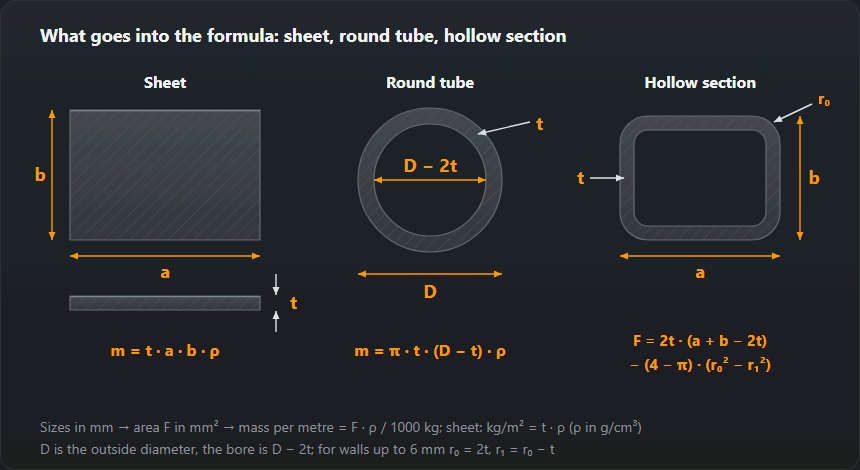
m = t · 7.85 · a · b, with t in mm and a
and b in metres.
Steel, kg/m²: 1 mm — 7.85 · 2 mm — 15.70 · 3 mm — 23.55 · 4 mm — 31.40 · 5 mm — 39.25 · 6 mm — 47.10 · 8 mm — 62.80 · 10 mm — 78.50. The full 0.5–40 mm range and sheet sizes are in the table; aluminium and stainless below.
The "width" field is the sheet width, "length" its other edge in metres. For a 1250×2500 sheet enter width 1250 and length 2.5.
Sheet metal weight per m² (kg/m²): steel table and standard sheet sizes
| Thickness, mm | 1 m², kg | 1000×2000, kg | 1250×2500, kg | 1500×3000, kg | 1500×6000, kg |
|---|---|---|---|---|---|
| 0.5 | 3.9 | 7.8 | 12.3 | 17.7 | 35.3 |
| 0.8 | 6.3 | 12.6 | 19.6 | 28.3 | 56.5 |
| 1.0 | 7.9 | 15.7 | 24.5 | 35.3 | 70.7 |
| 1.5 | 11.8 | 23.6 | 36.8 | 53.0 | 106.0 |
| 2.0 | 15.7 | 31.4 | 49.1 | 70.7 | 141.3 |
| 2.5 | 19.6 | 39.3 | 61.3 | 88.3 | 176.6 |
| 3.0 | 23.6 | 47.1 | 73.6 | 106.0 | 211.9 |
| 4.0 | 31.4 | 62.8 | 98.1 | 141.3 | 282.6 |
| 5.0 | 39.3 | 78.5 | 122.7 | 176.6 | 353.3 |
| 6.0 | 47.1 | 94.2 | 147.2 | 211.9 | 423.9 |
| 8.0 | 62.8 | 125.6 | 196.3 | 282.6 | 565.2 |
| 10 | 78.5 | 157.0 | 245.3 | 353.3 | 706.5 |
| 12 | 94.2 | 188.4 | 294.4 | 423.9 | 847.8 |
| 15 | 117.8 | 235.5 | 368.0 | 529.9 | 1059.8 |
| 20 | 157.0 | 314.0 | 490.6 | 706.5 | 1413.0 |
| 25 | 196.3 | 392.5 | 613.3 | 883.1 | 1766.3 |
| 30 | 235.5 | 471.0 | 735.9 | 1059.8 | 2119.5 |
| 40 | 314.0 | 628.0 | 981.3 | 1413.0 | 2826.0 |
1000×2000 and 1250×2500 are the thin sheets, usually cold rolled; 1500×3000 and 1500×6000 are hot rolled plate from 3 mm upwards. Thickness tolerance is set by EN 10051 for hot-rolled strip and EN 10131 for cold-rolled: on thin sheet the deviation reaches several per cent of the mass, so a weighed sheet rarely comes to exactly what the table says.

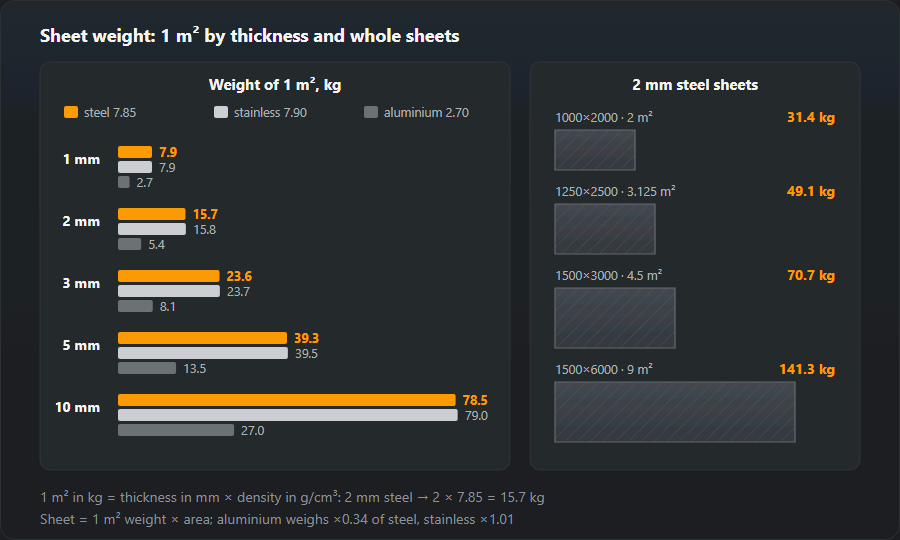
How much does a 1250×2500, 1500×3000 or 1000×2000 mm sheet weigh
Steel, mass of one sheet by thickness (the same figures the calculator above gives):
- 1250×2500: 1 mm — 24.5 kg · 2 mm — 49.1 kg · 3 mm — 73.6 kg · 4 mm — 98.1 kg · 5 mm — 122.7 kg · 6 mm — 147.2 kg · 8 mm — 196.3 kg · 10 mm — 245.3 kg
- 1500×3000: 1 mm — 35.3 kg · 2 mm — 70.7 kg · 3 mm — 106.0 kg · 4 mm — 141.3 kg · 5 mm — 176.6 kg · 6 mm — 211.9 kg · 8 mm — 282.6 kg · 10 mm — 353.3 kg
- 1000×2000: 1 mm — 15.7 kg · 2 mm — 31.4 kg · 3 mm — 47.1 kg · 4 mm — 62.8 kg · 5 mm — 78.5 kg · 6 mm — 94.2 kg · 8 mm — 125.6 kg · 10 mm — 157.0 kg
How to calculate sheet metal weight: formula and worked examples
The whole calculation rests on one relation: thickness in millimetres times density in g/cm³ gives the mass of a square metre in kilograms. A square metre of 1 mm sheet is exactly one cubic decimetre of metal, and a cubic decimetre of steel weighs 7.85 kg. That is why the multiplier never changes for steel, and for stainless or aluminium only the density does.
Example 1 — a single sheet. 1250×2500×3. Area 1.25 × 2.5 = 3.125 m², mass per square metre 3 × 7.85 = 23.55 kg/m², sheet 3.125 × 23.55 = 73.6 kg. That is 3 mm sheet weight for a two-person lift onto the guillotine; three of them on a trolley are already over 220 kg.
Example 2 — a batch for an order. 12 sheets of 1500×3000×6. One sheet: 4.5 m² × 47.1 kg/m² = 211.9 kg, the whole pack 2543.4 kg. For delivery that means a crane lorry or offloading by overhead crane; for storage, a cantilever rack arm rated above 2.5 t.
Example 3 — a part cut from sheet. A 600×400×8 plate: 0.24 m² × 62.8 kg/m² = 15.07 kg. That is how a blank is priced for laser cutting: first the rectangle the part fits in, then any holes are taken off.
Example 4 — a flange. A Ø300 disc in 10 mm plate weighs π/4 × 0.3² × 78.5 = 5.55 kg, and 4.93 kg with a Ø100 bore. The 300×300 square it is cut from weighs 7.07 kg: 2.1 kg goes in the scrap bin, but you pay for it, because plate is bought by weight.

Converting kilograms, square metres and sheets
Stockholders sell sheet by weight, while drawings call for square metres or a number of sheets. The table converts both ways: the second column is kg/m², the third how many square metres a tonne covers, the rest how many sheets of each size make a tonne.
| Thickness, mm | kg/m² | m² per tonne | 1000×2000 sheets per tonne | 1250×2500 sheets per tonne | 1500×3000 sheets per tonne |
|---|---|---|---|---|---|
| 0.5 | 3.93 | 254.8 | 127.4 | 81.5 | 56.6 |
| 0.8 | 6.28 | 159.2 | 79.6 | 51.0 | 35.4 |
| 1 | 7.85 | 127.4 | 63.7 | 40.8 | 28.3 |
| 1.5 | 11.77 | 84.9 | 42.5 | 27.2 | 18.9 |
| 2 | 15.70 | 63.7 | 31.8 | 20.4 | 14.2 |
| 2.5 | 19.63 | 51.0 | 25.5 | 16.3 | 11.3 |
| 3 | 23.55 | 42.5 | 21.2 | 13.6 | 9.4 |
| 4 | 31.40 | 31.8 | 15.9 | 10.2 | 7.1 |
| 5 | 39.25 | 25.5 | 12.7 | 8.2 | 5.7 |
| 6 | 47.10 | 21.2 | 10.6 | 6.8 | 4.7 |
| 8 | 62.80 | 15.9 | 8.0 | 5.1 | 3.5 |
| 10 | 78.50 | 12.7 | 6.4 | 4.1 | 2.8 |
From square metres to kilograms and sheets. A cladding job needs 40 m² of 2 mm sheet: 40 × 15.7 = 628 kg. In 1250×2500 sheets that is 40 / 3.125 = 12.8, so 13 sheets — in practice 14, because nesting rarely comes out without offcuts.
From a tonne to square metres. The stockholder has a 1 t pack of 1.5 mm sheet. That is 84.9 m², or 27.2 sheets of 1250×2500 — read straight off the 1.5 row. Dividing 1000 by the mass per square metre (11.77 kg/m²) gives the same.
Galvanised sheet. A Z275 coating to EN 10346 is 275 g of zinc per square metre, both sides together. It adds 0.275 kg/m² to 1 mm sheet (+3.5 %) and already +7.0 % to 0.5 mm. You will not notice it on one sheet, but you will on a lorry-load of roofing.
Other materials
Just change the multiplier. Mass per square metre at 1 mm thickness is as many kilograms as the density in g/cm³:
| Material | ρ, g/cm³ | 1 m², 1 mm | Relative to steel |
|---|---|---|---|
| Structural steel | 7.85 | 7.85 kg | 1.00 |
| Stainless steel 304 / 316 | 7.90 | 7.90 kg | 1.01 |
| Cast iron | 7.20 | 7.20 kg | 0.92 |
| Copper | 8.96 | 8.96 kg | 1.14 |
| Brass | 8.50 | 8.50 kg | 1.08 |
| Titanium | 4.51 | 4.51 kg | 0.57 |
| Aluminium | 2.70 | 2.70 kg | 0.34 |
Aluminium and stainless sheet weight by thickness
Stainless 304 and 316 is taken here at 7.90 g/cm³ and weighs only 0.6 % more than mild steel: a 1250×2500×2 stainless sheet is 49.4 kg against 49.1 kg in steel. Aluminium is 2.91 times lighter — the same sheet weighs 16.9 kg.
| Thickness, mm | Structural steel, kg/m² | Stainless steel 304 / 316, kg/m² | Aluminium, kg/m² |
|---|---|---|---|
| 0.5 | 3.93 | 3.95 | 1.35 |
| 0.8 | 6.28 | 6.32 | 2.16 |
| 1 | 7.85 | 7.90 | 2.70 |
| 1.5 | 11.77 | 11.85 | 4.05 |
| 2 | 15.70 | 15.80 | 5.40 |
| 2.5 | 19.63 | 19.75 | 6.75 |
| 3 | 23.55 | 23.70 | 8.10 |
| 4 | 31.40 | 31.60 | 10.80 |
| 5 | 39.25 | 39.50 | 13.50 |
| 6 | 47.10 | 47.40 | 16.20 |
| 8 | 62.80 | 63.20 | 21.60 |
| 10 | 78.50 | 79.00 | 27.00 |
Aluminium sheet sizes with a square-metre conversion are on the aluminium sheet weight calculator. If the stainless sheet is to be welded afterwards, settings and filler choice are in welding stainless steel.
Tread plate and perforated sheet
Perforated sheet weighs the same as plain sheet multiplied by
(1 − open area). The open area is pure geometry: for round holes staggered at
60° (designation Rv) it is 90.69·(d/p)² %, for straight rows (Rg)
78.54·(d/p)² %, where d is the hole diameter and p the pitch
between centres.
| Pattern | Hole d, mm | Pitch p, mm | Open area, % | Steel 1 mm, kg/m² | Steel 2 mm, kg/m² |
|---|---|---|---|---|---|
| Rv 2-3.5 | 2 | 3.5 | 29.6 | 5.53 | 11.05 |
| Rv 3-5 | 3 | 5 | 32.6 | 5.29 | 10.57 |
| Rv 5-8 | 5 | 8 | 35.4 | 5.07 | 10.14 |
| Rv 8-12 | 8 | 12 | 40.3 | 4.69 | 9.37 |
| Rv 10-14 | 10 | 14 | 46.3 | 4.22 | 8.44 |
| Rg 5-8 | 5 | 8 | 30.7 | 5.44 | 10.88 |
| Rg 10-15 | 10 | 15 | 34.9 | 5.11 | 10.22 |
Example: a 1250×2500×2 sheet perforated Rv 5-8. Plain, it weighs 49.1 kg; the open area is 35.4 %, so perforated it weighs 31.7 kg. Sheets usually keep plain margins along the edges: work their area out as plain sheet and add it on. Expanded metal is a different product — it is slit and stretched from a solid sheet, and its weight per square metre comes from the catalogue.
Tread plate (chequer plate, teardrop or diamond pattern) is described by two figures — base thickness and height over the raised pattern, for example 5/7. Its weight lies between 5 mm plate (39.25 kg/m²) and solid 7 mm plate (54.95 kg/m²); the exact figure for a given pattern is in the mill's catalogue. For booking transport and for floor loading, use the upper bound.
Common mistakes in sheet weight calculations
- Millimetres in the length field. The calculator expects length in metres: a 1250×2500 sheet is width 1250 and length 2.5, not 2500 — otherwise the answer is a thousand times too big.
- Thickness in centimetres. Typing 0.3 instead of 3 mm gives 2.355 instead of 23.55 kg/m² — ten times too little. The "thickness × 7.85" rule catches it at a glance.
- The wrong size. 1500×3000 is 4.5 m², 1500×6000 is 9 m². "A 1500 sheet" with no second dimension can double the weight of a delivery.
- Nominal instead of actual thickness. The thickness tolerance works both ways, so a weighed sheet rarely matches the table to the kilogram. Invoices go by the weighbridge; the table is for planning.
- Forgetting the zinc on thin sheet. On 0.5 mm a Z275 coating adds 7.0 %.
- Perforated sheet counted as plain. With Rv 5-8 more than a third of the mass would be extra; cutting quotes and haulage use the perforated weight.
If sheet is just one line of a larger cutting list, the bill of materials adds it up with the sections, a cutting allowance and the price, and tubes and hollow sections go through the tube and hollow section weight calculator.
What sheet mass tells the welder
Sheet thickness decides everything that follows: electrode diameter, current, whether preparation is needed and whether it can be welded at all without burning through. Sheet up to 2 mm is short-arc and stitch-weld work; from 3 to about 10 mm a normal weld with no preparation or a single bevel; thicker plate takes several layers with heat input under control.
Sheet mass is at the same time the question of how to lift and turn it. A 1500×3000 sheet 6 mm thick weighs 212 kg — that is slings and magnetic lifters, not hands. The same sheet at 10 mm is 353 kg, so the station has to be laid out to avoid moving it a second time.
Setting parameters by thickness — welding current calculator; thin sheet without burn-through — welding thin sheet; the mass of sections and bars — metal weight calculator.
Two typical jobs where this weight matters are a barbecue firebox and a sheet rack — see barbecues and stoves and storage and handling.
Frequently asked questions
How much does 1 mm sheet weigh per square metre?
7.85 kg. Hence the rule you can do in your head: mass per square metre in kilograms is the thickness in millimetres times 7.85. 3 mm sheet — 23.6 kg/m², 5 mm — 39.3 kg/m², 10 mm — 78.5 kg/m².
How much does a 1250×2500 sheet 4 mm thick weigh?
98 kg. The sheet is 3.125 m², so 4 × 7.85 × 3.125 = 98.1 kg. That is about the limit above which two people no longer carry a sheet.
What do stainless and aluminium sheet of the same thickness weigh?
Austenitic stainless (304, 316) has a density of 7.90 g/cm³, practically the same as structural steel — under one per cent apart. Aluminium is 2.70 g/cm³: aluminium sheet weighs 2.9 times less than steel of the same thickness.
How many sheets are there in a tonne?
Divide 1000 kg by the mass of one sheet. A 2 mm sheet in 1250×2500 weighs 49.1 kg, so a tonne is 1000 / 49.1 = 20.4 sheets; at 3 mm it is 13.6, at 1 mm 40.8. A tonne of 1.5 mm sheet covers 84.9 m², or 27.2 sheets of 1250×2500. All three standard sizes are in the conversion table on this page.
How much does galvanised sheet weigh?
The same as black sheet of that thickness plus the zinc. A Z275 coating to EN 10346 is 275 g of zinc per square metre, both sides together, so +0.275 kg/m². A 1 mm sheet comes to 8.13 kg/m² instead of 7.85 (+3.5 %), a 0.5 mm sheet to 7.0 % more than black. On heavy plate the coating can be ignored.
How do I work out the weight of perforated sheet?
Multiply the plain sheet mass by (1 − open area). For round holes staggered at 60° the open area is 90.69·(d/p)² %, where d is the hole diameter and p the pitch. Rv 5-8 is 35.4 % open, so a 1250×2500×2 sheet weighs 31.7 kg instead of 49.1 kg. Unperforated margins add mass back — count them as plain sheet.
Updated: