Steel flat bar weight calculator
A 40×4 steel flat bar weighs 1.256 kg/m, 50×5 1.96 and 100×10 7.85 kg/m; a 6 m length of 40×4 is 7.54 kg. Below: a chart of 52 sizes from 20×3 to 200×20 (hot rolled to EN 10058 and bright drawn to EN 10278), metres per tonne and a calculator for any size.
Short answer
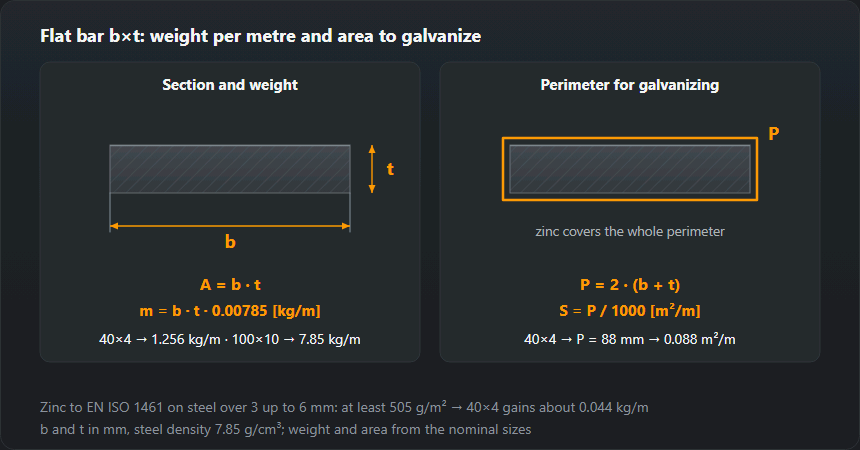
Flat bar weight is width × thickness (mm) × 7.85 / 1000 kg/m, i.e. 0.00785·b·t. A 30×4 flat weighs 0.942 kg/m, 40×5 1.570 and 60×6 2.826 kg/m; a 6 m length of 50×5 is 11.77 kg. A tonne of 40×4 is about 796 m. The size chart is below.

Steel flat bar weight chart: 20×3 to 200×20
The sizes stockholders sell most. Weights are worked out from the nominal size and a steel density of 7.85 g/cm³ — exactly as the calculator above does, so the two always agree.
| Size b×t, mm | Cross-section, mm² | Weight, kg/m | 6 m bar, kg | Metres per tonne |
|---|---|---|---|---|
| 20×3 | 60 | 0.471 | 2.83 | 2 123.1 |
| 20×4 | 80 | 0.628 | 3.77 | 1 592.4 |
| 20×5 | 100 | 0.785 | 4.71 | 1 273.9 |
| 25×3 | 75 | 0.589 | 3.53 | 1 698.5 |
| 25×4 | 100 | 0.785 | 4.71 | 1 273.9 |
| 25×5 | 125 | 0.981 | 5.89 | 1 019.1 |
| 30×3 | 90 | 0.707 | 4.24 | 1 415.4 |
| 30×4 | 120 | 0.942 | 5.65 | 1 061.6 |
| 30×5 | 150 | 1.178 | 7.06 | 849.3 |
| 30×6 | 180 | 1.413 | 8.48 | 707.7 |
| 35×5 | 175 | 1.374 | 8.24 | 727.9 |
| 40×4 | 160 | 1.256 | 7.54 | 796.2 |
| 40×5 | 200 | 1.570 | 9.42 | 636.9 |
| 40×6 | 240 | 1.884 | 11.30 | 530.8 |
| 40×8 | 320 | 2.512 | 15.07 | 398.1 |
| 40×10 | 400 | 3.140 | 18.84 | 318.5 |
| 45×5 | 225 | 1.766 | 10.60 | 566.2 |
| 50×5 | 250 | 1.963 | 11.77 | 509.6 |
| 50×6 | 300 | 2.355 | 14.13 | 424.6 |
| 50×8 | 400 | 3.140 | 18.84 | 318.5 |
| 50×10 | 500 | 3.925 | 23.55 | 254.8 |
| 60×5 | 300 | 2.355 | 14.13 | 424.6 |
| 60×6 | 360 | 2.826 | 16.96 | 353.9 |
| 60×8 | 480 | 3.768 | 22.61 | 265.4 |
| 60×10 | 600 | 4.710 | 28.26 | 212.3 |
| 70×6 | 420 | 3.297 | 19.78 | 303.3 |
| 70×10 | 700 | 5.495 | 32.97 | 182.0 |
| 80×6 | 480 | 3.768 | 22.61 | 265.4 |
| 80×8 | 640 | 5.024 | 30.14 | 199.0 |
| 80×10 | 800 | 6.280 | 37.68 | 159.2 |
| 90×10 | 900 | 7.065 | 42.39 | 141.5 |
| 100×5 | 500 | 3.925 | 23.55 | 254.8 |
| 100×6 | 600 | 4.710 | 28.26 | 212.3 |
| 100×8 | 800 | 6.280 | 37.68 | 159.2 |
| 100×10 | 1 000 | 7.850 | 47.10 | 127.4 |
| 100×12 | 1 200 | 9.420 | 56.52 | 106.2 |
| 100×15 | 1 500 | 11.775 | 70.65 | 84.9 |
| 100×20 | 2 000 | 15.700 | 94.20 | 63.7 |
| 120×8 | 960 | 7.536 | 45.22 | 132.7 |
| 120×10 | 1 200 | 9.420 | 56.52 | 106.2 |
| 120×12 | 1 440 | 11.304 | 67.82 | 88.5 |
| 140×10 | 1 400 | 10.990 | 65.94 | 91.0 |
| 150×10 | 1 500 | 11.775 | 70.65 | 84.9 |
| 150×12 | 1 800 | 14.130 | 84.78 | 70.8 |
| 150×15 | 2 250 | 17.663 | 105.98 | 56.6 |
| 150×20 | 3 000 | 23.550 | 141.30 | 42.5 |
| 160×10 | 1 600 | 12.560 | 75.36 | 79.6 |
| 180×10 | 1 800 | 14.130 | 84.78 | 70.8 |
| 200×10 | 2 000 | 15.700 | 94.20 | 63.7 |
| 200×12 | 2 400 | 18.840 | 113.04 | 53.1 |
| 200×15 | 3 000 | 23.550 | 141.30 | 42.5 |
| 200×20 | 4 000 | 31.400 | 188.40 | 31.8 |
Hot rolled flats usually come in 6 m lengths, less often 3 or 12 m. EN 10058:2018 treats the wide flats of 160–200 mm as a separate group, but the weight is worked out the same way.
kg/m chart for every width and thickness
If your size is not in the chart above, read it off this grid: the row is the width, the column is the thickness.
| b \ t, mm | 3 | 4 | 5 | 6 | 8 | 10 | 12 | 15 | 20 |
|---|---|---|---|---|---|---|---|---|---|
| 20 | 0.47 | 0.63 | 0.79 | 0.94 | 1.26 | 1.57 | — | — | — |
| 25 | 0.59 | 0.79 | 0.98 | 1.18 | 1.57 | 1.96 | 2.36 | — | — |
| 30 | 0.71 | 0.94 | 1.18 | 1.41 | 1.88 | 2.36 | 2.83 | 3.53 | — |
| 40 | 0.94 | 1.26 | 1.57 | 1.88 | 2.51 | 3.14 | 3.77 | 4.71 | 6.28 |
| 50 | 1.18 | 1.57 | 1.96 | 2.36 | 3.14 | 3.93 | 4.71 | 5.89 | 7.85 |
| 60 | 1.41 | 1.88 | 2.36 | 2.83 | 3.77 | 4.71 | 5.65 | 7.07 | 9.42 |
| 80 | 1.88 | 2.51 | 3.14 | 3.77 | 5.02 | 6.28 | 7.54 | 9.42 | 12.56 |
| 100 | 2.36 | 3.14 | 3.93 | 4.71 | 6.28 | 7.85 | 9.42 | 11.78 | 15.70 |
| 120 | 2.83 | 3.77 | 4.71 | 5.65 | 7.54 | 9.42 | 11.30 | 14.13 | 18.84 |
| 150 | 3.53 | 4.71 | 5.89 | 7.07 | 9.42 | 11.78 | 14.13 | 17.66 | 23.55 |
| 200 | 4.71 | 6.28 | 7.85 | 9.42 | 12.56 | 15.70 | 18.84 | 23.55 | 31.40 |
Weight is linear in each dimension: an 80×8 flat weighs twice as much as 40×8 and twice as much as 80×4 (5.02 against 2.51 kg/m).
How many metres of flat bar in a tonne
Metres per tonne is 1000 divided by the weight per metre, i.e. 127 389 / (b·t). A tonne of 20×3 is 2 123 m, 30×4 1 062 m, 40×4 796 m, 50×5 510 m and 100×10 only 127 m.
Ordering example: a gate and two fence panels need 14 m of 40×4. That is 17.6 kg, but the stockholder sells whole lengths: 3 × 6 m = 22.6 kg. At a price per kilo you pay for the second figure; the 4 m offcut goes on small parts.
The formula and where the figure comes from
A flat bar section is a rectangle: area = b · t. For 40×4 that is 160 mm², times 7.85 / 1000 = 1.256 kg/m. The 7.85 g/cm³ density is used for all non-alloy steels, from S235JR to C45 — the differences between grades are smaller than the size tolerances.
Hot rolled (EN 10058) or bright drawn (EN 10278)? For the same nominal size the weight is the same. Bright (cold drawn) flat has a smooth surface, sharp corners and a tight tolerance, usually h11; hot rolled flat has slightly rounded edges and mill scale. The rounded edges take off a fraction of a percent, while the actual thickness of hot rolled bar can stray further from nominal — which is where the gap between the chart and the weighbridge comes from.
Galvanized flat bar and earthing tape
Hot-dip galvanized flat — for example 30×4 or 40×4 earthing tape — is heavier by the weight of the zinc. EN ISO 1461 requires a mean coating of at least 55 µm (395 g/m²) on steel up to 3 mm, 70 µm (505 g/m²) on steel over 3 up to 6 mm and 85 µm (610 g/m²) over 6 mm. Zinc is counted on the perimeter: one metre of 30×4 has 0.068 m² of surface.
| Size b×t, mm | Black, kg/m | Zinc min., kg/m | Galvanized, kg/m | Increase, % |
|---|---|---|---|---|
| 25×4 | 0.785 | 0.029 | 0.814 | 3.7 |
| 30×3 | 0.707 | 0.026 | 0.733 | 3.7 |
| 30×4 | 0.942 | 0.034 | 0.976 | 3.6 |
| 40×4 | 1.256 | 0.044 | 1.300 | 3.5 |
| 40×5 | 1.570 | 0.045 | 1.615 | 2.9 |
| 50×5 | 1.963 | 0.056 | 2.018 | 2.8 |
These are minimums — in practice the coating is often thicker. To estimate a delivery, add 2.8–3.7 % to the black bar weight; that is what the standard’s minimum gives for the sizes in the chart.
Other steel weight calculators
The same flat bar in aluminium — aluminium flat bar calculator; other shapes and metals (round bar, tube, sheet, stainless) — general metal weight calculator. How many lengths to order for a cutting list — cutting list calculator.
| Calculator | What it works out |
|---|---|
| Steel weight calculator | Ø12 round bar — 0.888 kg/m, 40×5 flat bar — 1.57 kg/m, 1 mm sheet — 7.85 kg/m². One calculator for every shape and metal: steel, stainless, aluminium, copper, brass. |
| Steel angle weight | L 50×50×5 — 3.77 kg/m, L 100×100×10 — 15.0. Every size to EN 10056-1 with 6 m and 12 m bar weights and a calculator for length and quantity. |
| Sheet metal weight | Steel 1 mm = 7.85 kg/m², 2 mm — 15.7, 5 mm — 39.25. Weight of a 1250×2500 or 1500×3000 sheet and of a whole batch, with worked examples. |
| Tube and hollow section | 40×40×3 hollow section — 3.30 kg/m, 60×40×3 — 4.25, 42.4×3.2 tube — 3.09 kg/m. Enter size and wall for one piece, a batch or a metre; EN 10219 tables and formulas. |
| Aluminium flat bar | The weight of aluminium flat bar from 15×2 to 100×10: cross-section, kilograms per metre and a calculator for any width and thickness. |
| Stainless steel weight | Density of 304 — 7.90 g/cm³, 316L — 8.00. 2 mm sheet 15.80 kg/m², 42.4×2 tube 2.005 kg/m, 40×40×2 box section 2.402 kg/m. Calculator and tables. |
Frequently asked questions
How much does 40×4 steel flat bar weigh?
1.256 kg/m (40 · 4 · 7.85 / 1000). A 6 m length weighs 7.54 kg, and a tonne is about 796 m. 40×5 flat is 1.570 kg/m.
What does a metre of 50×5 and 30×3 flat bar weigh?
50×5: 1.963 kg/m (6 m length 11.77 kg); 30×3: 0.707 kg/m (6 m length 4.24 kg). 100×10 flat weighs 7.85 kg/m.
How many metres of flat bar are in a tonne?
1000 / weight per metre, i.e. 127 389 / (b·t). For 30×4 that is 1 062 m, for 40×4 796 m, for 50×5 510 m and for 60×6 354 m.
Does bright drawn flat weigh the same as hot rolled?
Yes, for the same nominal size: the weight is set by the b·t section and the 7.85 g/cm³ density. Bright flat to EN 10278 only has a tighter tolerance and sharp corners; the weight difference is a fraction of a percent.
How much does 30×4 galvanized earthing tape weigh?
The steel weighs 0.942 kg/m and the zinc, at the EN ISO 1461 minimum of 505 g/m², adds at least 0.034 kg/m — about 3.6 %. In total at least 0.976 kg/m, so 100 m of tape is about 98 kg.
Updated: