Tread plate weight calculator
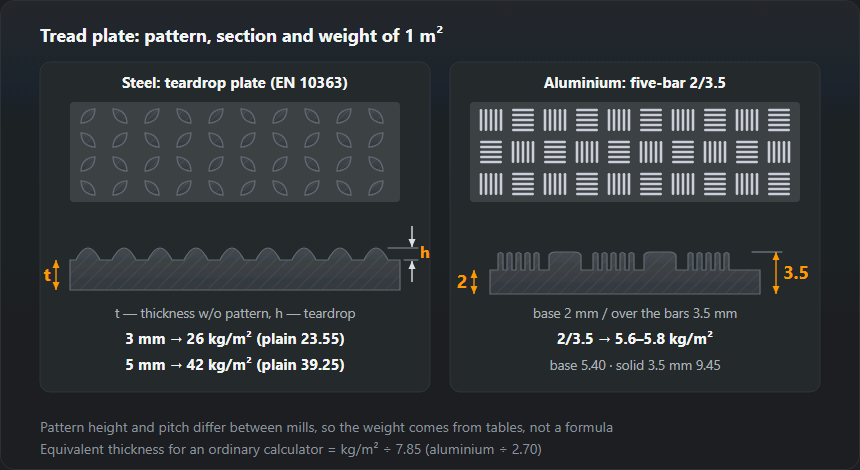
Tread plate cannot be weighed with the plain “thickness × 7.85” formula: the pattern adds ≈ 5.7–10.4 % to the mass, and its height and spacing depend on the mill. So the calculator and tables below take the mass per square metre from stockholders’ tables — for steel teardrop plate to EN 10363 (formerly DIN 59220), and for aluminium five-bar and two-bar plate.
Short answer
Steel teardrop tread plate 3 mm weighs about 26 kg/m² and 5 mm 42 kg/m²: the pattern adds ≈ 5.7–10.4 % to plain plate. A 1250×2500×3 sheet is about 81 kg. Aluminium five-bar 2/3.5 weighs 5.6–5.8 kg/m², a 1250×2500 sheet 17.5–18.1 kg. Full tables are below.
Steel teardrop plate: kg/m² and sheet weights
| Base thickness, mm | Tread plate, kg/m² | Plain plate, kg/m² | Pattern adds, % | 1000×2000 sheet, kg | 1250×2500 sheet, kg | 1500×3000 sheet, kg |
|---|---|---|---|---|---|---|
| 3 | 26 | 23.55 | +10.4 | 52 | 81.3 | 117 |
| 4 | 34 | 31.40 | +8.3 | 68 | 106.3 | 153 |
| 5 | 42 | 39.25 | +7.0 | 84 | 131.3 | 189 |
| 6 | 51 | 47.10 | +8.3 | 102 | 159.4 | 230 |
| 8 | 67 | 62.80 | +6.7 | 134 | 209.4 | 302 |
| 10 | 83 | 78.50 | +5.7 | 166 | 259.4 | 374 |
Two independent stockholders’ tables agree to within 1 kg/m²; a third source, a price list with the mass of a 1000×2000 sheet, gives 26.5 / 34.5 / 42.5 / 50.5 / 66.5 kg/m² for 3–8 mm. The difference is rounding, not a different plate. Galvanised plate is heavier by the zinc coat.
Aluminium tread plate: five-bar and two-bar
| Designation t/T, mm | Pattern | kg/m² | 1000×2000 sheet, kg | 1250×2500 sheet, kg | 1500×3000 sheet, kg |
|---|---|---|---|---|---|
| 1.5/2 | two-bar (duet) | 4.3–4.8 | 8.6–9.6 | 13.4–15.0 | 19.3–21.6 |
| 2/3.5 | five-bar (quintet) | 5.6–5.8 | 11.2–11.6 | 17.5–18.1 | 25.2–26.1 |
| 2.5/4 | five-bar (quintet) | 7.3–7.8 | 14.6–15.6 | 22.8–24.4 | 32.9–35.1 |
| 3/4.5 | five-bar (quintet) | 8.4–9.2 | 16.8–18.4 | 26.3–28.7 | 37.8–41.4 |
| 3.5/5 | five-bar (quintet) | 10.6–11.0 | 21.2–22.0 | 33.1–34.4 | 47.7–49.5 |
| 5/6.5 | five-bar (quintet) | 13.8–14.7 | 27.6–29.4 | 43.1–45.9 | 62.1–66.1 |
The data spread more here than for steel: for the same 3/4.5, three product data sheets give 8.4, 8.7 and 9.2 kg/m². That is why the table and calculator show a range. Price on the upper bound, and take the exact mass from your supplier’s data sheet. Aluminium tread plate is usually 5754 (AlMg3), less often 1050A.

How to handle tread plate in an ordinary calculator
The general sheet metal weight calculator works for plain sheet only. To include the pattern, enter an equivalent thickness — the mass from the table divided by 7.85 (2.70 for aluminium):
- 3 mm teardrop: 26 / 7.85 = 3.31 mm;
- 5 mm teardrop: 42 / 7.85 = 5.35 mm;
- 8 mm teardrop: 67 / 7.85 = 8.54 mm;
- aluminium 2/3.5: 5.8 / 2.70 = 2.15 mm.
Entering the thickness over the pattern is the most common mistake — it overstates the mass by tens of per cent. Plain aluminium sheet is covered on the aluminium sheet weight page.
Where it is used
Steel tread plate goes into platforms, stair treads, trench covers and trailer floors; aluminium tread plate into toolboxes, sill plates and van linings. On stair treads, add the plate mass to the self-weight of the structure and leave the load-bearing calculation to the structural engineer. The weight of the whole frame is in the metal weight calculator, other metals in the copper weight calculator and the calculators section.
Frequently asked questions
How much does 3 mm steel tread plate weigh?
About 26 kg/m² — 10 % more than 3 mm plain plate (23.55 kg/m²). A 1000×2000 sheet weighs 52 kg, 1250×2500 81 kg and 1500×3000 117 kg.
How much does 5 mm steel tread plate weigh?
About 42 kg/m²: a 1000×2000 sheet is 84 kg, 1250×2500 131 kg and 1500×3000 189 kg. Plain 5 mm plate is 39.25 kg/m², so the pattern adds 7 %.
What does 2/3.5 mean on aluminium tread plate?
The first figure is the base thickness without the pattern, the second the thickness measured over the bars. The mass lies between the two bounds but close to the lower one: for 2/3.5 suppliers quote 5.6–5.8 kg/m², against 5.40 kg/m² for the base alone and 9.45 kg/m² for solid 3.5 mm plate.
Is tread plate thickness quoted with or without the pattern?
Without. Steel teardrop plate is designated by its base thickness, and the tears stand above it. That is why “4 mm tread plate” weighs 34 kg/m², like 4.3 mm plain plate — not like plate as thick as the measurement over the tears.
Why does the stockholder’s weight differ from the table?
Stockholders’ tables give theoretical mass, while hot-rolled plate has a thickness tolerance both ways. A real sheet can be a few per cent lighter or heavier — leave a margin when ordering by weight.
Updated: