Copper weight calculator
Copper is weighed exactly like steel, just with a higher density: 8.96 g/cm³, or 8.96 kg for every square metre and millimetre of thickness. Below is a calculator for sheet, round bar, flat bar (busbar) and tube, with tables of common sizes — EN 1057 plumbing tube included.
Short answer
Copper weighs 8.96 kg/m² for every millimetre of sheet thickness: a 1000×2000×1 mm sheet is 17.9 kg. A Ø10 round bar weighs 0.704 kg/m, and 15×1 plumbing tube to EN 1057 0.391 kg/m. Copper is 14 % heavier than steel of the same size. Common sizes are in the tables below.
The calculator opens on copper and a 1000×2000×1 sheet. Switch the profile to round bar, flat bar or tube as needed; brass is in the same list of materials, and its tables are on the brass weight calculator page.
Copper sheet: weight per square metre and per sheet
| Thickness, mm | kg/m² | 1000×2000 sheet, kg | 1250×2500 sheet, kg | m² per 100 kg |
|---|---|---|---|---|
| 0.5 | 4.48 | 9.0 | 14.0 | 22.32 |
| 0.8 | 7.17 | 14.3 | 22.4 | 13.95 |
| 1 | 8.96 | 17.9 | 28.0 | 11.16 |
| 1.5 | 13.44 | 26.9 | 42.0 | 7.44 |
| 2 | 17.92 | 35.8 | 56.0 | 5.58 |
| 3 | 26.88 | 53.8 | 84.0 | 3.72 |
| 4 | 35.84 | 71.7 | 112.0 | 2.79 |
| 5 | 44.80 | 89.6 | 140.0 | 2.23 |
| 6 | 53.76 | 107.5 | 168.0 | 1.86 |
| 8 | 71.68 | 143.4 | 224.0 | 1.40 |
| 10 | 89.60 | 179.2 | 280.0 | 1.12 |
Thin copper is also bought as strip from the coil, and then the mass per running metre is what counts: width in metres × thickness in mm × 8.96. A 670×0.6 strip weighs 0.67 × 0.6 × 8.96 = 3.60 kg/m. Work out the purchase from sheets or metres of strip, not from the square metres of the finished job — offcuts and laps are paid for too.
Copper round bar and flat bar (busbar)
| Diameter, mm | Cross-section, mm² | kg/m | 3 m bar, kg |
|---|---|---|---|
| 6 | 28.3 | 0.253 | 0.76 |
| 8 | 50.3 | 0.450 | 1.35 |
| 10 | 78.5 | 0.704 | 2.11 |
| 12 | 113.1 | 1.013 | 3.04 |
| 16 | 201.1 | 1.802 | 5.40 |
| 20 | 314.2 | 2.815 | 8.44 |
| 25 | 490.9 | 4.398 | 13.19 |
| 30 | 706.9 | 6.333 | 19.00 |
| 40 | 1 256.6 | 11.259 | 33.78 |
| 50 | 1 963.5 | 17.593 | 52.78 |
Cu-ETP flat bar is mostly busbar for switchboards. Its mass goes up in step with the cross-section: a 40×10 bar weighs twice as much as 40×5.
| Size, mm | Cross-section, mm² | kg/m | 3 m length, kg |
|---|---|---|---|
| 15×3 | 45 | 0.403 | 1.21 |
| 20×3 | 60 | 0.538 | 1.61 |
| 20×5 | 100 | 0.896 | 2.69 |
| 25×5 | 125 | 1.120 | 3.36 |
| 30×5 | 150 | 1.344 | 4.03 |
| 40×5 | 200 | 1.792 | 5.38 |
| 50×5 | 250 | 2.240 | 6.72 |
| 40×10 | 400 | 3.584 | 10.75 |
| 60×10 | 600 | 5.376 | 16.13 |
| 100×10 | 1 000 | 8.960 | 26.88 |
EN 1057 copper tube: weight per metre
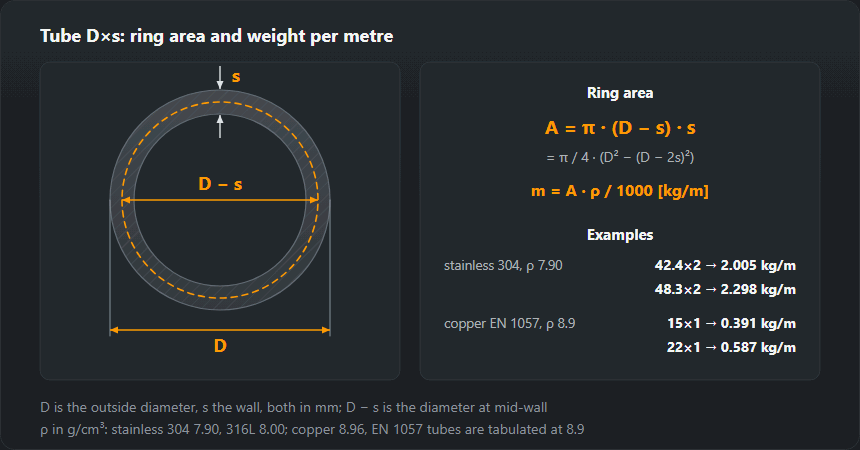
Water and gas tube to EN 1057 is described by outside diameter and wall. The standard’s own table works out the mass at 8.9 g/cm³, and so does the table below; the calculator at 8.96 gives 0.7 % more. The water column helps when working out the system volume of a heating circuit.
| Tube D×s, mm | Bore, mm | kg/m | 5 m length, kg | Water, l/m |
|---|---|---|---|---|
| 10×1 | 8 | 0.252 | 1.26 | 0.050 |
| 12×1 | 10 | 0.308 | 1.54 | 0.079 |
| 15×1 | 13 | 0.391 | 1.96 | 0.133 |
| 18×1 | 16 | 0.475 | 2.38 | 0.201 |
| 22×1 | 20 | 0.587 | 2.94 | 0.314 |
| 28×1 | 26 | 0.755 | 3.77 | 0.531 |
| 28×1.5 | 25 | 1.111 | 5.56 | 0.491 |
| 35×1.5 | 32 | 1.405 | 7.02 | 0.804 |
| 42×1.5 | 39 | 1.699 | 8.49 | 1.195 |
| 54×2 | 50 | 2.908 | 14.54 | 1.963 |
Tube mass is π · s · (D − s) · ρ / 1000 in kg/m, with D and s in millimetres.
For 22×1: 3.1416 × 1 × 21 × 8.9 / 1000 = 0.587 kg/m.

Copper grades and density
| Grade | EN number | Typical use | ρ, g/cm³ | 1000×2000×1 sheet, kg | vs calculator, % |
|---|---|---|---|---|---|
| Cu-ETP | CW004A | busbars, wire, electrical sheet | 8.93 | 17.86 | −0.3 |
| Cu-DHP | CW024A | EN 1057 plumbing tube, roofing sheet; brazes and welds well | 8.94 | 17.88 | −0.2 |
For weight, one figure does — the spread between grades is smaller than the dimensional tolerance. The grade does matter for joining: Cu-ETP contains oxygen and is prone to hydrogen embrittlement when welded or brazed in a reducing flame, which is why tube and parts meant for welding are made from deoxidised Cu-DHP. Joining copper to steel is covered in welding dissimilar metals.
How to work out copper weight yourself
- Cross-section in mm²: sheet — thickness × width, round bar — π·d²/4, tube — π·s·(D−s).
- Mass per metre in kg/m: area × 8.96 / 1000.
- Mass of a piece: kg/m × length in metres.
Example: Ø20 bar, 3 m long. Area 314.2 mm², 314.2 × 8.96 / 1000 = 2.815 kg/m, so the bar weighs 8.4 kg. The same size in steel is 7.4 kg — the metal weight calculator handles every metal with one formula, and steel and aluminium sheet have their own pages: sheet metal weight and aluminium sheet weight. Everything else is in the calculators section.
Frequently asked questions
How much does 1 m² of 1 mm copper sheet weigh?
8.96 kg. A 1000×2000×1 sheet therefore weighs 17.9 kg and a 1250×2500×1 sheet 28.0 kg. For another thickness, multiply by it: 2 mm sheet is 17.92 kg/m².
How much does a metre of 15 mm and 22 mm copper pipe weigh?
By the table in EN 1057, 15×1 tube weighs 0.391 kg/m and 22×1 0.587 kg/m, so a 5 m length is 1.96 and 2.94 kg. The standard works at a density of 8.9 g/cm³, the calculator at 8.96 — its result comes out 0.7 % higher.
Does the copper grade change the weight?
Hardly. Cu-ETP (CW004A) is 8.93 g/cm³, Cu-DHP (CW024A) 8.94, pure copper 8.96. The difference is 0.2–0.3 % — less than the thickness tolerance of the sheet.
How much heavier is copper than steel and aluminium?
14 % heavier than steel (8.96 against 7.85 g/cm³) and 3.3 times heavier than aluminium (2.70). The same 40×5 flat weighs 1.79 kg/m in copper, 1.57 in steel and 0.54 kg/m in aluminium.
Updated: