Press brake tonnage calculator
A 2 mm S235 (mild steel) sheet air-bent over a V = 16 mm die needs about 16.6 tonnes per metre of bend length. Enter the thickness, die opening, bend length and material — the calculator gives the tonnage in tonnes, t/m, kN and US tons, the recommended V-die, the inside radius and the minimum flange.
Short answer
Air-bending force at 90° is calculated with the formula published by press brake maker Bystronic: F = Rm·t²·L/V·(1 + 4·t/V), where Rm is the tensile strength in N/mm², t the thickness, V the die opening and L the bend length (with L in metres the result is in kN); tonnes-force = kN / 9.81. Example: S235 (Rm ≈ 435), t = 2 mm, V = 16 mm, L = 1 m — 163 kN, i.e. 16.6 t. The die opening is chosen at 6–12·t, the inside radius comes out at ≈ 0.16·V (2.6 mm), and the flange must be at least 0.7–0.8·V (11–13 mm).

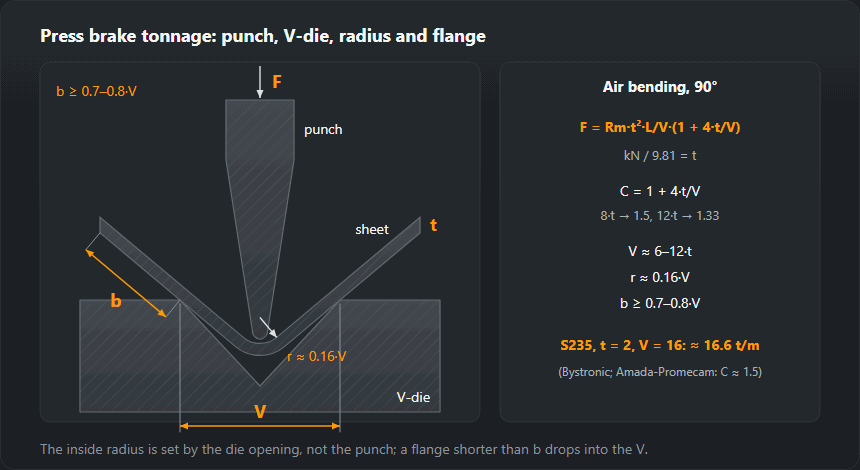
Bending force formula and the C factor
In air bending the sheet rests on the two die shoulders while the punch pushes in the middle — a beam on two supports. Hence thickness squared on top and die opening below. The manufacturers write it like this:
- Bystronic (tooling catalogue): F = Rm·t²/V·(1 + 4·t/V) — kN per metre with Rm in N/mm², t and V in mm. Their capacity chart for Rm 420 is computed with this formula.
- The Amada-Promecam chart (R = 45 kgf/mm²) follows F = 1.5·R·t²/V t/m — the same factor 1.5 that Bystronic gives at V = 8·t.
The generic form F = C·Rm·t²·L/V is correct, but C is not a constant: C = 1 + 4·t/V gives 1.67 at V = 6·t, 1.50 at 8·t, 1.40 at 10·t and 1.33 at 12·t. That explains the “1.33” and “1.42” found in online write-ups: 1.42 is C at V ≈ 9.5·t, 1.33 at V = 12·t. The calculator uses Bystronic and shows the “1.42” result for comparison — at V = 8·t it is 5–6 % lower. The US rule of thumb, 575·t²/V per foot in inches and short tons for 60 ksi steel, works out at C ≈ 1.6 in metric. Tonnes-force = kN / 9.81 (manufacturer charts often round 10 kN ≈ 1 t); 1 US ton = 8.9 kN.
Press brake tonnage chart, t/m
Values for S235 structural steel with the mid-range Rm of the standard, 90° air bending. For a part of length L, multiply by L in metres.
| t, mm \ V, mm | V6 | V8 | V10 | V12 | V16 | V20 | V25 | V32 | V40 | V50 | V63 | V80 | V100 |
|---|---|---|---|---|---|---|---|---|---|---|---|---|---|
| 0.8 | 7.3 | 5.0 | 3.7 | — | — | — | — | — | — | — | — | — | — |
| 1 | 12.3 | 8.3 | 6.2 | 4.9 | — | — | — | — | — | — | — | — | — |
| 1.2 | — | 12.8 | 9.5 | 7.5 | — | — | — | — | — | — | — | — | — |
| 1.5 | — | — | 16.0 | 12.5 | 8.6 | — | — | — | — | — | — | — | — |
| 2 | — | — | — | 24.6 | 16.6 | 12.4 | 9.4 | — | — | — | — | — | — |
| 2.5 | — | — | — | — | 28.2 | 20.8 | 15.5 | 11.4 | — | — | — | — | — |
| 3 | — | — | — | — | — | 31.9 | 23.6 | 17.2 | — | — | — | — | — |
| 4 | — | — | — | — | — | — | 47 | 33 | 25 | 19 | — | — | — |
| 5 | — | — | — | — | — | — | — | 56 | 42 | 31 | 23 | — | — |
| 6 | — | — | — | — | — | — | — | — | 64 | 47 | 35 | — | — |
| 8 | — | — | — | — | — | — | — | — | — | 93 | 68 | 50 | 37 |
| 10 | — | — | — | — | — | — | — | — | — | — | 115 | 83 | 62 |
| 12 | — | — | — | — | — | — | — | — | — | — | — | 128 | 95 |
The force is proportional to Rm: for S355 (Rm ≈ 550) the values are about 1.26 times higher, for 1.4301 stainless (645) 1.48 times, for AlMg3 H22 aluminium (245) 0.56 times. Check against the Bystronic chart: 2 mm sheet on V16 at Rm 420 — 160 kN/m; the calculator with Rm 420 gives 157.5 kN/m.
Worked example
2 mm sheet, S235, 16 mm die, 1 m bend. V/t = 8, C = 1 + 4·2/16 = 1.50. F = 435·2²/16·1.50 = 163 kN = 16.6 t. S235 has Rm 360–510 by the standard, so a real sheet will need 13.8 to 19.5 t/m. The 1.42 formula would give 15.7 t.
3 mm sheet, S355, 24 mm die, 2.5 m bend. F = 773 kN ≈ 79 t, at the upper Rm limit of 630 — 90 t. A 100-tonne press brake will do it, but check the tooling separately: punch and die load limits are marked in kN/m, and this job needs 354 kN/m.
Die opening V, inside radius and minimum flange
Bystronic and Amada-Promecam give the same guidance: for 0.5–2.5 mm V = 6·t, 3–8 mm — 8·t, 9–10 mm — 10·t, 12 mm and up — 12·t; many shops simply use the “rule of 8”, V = 8·t, for steel. A narrow die needs more force and marks the part; a wide one gives a large radius and more angle scatter.
- Inside radius in air bending is set by the die, not the punch: r ≈ 0.16·V (about V/6) — both manufacturers say so.
- Minimum flange — the flange must stay on the die shoulder or it drops into the V: ≈ 0.7·V in the Amada-Promecam chart, 0.7–0.8·V in Bystronic’s.
| t, mm | V, mm | r ≈ 0.16·V, mm | Min. flange, mm | Force, t/m |
|---|---|---|---|---|
| 1 | 6·t = 6 | 1.0 | 4.2–4.8 | 12.3 |
| 1.5 | 6·t = 9 | 1.4 | 6.3–7.2 | 18.5 |
| 2 | 6·t = 12 | 1.9 | 8.4–9.6 | 24.6 |
| 2.5 | 6·t = 15 | 2.4 | 10.5–12.0 | 30.8 |
| 3 | 8·t = 24 | 3.8 | 17–19 | 25.0 |
| 4 | 8·t = 32 | 5.1 | 22–26 | 33.3 |
| 5 | 8·t = 40 | 6.4 | 28–32 | 41.6 |
| 6 | 8·t = 48 | 7.7 | 34–38 | 49.9 |
| 8 | 8·t = 64 | 10.2 | 45–51 | 66.5 |
| 10 | 10·t = 100 | 16.0 | 70–80 | 62.1 |
| 12 | 12·t = 144 | 23.0 | 101–115 | 59.1 |
| 15 | 12·t = 180 | 28.8 | 126–144 | 73.9 |
Enter the radius you actually get on the machine into the bend allowance calculator — the K-factor and the flat length depend on it.
Tensile strength Rm by material
The formula uses the ultimate tensile strength Rm, not the yield strength. The calculator takes the middle of the standard range; when sizing a press with a margin, use the upper limit or the Rm from the mill certificate.
| Material | Standard | Rm, N/mm² | Rm used | t/m (t = 2, V = 16) | t/m at max Rm |
|---|---|---|---|---|---|
| S235 steel | EN 10025-2 | 360–510 | 435 | 16.6 | 19.5 |
| S275 steel | EN 10025-2 | 410–560 | 485 | 18.5 | 21.4 |
| S355 steel | EN 10025-2 | 470–630 | 550 | 21.0 | 24.1 |
| 1.4301 (304) stainless, sheet C up to 8 mm | EN 10088-2 | 540–750 | 645 | 24.7 | 28.7 |
| EN AW-5754 (AlMg3) H22 aluminium | EN 485-2 | 220–270 | 245 | 9.4 | 10.3 |
For S235 and S355 thinner than 3 mm EN 10025-2 gives a different range (S355: 510–680), for stainless plate (P) it is 520–720. The sheet weight calculator gives the mass of the blank.
What the calculator does not cover
- Bending method. The formula is for air bending. Bottoming and coining need 4–8 times more force, according to Bystronic.
- Mill scale. Hot-rolled sheet with scale raises the force by a factor of 1.05–1.1.
- Tooling load. Every punch and die has its own load limit in kN/m; a short part on a long press loads the tooling harder than the machine tonnage suggests.
- Angle. Manufacturer formulas and charts are for 90° bends; acute bends on 30° dies and hemming need other tooling and other forces.
The flat blank length before bending comes from the bend allowance calculator, the mass from sheet weight, and the other tools are in the calculators section.
Frequently asked questions
How do you calculate press brake tonnage?
For 90° air bending: F = Rm·t²·L/V·(1 + 4·t/V), in kN with Rm in N/mm², t and V in mm, L in m; tonnes = kN / 9.81. For S235, t = 2 mm, V = 16 mm and L = 1 m that is about 16.6 t.
How many tons does it take to bend 3 mm sheet 3 metres long?
S235 on a 24 mm die (8·t) — about 25.0 t/m, so 75 t for 3 m; with Rm at the upper limit of 510 — 88 t. For S355 — about 95 t.
What V-die opening should I use for a given thickness?
Per the Bystronic and Amada-Promecam charts: up to 2.5 mm — 6·t, 3–8 mm — 8·t, 9–10 mm — 10·t, 12 mm and up — 12·t. For 2 mm sheet that is V12, but many shops bend it on V16 (8·t) — less force, larger radius.
What inside radius does air bending produce?
About 16 % of the die opening: r ≈ 0.16·V. On a 16 mm die about 2.6 mm, on 24 mm — 3.8 mm, regardless of the punch radius as long as it is smaller.
What is the minimum flange length on a press brake?
Roughly 0.7–0.8·V: on a 16 mm die the flange must be at least 11–13 mm, or it slips into the V. A short flange needs a narrower die — and more force.
Updated: