Gates and wickets
A gate is the only thing in a yard that moves every day. That is why a mistake costs more here: the wrong type cannot be changed without moving the posts, and an undersized operator fails in its first winter.
A sliding gate in section
The leaf of a sliding gate does not roll along the ground. It hangs from two roller carriages fixed to a foundation beside the opening, and reaches past the opening with a cantilever counterweight tail. There is no rail across the driveway, so there is nothing to pack with snow and grit, and no threshold to catch a low car.

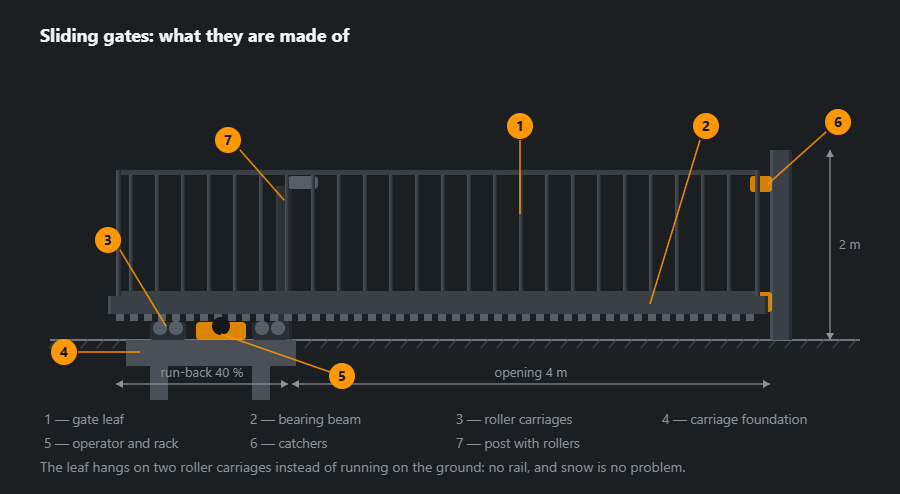
Every limitation of the type follows from that. It needs clear run-back to one side; it needs a foundation under the carriages — one shared frame, not two separate blocks, or the carriages drift apart; and it needs a receiving post with catchers, which takes the leaf when closed and lifts the load off the rollers.
Six types of gate

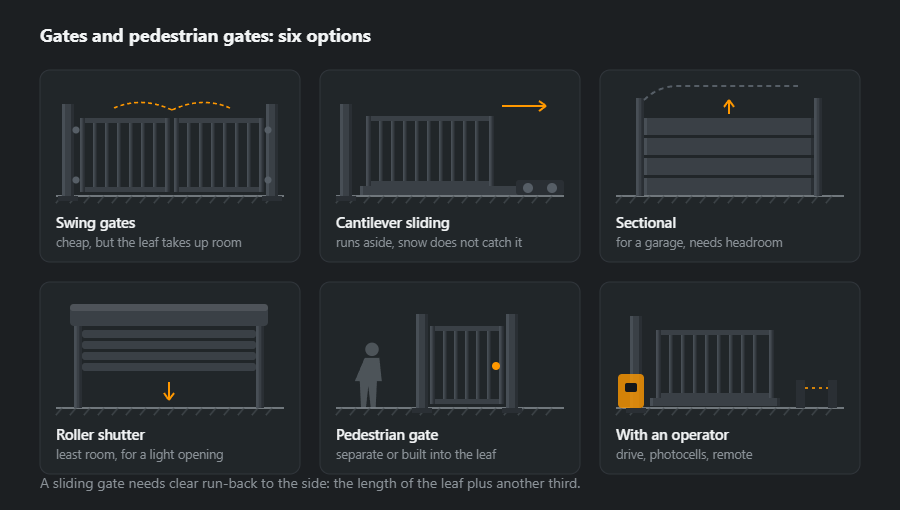
- Swing gates — the cheapest, but the leaf claims a metre and a half of yard and meets the snow in winter.
- Cantilever sliding — the yard stays clear and snow is no obstacle, but run-back and a foundation are needed.
- Sectional — for a garage; they need headroom above the opening for the stacked panels.
- Roller shutter — least room of all, but the opening must be a light one: not a solution for a driveway entrance.
- Wicket gate — separate or built into the leaf; the second is cheaper but leaves a threshold in the way.
- Automated — any of these types with an operator, photocells and a remote; how to choose the operator is covered below.
Posts and foundations
A gate post works in uplift and bending, not compression. A solid 4×2 m leaf is eight square metres of sail, and a gust puts a serious moment into the top of the post. Hence the 1.2–1.5 m depth and the requirement to get below the frost line: otherwise the post lifts over winter and the leaf stops closing.

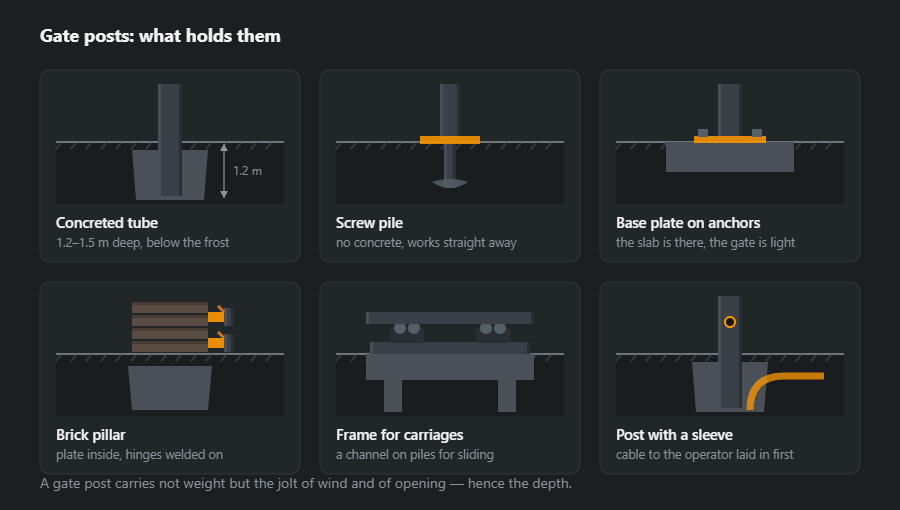
A brick pillar still has a tube inside, and the hinges are welded to cast-in plates rather than to masonry. If the gate is to be automated, the cable to the operator is laid in a sleeve in advance — breaking the yard open for it later costs more than the operator itself.
How the leaf is clad

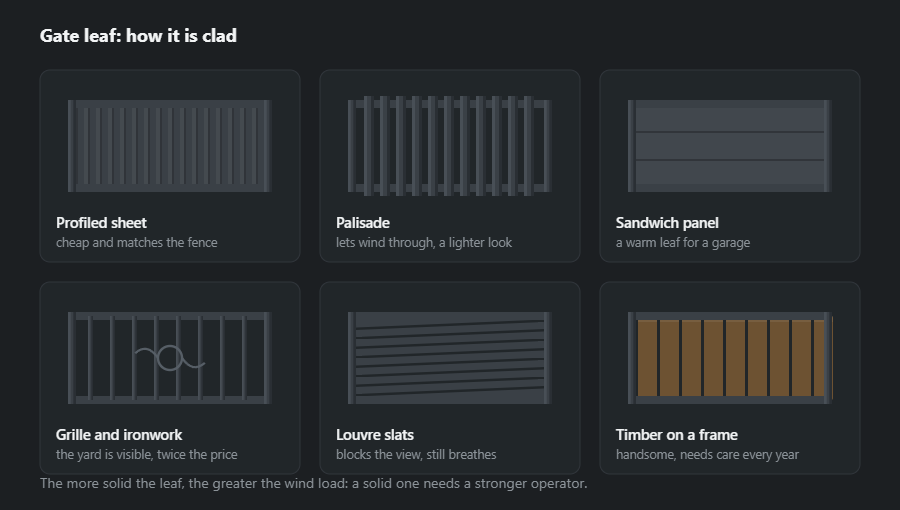
The infill is chosen to match the fence: gate and fence are seen together, and a mismatch shows at once. But the infill also has a technical side — weight and wind load. Solid profiled sheet and sandwich panel put the greatest demand on the operator and the posts; palisade and grille let wind through and weigh less.
What opens the gate

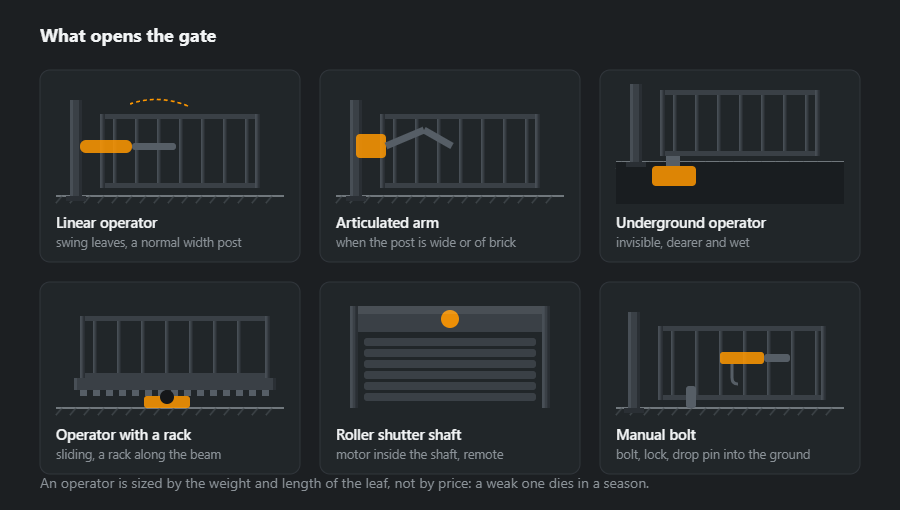
Three things decide the operator: the type of gate, the width of the post and whether there is power on site. Swing leaves on a normal post take a linear operator; a wide or brick post needs an articulated arm; a completely hidden solution means an underground unit, dearer and sitting in water. Sliding gates need a rack operator with the toothed rack along the whole beam.
A manual bolt stays even with automation: a bolt, a lock and a drop pin into the ground are what you use when the power is off and while you are away.
Which sections, and why
What matters in a gate is leaf stiffness: any sag shows at once, because the leaf stops meeting the catch or the lock. So the frame is made from a deeper section than the infill, with its long side vertical.
- Leaf frame — 60×40×3 box, 4.25 kg/m, or for wider openings 80×40×3, 5.19 kg/m.
- Infill — 40×20×2, 1.68 kg/m, or 20×20×2 pickets, 1.05 kg/m, to match the fence.
- Posts — 80×80×4, 9.22 kg/m, or 100×100×4, 11.7 kg/m, for heavy, solid leaves.
- Swing-leaf brace — same section as the infill, from the bottom corner at the hinges to the top corner at the lock side: it works in compression and stops the leaf dropping.

Weights for other sizes are in the hollow section calculator. A powered gate is a machine: the product falls under EN 13241 and safety in use under EN 12453 (force limits, photocells, safety edges). Posts and foundation for a heavy sliding leaf are sized by calculation, and the automation is commissioned and handed over by the installer who issues the paperwork.
Joints and welds
- Sliding gate track beam — welded to the frame in stitches, alternating sides. A continuous weld on one side bows the beam, and a bowed beam binds on the rollers. Check straightness with a string line before and after welding.
- Swing gate hinges — both on one axis; set them on a bar passed through both hinges and only then weld.
- Infill to frame — welded all round or on two sides in short runs: a 2 mm wall burns through easily, and a burn-through is where rust starts.
- Hinge plates in a masonry pier — anchored into the concrete core, not into brick.
With a 3 mm wall the upper limit of 0.7·t is only 2.1 mm, below the a3 minimum of EN 1993-1-8, so load-bearing welds at the post are made a3 — z ≈ 4.2 mm, 0.078 kg of weld metal per metre. The fillet weld calculator checks sizes, and welding box section covers thin-wall technique.
Fabrication and installation sequence
- Survey and choice of type — opening width, run-back or swing space, ground slope, power for the operator.
- Foundations and posts — with a cable duct; the concrete must cure before the leaf is hung.
- Leaf in the shop — frame on the table with diagonals checked, infill to a jig, track beam or hinges.
- Protection — galvanising with powder coat in the fence colour on top.
- Installation — roller carriages on a common foundation frame, leaf, catches, adjustment level and plumb.
- Automation — operator, rack, photocells; force test and handover of the instructions.
Corrosion protection
A gate stands in the worst spot on the plot: by the road, in splashed mud and salt. The most durable choice is a duplex system — hot-dip galvanising plus powder coat. Leaf sections need vent holes, and the track beam and rollers carry factory zinc that must not be overheated by welding. The bottom edge of the leaf rusts first, along with anything cut on site; each such spot is cleaned and cold-galvanised. For the same reason, avoid welding anything to the leaf after galvanising.
Common mistakes
- Swing leaf without a brace — after a season the corner drops and the leaf scrapes the paving.
- Brace the wrong way round — a rigid bar running down from the top hinge pulls on its weld in tension and does not hold.
- Track beam welded continuously on one side — it bows and the leaf runs in jerks.
- Operator chosen on price — it runs at its limit and dies within a season.
- No cable duct in the foundation — the drive gets dug up later.
How to work out the material: a 3×2 m leaf and two posts
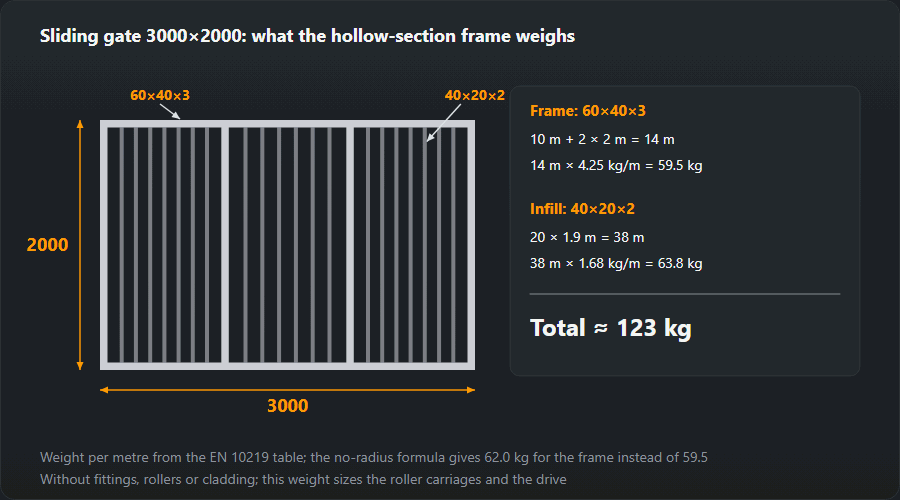
The 3000×2000 mm leaf from the drawing: frame with two intermediate posts (14 m of 60×40×3 in total) and twenty 40×20×2 bars of 1.9 m, plus two 80×80×4 posts of 3.4 m — 2 m above ground and 1.4 m in the foundation. No hardware, track beam or sliding tail.
| Member | Section | Length, m | Qty | kg/m | kg |
|---|---|---|---|---|---|
| Leaf frame | 60×40×3 | 14.00 | 1 | 4.25 | 59.5 |
| Infill | 40×20×2 | 1.90 | 20 | 1.68 | 63.8 |
| Post | 80×80×4 | 3.40 | 2 | 9.22 | 62.7 |
| Total | 186.0 | ||||
| With 5 % allowance | 195 | ||||
That makes 186 kg net and 195 kg with allowance. The leaf alone is about 123 kg — and that figure, plus tail and track beam for a sliding gate, is where choosing rollers, hinges and the operator starts: the hardware and operator data sheets always state the permitted leaf weight and length. The 1.9 m bars cut three to a 6 m length with about 0.3 m of offcut — check in the cutting plan. Gate and fence together go through the bill of materials calculator, and a matching pedestrian gate you can build yourself with the steel pedestrian gate guide.
Where to go next
A gate is almost always ordered together with the fence — the same infill and the same coating, or the colours will part company within a year. Lead times, coatings and fixings are in how ordering works.
Frequently asked questions
How much room does a sliding gate need?
The width of the opening plus roughly a third — that is how far the leaf runs back. A 4 m opening needs about 5.5 m of clear fence to one side. Where that room does not exist, swing gates remain, and in a tight yard sectional or roller shutters.
Why is a sliding gate dearer than a swing gate?
Because it has what a swing gate does not: a bearing beam running the full length of the leaf with margin, two roller carriages and a foundation under them, and a receiving post with catchers. In return it takes up none of the yard and needs no digging out in winter.
Which operator should I choose?
An operator is sized by the weight and length of the leaf, not by price. A weak one does not simply run slower — it dies within a season, because every cycle is at its limit. On a wide or brick post a linear operator will not fit at all: there it is an articulated arm or an underground unit.
How deep do gate posts go?
1.2–1.5 m, below the frost line. A gate post carries not the weight of the leaf but the jolt: wind against solid cladding and the shove of opening. That is precisely why it goes deeper than a fence post of the same height.
What section is a sliding gate welded from?
The leaf frame is usually 60×40×3 or 80×40×3 box section, the infill 40×20×2 or pickets, the posts 80×80×4 or heavier. A track beam from the hardware kit is welded to the bottom edge — that is what runs on the roller carriages, so its size is chosen from the hardware data sheet for the leaf weight and length, not from whatever is lying in the shop.
How much does a 3×2 m gate leaf weigh?
A 3000×2000 mm leaf with a 60×40×3 frame and twenty 40×20×2 bars weighs about 123 kg of steel. A sliding gate adds a counterbalance tail and the track beam, so its leaf for the same opening is noticeably heavier — and that is the weight the rollers and operator are chosen for.
Updated: