Bedplates, frames and jigs
The things welded not for sale but for one particular machine: a pump bedplate, saddles for a vessel, a transport frame, a jig, a cover, a guard. The sizes here come off the equipment, not out of a catalogue.
How a bedplate is put together
A pump bedplate is not a stand. Whether the motor and pump shafts end up on one axis depends on it, and on that in turn depend the life of the bearings and the coupling. That is why stiffness matters more than strength here: the frame must not work under the anchors being tightened, nor under starting.

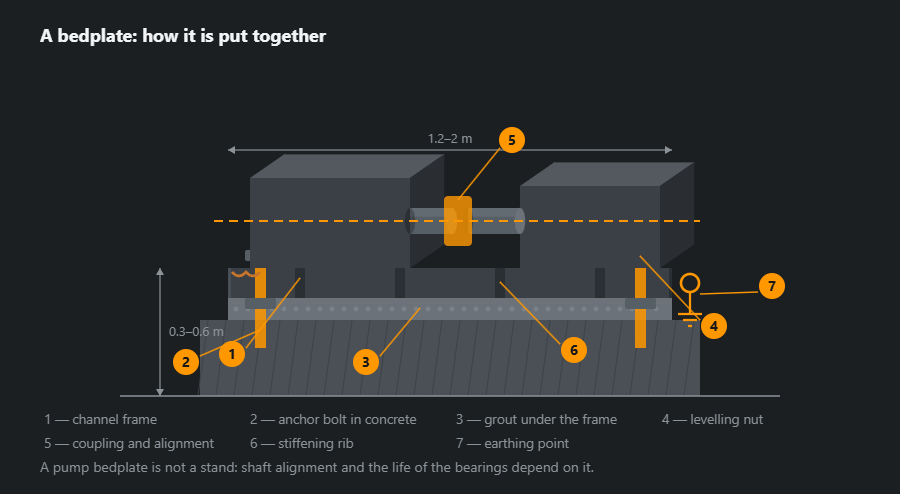
The order of work is the reverse of what feels natural. First the frame goes onto levelling nuts and is brought to level, then the anchors are tightened, and only after that is the grout poured with a non-shrink mix. Pour first and there is nothing left to set: the concrete goes off in whatever position it found.
What jobs look like

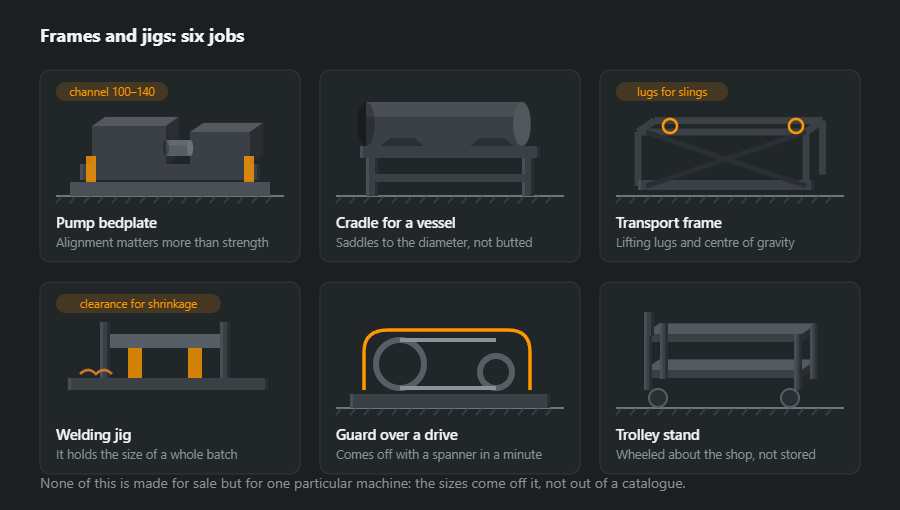
A transport frame differs from a bedplate in being sized for lifting rather than for standing: the lugs go where the slings pass through the centre of gravity, or the load twists in the air. This is the case where an extra half hour of calculation is cheaper than one bent assembly.
A welding jig is not a product but a tool. It holds the size of a whole batch and pays for itself from about ten pieces; on three parts it is cheaper to fit each one on the bench.
Machine guards
The main thing about a guard is known to every maintenance fitter: one that gets in the way will be gone within the week. So the question is not strength — all of them have enough — but how quickly the guard opens for setting up and comes back.

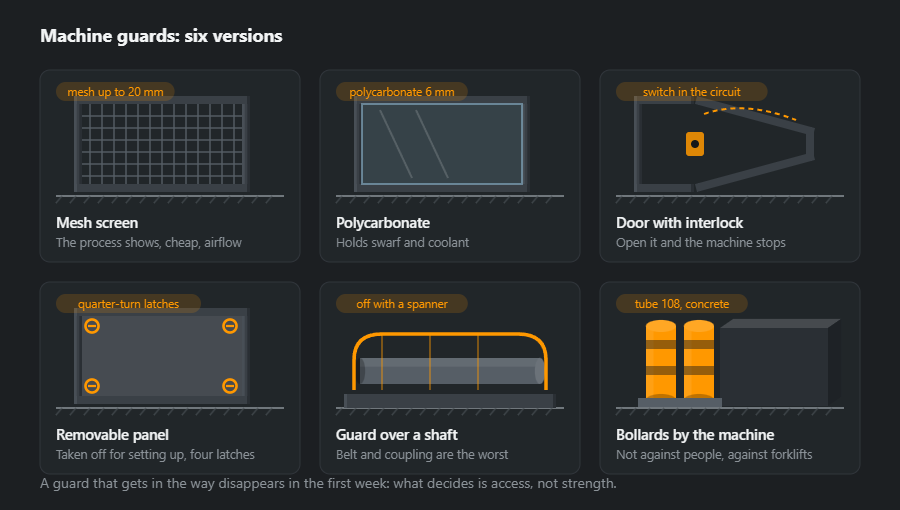
A door with an interlock is the only version that works without discipline: a limit switch in the control circuit stops the machine as it opens. Everything else relies on a person closing the guard themselves — and they will only close one that does not get in the way.
Bollards stand apart: they protect not the person from the machine but the machine from the forklift. Tube 108 set in concrete goes wherever traffic passes close by — and it is very nearly the most frequent item on the list.
Which sections, and why
In frames and fixtures stiffness is what counts, so sections are chosen differently from building steelwork: deeper and heavier than strength alone would require.
- Pump or compressor baseframe — side rails in UPN 160 channel, 18.8 kg/m, or UPN 120, 13.4 kg/m, for smaller sets; cross members in UPN 100, 10.6 kg/m. The channels face inwards: a clean back on the outside, room for the anchors inside.
- Transport frame — square hollow section 100×100×5, 14.4 kg/m, or HEB 100, 20.4 kg/m, for heavier loads. A closed section copes better with torsion when the slings do not pull evenly.
- Welding jig — a thick base plate and a frame of 80×80×4 tube, 9.22 kg/m. A heavy plate is harder to distort with the heat of the parts welded on it.
- Mesh guard — frame of 30×30×2 tube, 1.68 kg/m, with welded mesh; light, because it has to open easily.
Plate for pads and base plates is weighed by thickness: 20 mm plate is 157.0 kg/m², 10 mm is 78.5 kg/m². Other sizes are in the channel and plate calculators.
Welds and distortion
A machine frame rarely cracks, but it often warps. Every weld shrinks as it cools and pulls the section with it, so the welding sequence matters more than the weld size.
- Symmetrical and staggered — tack all round first, then short runs alternating from side to side and across the diagonal.
- No more weld than drawn — an a5 instead of an a4 is 0.216 instead of 0.138 kg of weld metal per metre: more heat and more shrinkage for the same joint strength.
- Machine pads with allowance — after welding and straightening they are milled in one setup; no welder can produce a flat plane by hand.
- Lifting lugs — these are lifting points: an engineer designs them, a suitably qualified welder welds them, and the welds are inspected before the first lift. There is no “by eye” here.
Thick plate and thin wall in one joint is a subject of its own: with 20 mm plate the heat drains into the plate, while a 2 mm tube burns through before the plate warms up. Current and torch angle are set so the arc heats the thicker part more. The fillet weld calculator checks weld sizes, and thin walls have their own article, how to weld thin metal.
Fabrication sequence
- Machine data — hole pattern in the motor and pump feet, shaft heights, set weight; from the manufacturer’s documents, not by eye.
- Drawing — frame, pads with allowance, holes for anchors and jacking screws, lugs if the frame will be lifted.
- Cutting and tacking — on a flat table, checking diagonals before the first weld.
- Welding in sequence — staggered, checking flatness after each stage.
- Straightening and machining — milling the pads, drilling and tapping for the machines.
- Painting — with machined faces masked.
- Setting — levelling nuts, level, anchors, grout, and finally shaft alignment by the fitter.
Corrosion protection
A pump frame lives in the wet: glands drip, pipes sweat, the floor gets hosed. Primer and topcoat are chosen as for outdoors, not for a dry building. Channels facing inwards form a gutter, so drain holes go into the bottom flanges to stop water standing under the machine. Machined faces are protected with grease or a preservative instead of paint: paint under a machine foot is an uncontrolled shim that crushes within a year and throws the shafts out of line.
Common mistakes
- Frame too flexible — strong enough, but it twists as the anchors are tightened, and the bearings start running hot after a few weeks.
- Unmachined pads — a stack of packers goes under the feet and settles with vibration.
- Welding “from one end” — the frame comes out bowed and cannot be straightened without heat.
- No drain holes — water stands in the channel and eats it from inside, under the machine where no one looks.
- A guard that is slow to open — a week later it is lying next to the machine.
How to work out the material: a 1.6×0.6 m pump baseframe
Baseframe for a pump and motor: two 1.6 m side rails in UPN 160, three 0.5 m cross members in UPN 100 and four 200×150 mm pads in 20 mm plate. The sections are illustrative — frame dimensions for a particular set come from the manufacturer or engineer.
| Member | Section | Length, m | Qty | kg/m | kg |
|---|---|---|---|---|---|
| Side rail | UPN 160 | 1.60 | 2 | 18.8 | 60.2 |
| Cross member | UPN 100 | 0.50 | 3 | 10.6 | 15.9 |
| Total | 76.1 | ||||
| With 5 % allowance | 80 | ||||
The sections come to 76 kg net and 80 kg with allowance, and the four pads add about 19 kg of plate. On a small frame the offcut weighs more than the allowance suggests: only 3.2 m of a 6 m length of UPN 160 is used, so the rest should be allocated to the next job straight away, or the channel bought cut to length. The cutting plan works out the nesting, and the bill of materials calculator the full list.
Where to go next
Access platforms and the stairs to them are in platforms and walkways. Tanks, pipework and ventilation are in tanks and pipework. Price, lead time and fixings by substrate are in how ordering works.
Frequently asked questions
Why does a pump bedplate need grout if it sits on anchors?
Because the anchors hold it against movement and the grout against deflection. The concrete under a bedplate is never flat, and without grout the frame bears on three or four random points. At the first start it flexes, the alignment drifts and the bearings begin to run warm. Grout goes in with a non-shrink mix after the frame has been levelled.
How accurately does the bedplate have to be levelled?
The frame itself to within 0.1 mm per metre. Shaft alignment after that is done at the coupling rather than on the frame: with a dial gauge or a laser, to the pump maker's tolerance. All the frame has to do is make alignment possible and then not pull it out again.
How does a welding jig differ from an ordinary frame?
It is not a product but a tool: its job is to hold the size of a whole batch. So it has stops and clamps, and the clearances are set with an allowance for weld shrinkage. A jig pays for itself from about ten pieces; on three it is not worth building.
Is an interlock on a guard door mandatory?
Where something dangerous moves behind that door, yes. A limit switch in the control circuit stops the machine when the door opens, and that is what separates a guard from a decorative panel. A door without an interlock will be found open and propped with a spanner inside the first week.
What channel is a pump baseframe welded from?
For a medium-sized pump and motor, usually UPN 120–160 for the side rails and a smaller channel for the cross members, with 15–20 mm plate pads under the machine feet. Stiffness decides, not strength: the frame must not twist when the anchors are tightened or at start-up. For large sets the frame dimensions come from the pump manufacturer or a design engineer.
Why are the machine pads machined after welding?
Because welding always distorts a frame a little, and the pads under the feet have to lie in one plane to a tolerance no welder can hold by hand. The frame is welded with machining allowance on the pads, straightened, and then the pad faces are milled in a single setup. Then a few thin shims are enough under motor and pump instead of a stack of packers.
Updated: