Stainless for kitchens and food plants
Tables, sinks, hoods, shelving and trolleys for food production. What sets this work apart from anything else in a fabrication shop is that it is signed off not by the customer's eye but by an inspector's finger — and what they check is not what shows in a photograph.
Where the conversation starts: the grade
Food production means AISI 304 — not caution but a condition of acceptance. Grade 201 looks identical and costs less, but under constant damp it comes out in rust staining within the first year and has to be replaced entire. Molybdenum-bearing 316 is needed where there is salt and chlorine: fish processing, curing, swimming pools, the coast.
How a work table is built
From the top down: a top in 1.2–1.5 mm sheet over a frame, an upstand at the back so water does not run behind the table, a welded-in bowl with radiused corners, a frame of 40×40 tube and adjustable feet. A lower shelf is optional, but it is asked for almost every time.

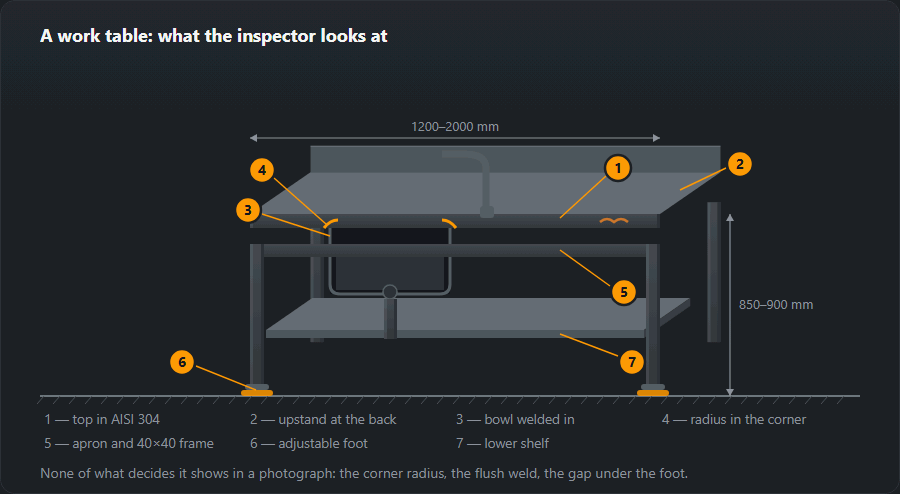
The decisive detail of the table is not the top but how the sink is made. A welded-in bowl gives a continuous surface with no joint round the rim: one wipe cleans it. A drop-in bowl with a flange saves an hour of work and creates a seam that collects everything ever cut on that table.
What gets made in stainless

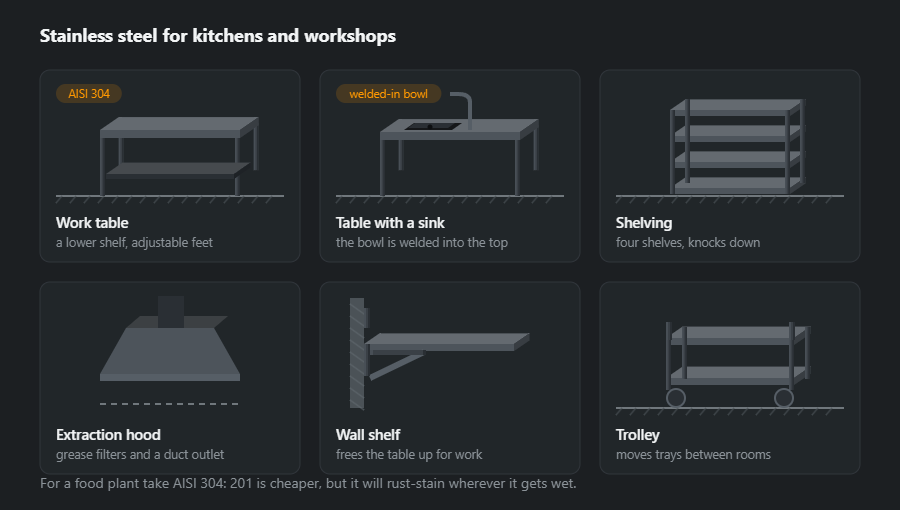
A table, a table with a sink, shelving, an extract hood, a wall shelf and a trolley — that is the whole range any food plant is assembled from. What separates one shop from another is not this list but how their corners, welds and feet are made.
Six points the job is accepted on
Acceptance in a food plant goes not by the drawing but by one rule: everything must wipe clean in a single pass. Hence the requirements — no seams, no sharp internal corners, no scale beside the weld, and a gap under the item so the floor can be washed beneath it.

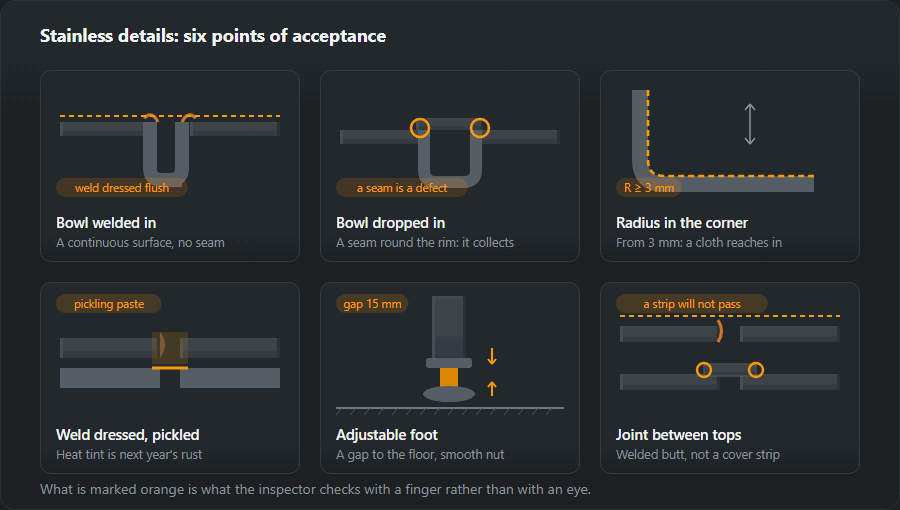
Heat tint deserves a paragraph of its own, because it passes for cosmetics. Welding stainless burns chromium out of the zone beside the bead and takes it into the scale; blue and gold tint is metal without its protection. It comes off with a stainless wire brush and pickling paste — otherwise a year later rust runs exactly along the weld.
What it is made from, and why
Stainless catering and food-plant equipment is structurally light — the loads are pots, crates and dough — so sections are chosen for stiffness and hygiene rather than strength. Weight is worked out as for mild steel: stainless is only about 1 % heavier (factor 1.01 in the density table).
- Legs — 40×40×2 box, 2.31 kg/m in mild steel; closed, with no flanges for dirt to settle on.
- Frame under top and shelf — 40×20×2, 1.68 kg/m, long side vertical so the 1.2–1.5 mm top does not sag under load.
- Top — 1.5 mm sheet, 11.8 kg/m², with a folded upstand; undershelf 1 mm, 7.9 kg/m².
- Canopy — 1 mm sheet on an angle frame; weight is small, what matters is tight condensate gutters and removable filters.
Folding replaces welding wherever possible: the top upstand, shelf corners and canopy skirt are done on the press brake, because every weld is a spot to grind and pickle. Sheet weights are in the sheet calculator.
Welds: TIG, back purge and clean tools
- TIG with the right filler — 308L for 304, 316L for 316; low-carbon filler keeps its resistance in the heated zone.
- Back purging — tubes and hollow sections are flushed with argon inside, or the root oxidises to a colour and starts corroding from within.
- Thin 1–1.5 mm sheet — short runs, a copper backing bar to draw off heat, close tacks; a top quickly goes wavy with too much heat.
- Dedicated tools — discs, brushes, files and bench for stainless only. Carbon-steel particles embedded in the surface rust within weeks.
After welding the scale is removed by pickling and the surface passivated so the chromium oxide layer re-forms. Technique is covered in TIG and welding stainless steel.
Fabrication sequence
- Room survey — walls, water and drain connections, clearance under equipment, route in.
- Drawing and flat patterns — top with upstand, sink bowl, shelves; steel grade and surface finish written on the drawing.
- Cutting and folding — laser and press brake, protective film left on the sheets.
- Welding the frame — TIG with purge, on a flat bench.
- Top and bowl — bowl welded in, weld dressed flush.
- Pickling and passivation — paste or bath, then rinse with clean water.
- Installation — adjustable feet, level, sealing to the wall, film off last.
When stainless does rust
Stainless is not immune to everything: it is protected by a thin chromium oxide layer that can be broken down. Rust spots come from carbon-steel particles, heat tint, chlorine in cleaners and crevices holding water. Hence the rules of use: clean with products meant for stainless, no steel-wool scourers, rinse off chlorine cleaners and do not leave salt on the top overnight. Where chlorine and salt are constant — fish processing, brining — go straight for 316.
Common mistakes
- A disc used on carbon steel — rust spots over the whole top a month later.
- Tube welded without purge — a black root inside and corrosion in the table leg.
- Top welded in long runs — waves that cannot be straightened.
- Pickling without rinsing — leftover paste etches stains.
- Steel scourer for cleaning — the same result as the carbon-steel disc.
How to work out the material: a 150×70 cm work table
Table 1500×700×850 mm with undershelf: four legs in 40×40×2, a frame under the top and a shelf frame in 40×20×2 (4 m each), a 1.5 mm top with upstand (flat pattern about 1.36 m²) and a 1 mm shelf (0.84 m²). Table weights are for mild steel; stainless weighs about 1 % more.
| Member | Section | Length, m | Qty | kg/m | kg |
|---|---|---|---|---|---|
| Leg | 40×40×2 | 0.85 | 4 | 2.31 | 7.9 |
| Frame under top | 40×20×2 | 4.00 | 1 | 1.68 | 6.7 |
| Shelf frame | 40×20×2 | 4.00 | 1 | 1.68 | 6.7 |
| Total | 21.3 | ||||
| With 5 % allowance | 22 | ||||
The sections come to 22 kg with allowance, the top to about 16 kg and the shelf to about 7 kg — under 50 kg in all, a two-person lift. The expensive part of such a table is not the steel but the hours of welding, grinding and pickling. Several tables at once go through the bill of materials calculator, and sheets for the tops through the sheet calculator.
Where to go next
Tanks, pipework and plant ventilation are in tanks and pipework. The weldability of stainless itself, the filler and root shielding are covered in welding stainless steel. Price and lead time are in how ordering works.
Frequently asked questions
Which stainless grade for a kitchen?
AISI 304. Grade 201 costs about a third less, but it has less nickel and under constant damp it comes out in rust staining within the first year. For food production that is a question of acceptance rather than looks.
How does 316 differ from 304, and when do you need it?
Molybdenum. It stands up to chlorides, so 316 goes where there is salt and chlorine-based cleaning: fish processing, curing, pools, the coast. In an ordinary kitchen you will not see the difference, and it costs about half as much again — buying it just in case makes no sense.
Why dress and pickle a weld if it holds anyway?
Because the weld holds and the metal beside it rusts. Welding stainless burns chromium out of the zone next to the bead and takes it into the scale; blue and gold heat tint is metal without its protection. It comes off with a stainless wire brush and pickling paste — otherwise a year later rust runs along the weld.
Why does a welded-in bowl cost more than a drop-in one?
By an hour or so of work: the bowl has to be fitted, tacked, welded out and the weld dressed flush. In exchange you get a continuous surface with no seam round the rim. A drop-in bowl with a flange saves that hour and creates a joint that is the first thing checked with a finger at acceptance.
What filler is used to weld a 304 stainless table?
TIG with 308L wire (designation 19 9 L under EN ISO 14343), and 316L wire (19 12 3 L) for grade 316. The L stands for low carbon: the weld keeps its corrosion resistance in the heat-affected zone. Tubes and hollow sections are welded with an argon back purge.
Why does stainless steel rust?
Most often through contamination with carbon steel: a disc, brush or bench previously used on ordinary steel leaves iron particles that rust on the surface. The second cause is heat tint left after welding, the third chlorine in cleaning agents and crevices where water stands. That is why stainless gets its own tools.
Updated: