HEA 300 beam: weight per metre and dimensions
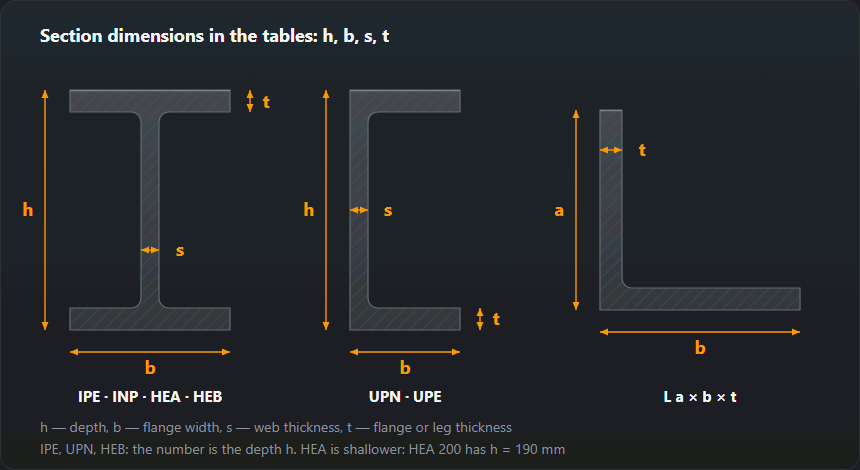
HEA 300 weighs 88.3 kg per metre. A 6 m bar is 529.8 kg, a 12 m bar 1060 kg, and a tonne is about 11.3 m of this section. Nominal values to EN 10365: depth 290 mm, flange width 300 mm.
Another length or a whole order: the beam weight calculator opens with HEA 300 already selected.
HEA 300 dimensions
| Dimension | Symbol | Value |
|---|---|---|
| Depth | h | 290 mm |
| Flange width | b | 300 mm |
| Web thickness | tw | 8.5 mm |
| Flange thickness | tf | 14 mm |
| Root radius | r | 27 mm |
| Cross-section area | A | 112 cm² |
| Mass per metre | G | 88.3 kg/m |
The number in the designation is not the depth: HEA 300 is 290 mm deep with a 300 mm flange. A delivered bar may differ from these nominal values within the rolling tolerances of EN 10034; invoicing goes by the mill certificate, not by the table.

HEA 300 weight by length
| Length, m | Mass, kg |
|---|---|
| 1 | 88.3 |
| 2 | 176.6 |
| 3 | 264.9 |
| 4 | 353.2 |
| 5 | 441.5 |
| 6 | 529.8 |
| 8 | 706.4 |
| 10 | 883 |
| 12 | 1060 |
Steel cost is mass times the price per kilogram: at a price C per kg a 12 m bar costs 1060 × C and a 6 m bar 529.8 × C. Cutting, drilling and painting are priced separately; paint goes by surface area, not by weight.
HEA 300 section properties
| Property | Symbol | Value |
|---|---|---|
| Second moment of area, major axis | Iy | 18260 cm⁴ |
| Elastic section modulus, major axis | Wel,y | 1259 cm³ |
| Radius of gyration, major axis | iy | 12.8 cm |
| Second moment of area, minor axis | Iz | 6309 cm⁴ |
| Elastic section modulus, minor axis | Wel,z | 420.6 cm³ |
Iy governs deflection, Wel,y bending stress, iy the slenderness of a strut. Iy / Iz = 2.9: in vertical bending the section is 2.9 times stiffer than sideways. Source: ArcelorMittal catalogue “Sections and Merchant Bars” (2023), each value checked against a second, independent table. These are inputs for a check to EN 1993-1-1, not a load capacity.
HEA 300 next to neighbouring sizes
| Section | h, mm | b, mm | kg/m | Iy, cm⁴ |
|---|---|---|---|---|
| HEA 280 | 270 | 280 | 76.4 | 13670 |
| HEA 300 | 290 | 300 | 88.3 | 18260 |
| HEA 320 | 310 | 300 | 97.6 | 22920 |
| IPE 300 | 300 | 150 | 42.2 | 8356 |
| HEB 300 | 300 | 300 | 117 | 25160 |
| UPN 300 | 300 | 100 | 46.2 | 8030 |
Against HEA 300 at the same number: IPE 300 — mass ×0.5, Iy ×0.5; HEB 300 — mass ×1.3, Iy ×1.4; UPN 300 — mass ×0.5, Iy ×0.4. One size up, HEA 320 adds 11 % mass and 26 % Iy.
Other sizes
- IPE beams: IPE 100 · IPE 120 · IPE 140 · IPE 160 · IPE 180 · IPE 200 · IPE 220 · IPE 240 · IPE 270 · IPE 300
- HEA beams: HEA 100 · HEA 120 · HEA 140 · HEA 160 · HEA 180 · HEA 200 · HEA 220 · HEA 240 · HEA 260 · HEA 280 · HEA 300
- HEB beams: HEB 100 · HEB 120 · HEB 140 · HEB 160 · HEB 180 · HEB 200 · HEB 220 · HEB 240 · HEB 260 · HEB 280 · HEB 300
- UPN channels: UPN 100 · UPN 120 · UPN 140 · UPN 160 · UPN 180 · UPN 200 · UPN 220 · UPN 240 · UPN 260 · UPN 280 · UPN 300
Frequently asked questions
How much does a 6 m and a 12 m HEA 300 weigh?
HEA 300 weighs 88.3 kg/m, so a 6 m bar is 529.8 kg and a 12 m bar 1060 kg. Ten 12 m bars come to 10596 kg.
Which is heavier: IPE 300, HEA 300, HEB 300 or UPN 300?
Per metre: HEB 300 — 117 kg/m (h 300 mm); HEA 300 — 88.3 kg/m (h 290 mm); UPN 300 — 46.2 kg/m (h 300 mm); IPE 300 — 42.2 kg/m (h 300 mm). The wide-flange HE sections carry load in both planes and go into columns; IPE is the lighter floor beam for bending in one plane.
What does 300 mean in HEA 300?
The size in the HE range, not the actual depth: HEA 300 is 290 mm deep with a 300 mm flange. HEA is the light series of wide-flange beams and is shallower than its number; HEB 300 is exactly 300 mm deep.
How many metres of HEA 300 are in a tonne?
11.3 m: 1000 kg / 88.3 kg/m. That is about 1.9 bars of 6 m or 0.9 bars of 12 m.
Does S235 or S355 steel change the weight of HEA 300?
No. The table mass is the cross-section area times the density of steel, 7850 kg/m³: 112 cm² × 0.785 = 87.92 kg/m. The grade to EN 10025-2 sets strength, not density. A real bar differs from nominal only within the rolling tolerances of EN 10034.
Updated: