How much welders earn in Warsaw and Poland: figures with sources
Our general page on welders’ pay avoids amounts because they depend on the country and date quickly. This one does the opposite: Poland and Warsaw only, and every figure carries its source and month. Where sources disagree, both are shown. Amounts are in Polish złoty; we do not convert to euros because the rate moves faster than the data do.
Short answer
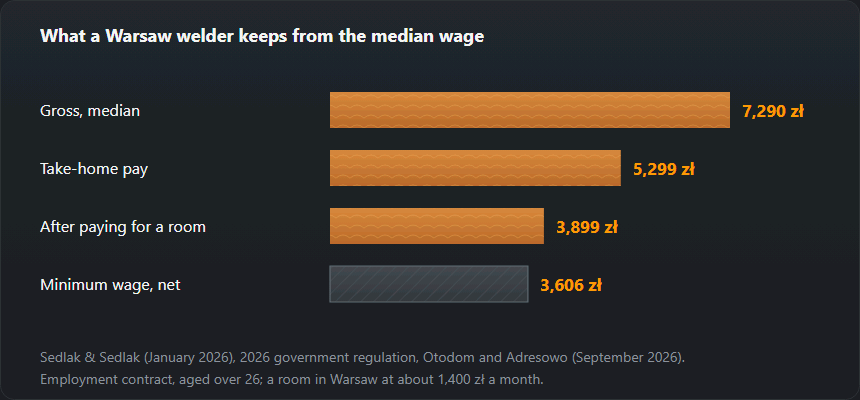
The middle of the market is about 7,290 zł gross a month — the median for the job title “welder” in the Polish National Salary Survey (Sedlak & Sedlak, data for January 2026). The middle half of welders earn 6,300–8,520 zł. Take-home pay on an employment contract is about 5,299 zł. In Warsaw, job ads in September 2026 quote 6,000–14,000 zł gross, and permanent jobs without a middleman usually 6,800–8,100 zł. The legal floor is the minimum wage: 4,806 zł gross from 1 January 2026.

Where the numbers come from: GUS, Sedlak & Sedlak and job ads
There is no single “official welder salary”. There are three kinds of data, each measuring something different, so they are collected in one table with a date next to every amount.
| Source | What it measures | Gross amount | Data as of |
|---|---|---|---|
| GUS | Average of group 721 (moulders, welders, sheet-metal and structural workers) | 7,949 zł/month | October 2024 |
| GUS | Median of the same group; one in ten below 4,500 zł, one in ten above 11,570 zł | 7,384 zł/month | October 2024 |
| GUS | Average hourly pay in group 721 (employees) | 41.91 zł/hour | October 2024 |
| Sedlak & Sedlak (OBW) | Median for the job title “welder”; the middle half earn 6,300–8,520 zł; sample of 1,034 | 7,290 zł/month | January 2026 |
| Jooble | Average across job ads for all of Poland (offers, not payslips) | 8,821 zł/month | July 2026 |
| OLX, Jooble — Warszawa | Ranges in Warsaw job ads; permanent jobs without an agency usually 6,800–8,100 zł | 6,000–14,000 zł/month | September 2026 |
| Council of Ministers regulation | Statutory minimum wage; an employment contract may not pay less | 4,806 zł/month | from 1 Jan 2026 |
GUS reports an occupational group rather than a single job title, and its data are two years old; the Sedlak & Sedlak survey is self-reported; job portals count offers, not payslips. That is why the numbers differ — and why all three are shown side by side.
How to read the table
- GUS (Statistics Poland) is the only source based on payroll records rather than self-reports or adverts. It has two drawbacks: the data are from October 2024 (when the minimum wage was 4,300 zł), and they cover all of group 721 — sheet-metal workers, moulders and structural fitters alongside welders. The publication gives no separate figure for welders alone.
- Sedlak & Sedlak surveys people in welding jobs, so it hits the trade more precisely, but relies on what respondents entered themselves. Sample: 1,034 people.
- Job portals show what employers promise today. An offer is the top of a range, not what lands in the account — and the highest figures often belong to jobs abroad or agency work with overtime.
Despite the different methods, the middle agrees remarkably well: the GUS median of 7,384 zł and the Sedlak & Sedlak median of 7,290 zł are less than a hundred złoty apart. For comparison, the median for employees of firms with 10 or more staff in Poland in October 2024 was 7,405 zł according to GUS. A welder earns roughly what the typical Polish employee earns — not less, as is often assumed.
Warsaw: what the job ads pay
A review of OLX and Jooble listings for Warsaw (September 2026) gives a very wide picture, which becomes readable once the ads are split into three kinds:
- A permanent job with a Warsaw employer — municipal companies, factories, service firms. The ranges are narrow: 6,800–8,100 zł gross. Less than the loudest adverts, but with a predictable schedule, paid holiday and no travelling across the country.
- Production work through an agency — the top figures of up to 14,000 zł gross usually come with shifts and overtime. Compare the hourly rate, not the monthly total: 14,000 zł for 250 hours is a different job from 8,000 zł for 168.
- Work abroad — adverts posted in Warsaw for sites in Germany or the Netherlands, with rates in euros. That is a different market, covered on the page welding work in the EU.
The average of Warsaw job ads on Jooble is about 8,800 złgross (September 2026), and 8,821 zł for Poland as a whole (July 2026). Both are roughly a thousand złoty above the payroll medians — which is exactly the gap between what employers promise in an advert and what they pay on average.
The capital pays more than eastern Poland, but it also costs more. When comparing a Warsaw offer with one from a smaller town, subtract housing from both net amounts: the difference can vanish into the rent.
MAG, TIG, pipe: where each process sits in the range
No public source splits welders’ pay by process — neither GUS nor Sedlak & Sedlak. The difference shows up only in job ads, and there it follows much the same pattern as the indicative table on our general page:
- Certified MIG/MAG (135) — the most vacancies and the middle of the market: roughly 6 500 – 9 000 zł gross. Both medians from the sources table fall here. Flux-cored wire (136) pays similarly, but more often on structural erection and out of position — what those numbers mean is explained on 135 vs 136 vs 138.
- TIG (141) on carbon steel — roughly 8 000 – 11 000 zł; on stainless and aluminium 10 000 – 14 000 zł. Individual Warsaw ads can be lower: a TIG aluminium vacancy in September 2026 offered 6,800–7,580 zł gross. The range for a process is a ceiling, not a guarantee.
- Pressure pipework, orbital welding, EXC3–EXC4 structures — the top shelf, roughly 12 000 – 18 000 zł. This adds non-destructive testing of every weld and a qualification passed on pipe in the H-L045 position.
The full table by process and why the gaps exist — on the page what a welder earns. The certificate range employers actually pay for can be checked with the qualification range calculator.
Gross vs net: what a welder takes home
Amounts in adverts and statistics are almost always gross. On an employment contract, pension, disability and sickness contributions, the health contribution and the income-tax advance come off the gross. Two reference points from official data:
- the minimum wage of 4,806 zł gross gives 3,605.85 zł net;
- the welders’ median of 7,290 zł gross gives about 5,299 zł net.
So 72–75 % of gross reaches the account, closer to the lower figure as pay rises. The biggest exception: anyone under 26 pays no income tax on earnings up to the youth relief limit, so the same gross pays out noticeably more. Social insurance and the health contribution are paid regardless of age.
One advert gives gross, another “take-home”, a third a net hourly rate on B2B. The difference looks like a pay rise, but it is only a different basis. Before comparing, bring all three to one: monthly net after every cost.
Welder hourly rate in Poland
The hourly rate is the fairest measure because it does not depend on overtime. From the available data:
- GUS: an average of 41.91 zł gross per hour in group 721, employees, October 2024;
- Jooble: an average of 55.13 zł gross per hour in offers across Poland, July 2026;
- Warsaw ads for TIG and MIG/MAG, September 2026: 60–85 zł gross per hour;
- the minimum on a civil contract (umowa zlecenie) in 2026: 31.40 zł gross per hour.
A worked example: the median of 7,290 zł gross over a typical 168-hour month is about 43.39 zł gross per hour — close to the GUS average. An offer of “60 zł an hour” is therefore well above the middle of the market, but only if both amounts are gross and on the same kind of contract.
UoP, zlecenie, B2B and agencies: the same money, different results
| Contract | Legal floor | What comes off the amount | What to watch |
|---|---|---|---|
| Employment contract (UoP) | 4,806 zł/month | Employee social insurance (ZUS), health contribution, income-tax advance | Paid holiday and sick pay are included; always compare offers in gross |
| Umowa zlecenie (civil contract) | 31.40 zł/hour | Usually the same contributions as UoP if it is the only contract | No paid holiday; hours must be recorded |
| Self-employed (B2B) | none | Your own ZUS, tax and bookkeeping; idle days and holidays earn nothing | An invoice rate is not a salary — work out what is left after costs |
| Temporary work agency | as UoP or zlecenie | As under the chosen contract; housing often on top | Who pays for housing and travel decides the result |
How to compare employment with B2B: take the invoice rate, multiply it by the hours you will really work in a year (without holidays, bank holidays and gaps between contracts), then subtract social insurance, tax under your chosen regime and bookkeeping. Only compare that with the annual net on an employment contract, remembering that employment includes 20 or 26 days of paid holiday. With short, uncertain contracts B2B loses even at a rate that looks impressive in the advert.
For foreign welders: what is left after housing
For someone coming to Poland for work, what matters is not the gross but what is left after housing. A room in Warsaw costs about 1,400 zła month on average in listings (Otodom and Adresowo, September 2026), within 1,000–1,800 zł. The sum at the median:
| Item | Amount | Where from |
|---|---|---|
| Take-home pay at the median (UoP, over 26) | 5,299 zł | Sedlak & Sedlak, January 2026 |
| A room in Warsaw, rent | − 1,400 zł | Otodom, Adresowo, September 2026 |
| Left for food, travel, phone and savings | 3,899 zł | difference |
Agencies often promise “free accommodation” or housing for a small fee. That changes the result by more than a thousand złoty, so ask three things: how many people share a room, who pays for travel to the plant, and how the housing is charged. From pay under an employment contract, an employer may deduct amounts other than the statutory ones only with the employee’s written consent (Article 91 of the Polish Labour Code) — an automatic deduction without it is a warning sign. A temporary work agency can be checked in the Polish register of employment agencies (KRAZ).
Residence and work permits are a separate matter from welding certificates: what to bring, what an employer will accept and what has to be retaken — on the page welding work for foreign workers. Which documents hide behind the Polish word “uprawnienia” — welding certificates in Poland.
How to compare two offers in five minutes
- Bring both amounts to gross per month on the same kind of contract.
- Divide by the hours in the schedule — overtime is counted separately.
- Check that the advert names the process, material and positions. “Welder” without a process number is often a helper’s job.
- Subtract housing and travel if the offer does not cover them.
- Ask whether the welds are inspected. Work under RT/UT is the top shelf and usually a higher rate — but it requires a valid certificate for that process.
We update the amounts on this page when GUS publishes new data and a new edition of the salary survey comes out. The date next to each figure tells you how fresh it is. How to get the certificates that move you up the range, and what they cost — welding courses: cost and length.
Frequently asked questions
What is the welder salary in Warsaw in 2026?
Warsaw job ads in September 2026 offer 6,000–14,000 zł gross a month for employed welders, and permanent jobs without an agency usually sit at 6,800–8,100 zł gross. The national median from the Polish National Salary Survey (January 2026) is 7,290 zł gross, which is about 5,299 zł take-home.
How much does a welder take home in Poland?
At the median of 7,290 zł gross on an employment contract, about 5,299 zł net is left (Sedlak & Sedlak, January 2026). At the minimum wage of 4,806 zł gross it is 3,605.85 zł net. Workers under 26 pay no income tax up to the relief limit, so the same gross amount pays out more.
What is the hourly rate for a welder in Poland?
For employees, an average of 41.91 zł gross per hour in the welders’ occupational group according to GUS (October 2024). Job ads in 2026 average about 55 zł gross, and Warsaw ads for TIG and MIG/MAG quote 60–85 zł gross per hour. A civil contract (umowa zlecenie) may not pay less than 31.40 zł gross per hour.
Why do GUS and the job portals give different numbers?
They measure different things. GUS covers the whole group 721 (welders, sheet-metal workers, structural fitters, moulders) from October 2024: median 7,384 zł. The Sedlak & Sedlak survey asks welders themselves (January 2026): median 7,290 zł. Portals count offers, and offers usually run higher than payslips. The middle still lands close together — around 7,300 zł gross.
How much is left for a foreign welder after rent in Warsaw?
With a median net of 5,299 zł and a room at about 1,400 zł (Otodom and Adresowo average, September 2026), roughly 3,899 zł is left for food, travel and savings. Agency housing can be cheaper or included — in that case check that it is not deducted from your pay without your written consent.
Is an employment contract or B2B better for a welder?
Compare what is left after every cost, not the rate. An employment contract includes paid holiday (20 or 26 days a year), sick pay and contributions partly paid by the employer. On B2B every idle day earns nothing, and social insurance, tax and bookkeeping are yours to pay. B2B usually wins only at a clearly higher rate and a full schedule.
Updated: