Working as a welder in the EU with a non-EU certificate
Skill transfers across borders; paperwork does not. For a welder arriving from outside the Union, almost all of the difficulty is in the second category — and it is solvable in a predictable order.
Short answer
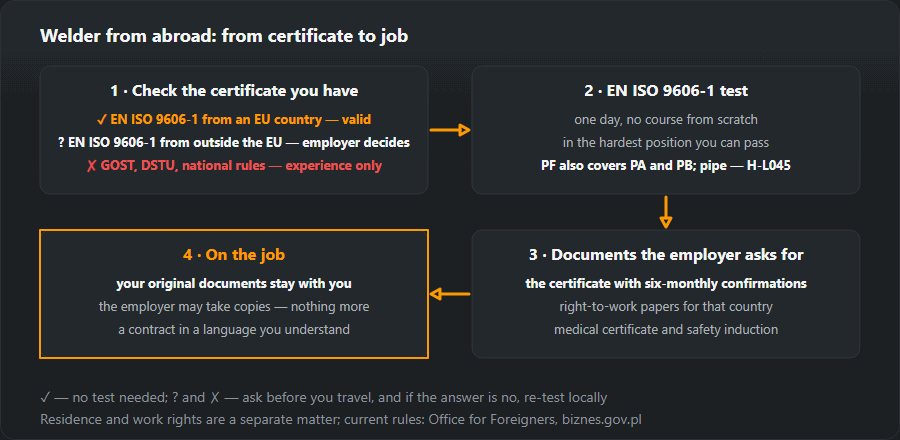
An EN ISO 9606 certificate from an accredited body in any EU country is normally accepted across the Union. A certificate from outside the EU is not recognised automatically — the employer, its certification body or the client decides, and often the test is sat again, though a practising welder usually needs only the examination and not a full course. Beyond the paper you need a medical, safety induction, and enough of the language to read a WPS.
Certificate recognition
A document issued under GOST, DSTU or other national rules is not an EN ISO 9606-1 certificate: it shows experience, not a qualification. A certificate to EN ISO 9606-1 issued outside the EU is a different case, and there is no automatic answer for it either way. The standard does not decide who must accept it: that is up to the employer and, depending on the work, to the certification body behind its EN 1090 certificate, the notified body for pressure equipment, or the client — and contracts increasingly ask for certificates from an accredited third-party body they recognise. Ask before you travel; if the answer is no, the route is a re-test.
The practical answer is not to argue but to re-sit. An accredited centre will take an examination on its own, without a course, and an experienced welder normally passes first time. Cost and time: one day and one examination fee, against three weeks and a course fee for the route people are often sold instead.
| The right to work | The qualification | |
|---|---|---|
| Who decides | The voivodeship office and the employer | The certifying body |
| Document | A work permit or the employer’s declaration, plus a residence title | An EN ISO 9606-1 certificate and the welder’s book |
| Depends on | Citizenship, residence status, type of contract | Only on passing the test |
| How long it takes | Weeks to months | One day |
Choosing what to certify
Certify for the work you intend to do, in the hardest position you can pass. Positions cover downwards, so a test in PF covers PA and PB while PA covers almost nothing else — the ranges are in the qualification range calculator.
For structural fabrication: 135 (MAG solid wire) on plate, in PF. For pipe and process work: 141 (TIG) for roots plus 111 or 135 for fill, in H-L045 if you can. For everything: check the material group on the certificate, because a group 1 steel certificate says nothing about stainless.

What a site will ask for
- The EN ISO 9606-1 certificate, with current six-monthly confirmation signatures.
- Right-to-work documentation for the country in question.
- A safety induction or passport, depending on the sector.
- A medical certificate for confined space or height work.
- Often an eyesight test.
Keep your own copies of everything, scanned. Certificates held only by an employer have a way of becoming difficult to retrieve when the contract ends.
Current residence and work conditions in Poland for your particular case are worth checking on the site of the Office for Foreigners and on the biznes.gov.pl portal — the rules change more often than anyone expects.
Language
Enough of the local language for safety instructions, and enough English to read a WPS. On international sites the documentation is in English regardless of where the site is, which is the practical reason for learning the English terminology even if you work in another language — the glossary is arranged for exactly that.
What to be careful about
Two things come up repeatedly. Agencies that hold your documents — there is no legitimate reason for anyone else to keep your originals. Contracts that are unclear about which country's law applies, which determines your pay, your notice and your social security. Both are worth resolving before starting rather than after; the framework is described in welding work in the EU.
What a foreign welder earns in Poland
The same as any welder in the same job: the rate follows the market and the certificates, not the passport. In the Polish national salary survey (Sedlak & Sedlak, January 2026) the median for the job title “spawacz” is 7,290 zł gross a month, and the middle half of welders earn 6,300–8,520 zł. The 2026 minimum wage of 4,806 zł gross applies whatever your citizenship.
With offers that include accommodation, what counts is the amount after deductions. A room in Warsaw costs about 1,400 zł a month (range 1,000–1,800 zł); if an agency deducts more than that for a bed in a shared room, the agency is making money on the housing, not you. Rates by process, contract type and city — welder salary in Poland.
Agency or direct: what to check before you sign
In Poland a recruitment or temporary-work agency operates legally only if it is entered in the register of employment agencies (KRAZ) — checking the number in the register search takes two minutes. Other EU countries keep similar registers or licences. A demand for money up front “for finding you a job” is a signal to keep looking.
- A contract in a language you understand, before you travel or before the first day — not “on site”.
- The type of contract: direct employment, a civil contract or agency work — it decides contributions, holiday and notice.
- Gross and net rate in writing, hours per month, overtime rate.
- Deductions for housing, transport and workwear — as amounts, not “at cost”.
- Who pays for the test and how long you must work it off.
- Your original documents stay with you. An employer may copy your passport and certificate; nobody has the right to keep them.
Showing experience your papers do not show
A non-EU certificate will not give you a qualification, but it can get you a trial weld. A recruiter at a steel fabrication shop reads fast, so prepare one page:
- your processes as ISO 4063 numbers — 111, 135, 136, 141 — rather than “stick, MIG, argon”; the numbers are in the process table;
- materials: structural steel, stainless, aluminium — and thicknesses;
- the positions you really weld in production, written as PA–PF or PH, PC, H-L045;
- the kind of work: building frames, pipelines, tanks, ships;
- photos of your own welds — the face and, if you have one, a broken test piece.
From a list like that an employer sees at once which test to book you on and whether a trial weld is worth it. Attach the old certificate as proof of experience, not as a qualification.
First certificate by industry
Structural shops and pipe work are covered in the section on choosing what to certify above. Two more common entry routes:
- Shipyards and heavy fabrication — often flux-cored 136 in several positions; about the process — flux-cored arc welding.
- Food and chemical plant — 141 on stainless, which is a different material group from ordinary steel; details — welding stainless steel.
How the test runs and why people fail it is described under welder qualification to EN ISO 9606-1. Who issues certificates in Poland (Instytut Spawalnictwa, TÜV, UDT-CERT), what the test costs and how an employer checks the document — welder certification in Poland.
Frequently asked questions
Will my certificate from outside the EU be accepted?
There is no automatic answer. A certificate to EN ISO 9606-1 issued outside the EU is not void, but it is not recognised automatically either: the employer decides, and depending on the work so do the certification body behind its EN 1090 certificate, the notified body for pressure equipment, or the client. Many ask for a re-test with a body they accept, so be ready to re-sit at an accredited European centre — for someone who can already weld that is a day, not a course.
Can I sit the examination without taking the course?
Yes. Accredited centres take examinations on their own, and that is exactly the right route for an experienced welder without EU paperwork. Ask for an examination booking rather than a course place, and say what you can already do.
Which qualification should I take first?
The one matching the work you want, in the hardest position you can pass. For structural fabrication that is 135 in PF; for pipe, 141 plus 111 in H-L045. One well-chosen certificate opens more doors than three easy ones.
How much does a foreign welder earn in Poland?
What the market pays for the certificates held: the median for the job title “spawacz” in the Polish national salary survey (January 2026) is 7,290 zł gross a month, and the middle half earn 6,300–8,520 zł. The minimum wage of 4,806 zł gross applies to everyone.
Is an EN ISO 9606-1 certificate from one EU country valid in another?
Yes, if it was issued by an accredited certifying body and the six-monthly confirmations are unbroken. The standard is common to the whole Union. An employer may still ask for a trial weld before letting you on production work — that is their right, not a challenge to the certificate.
Can I take the welder test before I have a work permit?
Yes. The test does not depend on residence status — the certifying body judges the weld, not your residence papers. Run both in parallel, so that the certificate is ready on the day the paperwork comes through.
Updated: