Welding qualifications in Poland
To weld in Poland you need an examination certificate to EN ISO 9606-1 — the świadectwo egzaminu spawacza — covering the process, material, thickness and position of the job, with its six-monthly confirmations signed. A certificate from the EU is valid as it is; one from outside the EU usually means re-sitting the examination at a Polish accredited centre.
What documents a welder needs in Poland
Find your case in the list — it decides what you have to do next.
- You hold an EN ISO 9606-1 certificate from an EU country. It is valid in Poland. Bring a translation and make sure the six-month confirmations are up to date — an unsigned half-year is the most common reason a good certificate is turned down on site.
- Your certificate was issued outside the EU. As a rule it is not recognised directly. You re-sit the examination at a Polish accredited centre. If you can already weld, that is an examination, not a course.
- You have no certificate at all. Course plus examination at an accredited centre, for the process you will actually work with.
- Separate documents, separate cases. The UDT examination is only for vessels, boilers and pipework under technical supervision. Welding PE pipe for gas and water needs its own qualification recognised by the network operator. The książeczka spawacza (welder’s booklet) is a record book, not a qualification. And if you are not an EU citizen, the right to work legally is a separate question from welding — see welding work for foreign workers.

Uprawnienia, kwalifikowanie, certyfikacja: what each word means
Three words describe the same road but mean different things. The job advert says “uprawnienia”, the document says “świadectwo”, and the training centre writes “certyfikacja”. Worth sorting out before you pay for anything.
| The word | What it actually means | Who uses it |
|---|---|---|
| Uprawnienia spawalnicze | The word from job adverts and conversation. No document carries that name — behind it stands the świadectwo egzaminu kwalifikacyjnego spawacza | Employers, job adverts, welders themselves |
| Kwalifikowanie | The term used by PN-EN ISO 9606: testing a welder’s skill on a test piece. The result is the świadectwo | The standard and the examining body |
| Certyfikacja spawaczy | Third-party attestation to PN-EN ISO/IEC 17024. A welder under 9606 is qualified, not certified; what gets certified is coordination personnel — IWE, IWT, IWS, IWP | Certification bodies and job adverts — often wrongly |
| Świadectwo egzaminu | The document itself: it carries the range code — process, product form, material group, thickness, diameter, position | The standard, the body, the site manager |
| Książeczka spawacza | Not a qualification in itself but a booklet the qualifications and six-month confirmations are written into. On its own it entitles you to nothing | The training centre, the employer, welding coordination |
Six documents, one word
Behind the word “uprawnienia” sit six different Polish documents. It is not only candidates who mix them up: an advert will ask for “uprawnienia UDT” where a 9606 certificate is enough — and, the other way round, nobody asks about UDT on a vessel that really is under statutory supervision.
| Document | Who issues it | What it entitles you to | Validity |
|---|---|---|---|
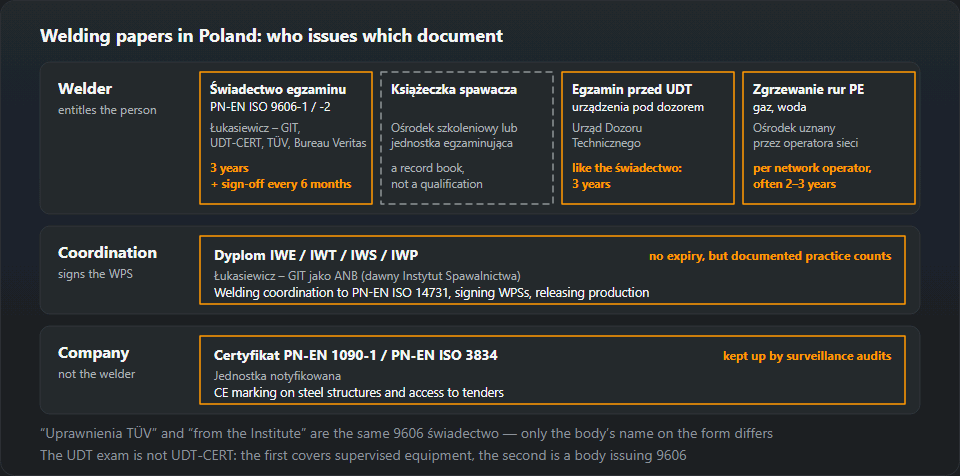
| Świadectwo egzaminu spawacza PN-EN ISO 9606-1 / -2 | Łukasiewicz – GIT, UDT-CERT, TÜV, Bureau Veritas i inne akredytowane | Making joints within the range written into the code: process, product form, material group, thickness, diameter, position | Three years, with a confirmation every six months |
| Książeczka spawacza | Ośrodek szkoleniowy lub jednostka egzaminująca | To nothing — it is a record book. Without the świadectwo it is an empty booklet | Indefinite — what counts is the entries, not the booklet |
| Egzamin przed UDT dla urządzeń podlegających dozorowi | Urząd Dozoru Technicznego | Welding vessels, boilers and pipework subject to statutory technical supervision | As on the świadectwo: three years with confirmations |
| Uprawnienia do zgrzewania rur PE (gaz, woda) | Ośrodek uznany przez operatora sieci | Butt and electrofusion welding of polyethylene — a different world from arc welding | Set by the network operator, usually two to three years |
| Dyplom personelu nadzoru IWE / IWT / IWS / IWP | Łukasiewicz – GIT jako ANB (dawny Instytut Spawalnictwa) | Acting as welding coordinator under PN-EN ISO 14731, signing WPSs and releasing production | The diploma does not expire, but documented practice is what counts |
| Certyfikat zakładu PN-EN 1090-1 / PN-EN ISO 3834 | Jednostka notyfikowana | It entitles the company, not the welder: CE marking on steel structures and access to tenders | Maintained by the body’s surveillance audits |

How to get a welding certificate in Poland, step by step
- Choose the body, not just the school. Training centres prepare you; the świadectwo is issued by an accredited body — Łukasiewicz – GIT, UDT-CERT, TÜV, Bureau Veritas and others. Ask the centre which body will sign your certificate and check that body’s accreditation. Accreditation, not the sign over the door.
- Pick the process and position for the work you want. Not the easiest test, not every process on offer — the combination employers in your trade ask for. The table further down gives the usual choices: 135 on plate in PB and PF for shop fabrication, 111 plus 135 in PF and PE for site erection, 141 on pipe in H-L045 for pipework.
- Weld the test piece. You weld a plate or a pipe to a pWPS or WPS, in the chosen position, under the eye of an examiner.
- Testing. Visual inspection comes first and ends the attempt if the piece fails it. Then, depending on material and thickness, radiography or ultrasonics, or bend or fracture tests. What exactly is checked and why is set out in the EN ISO 9606-1 test explained.
- Receive the świadectwo. Check the code before you leave: process, product form, material group, thickness, diameter, position. Every field is a limit on what you may weld.
- Keep it alive. Every six months the employer or welding coordinator confirms that you have welded within the range. The certificate runs for three years on that condition.
Instytut Spawalnictwa: what happened to it
The name is still in circulation, but no institution carries it any more. Instytut Spawalnictwa in Gliwice joined the Łukasiewicz Research Network in 2019 and merged with other units in 2022 into Łukasiewicz – Górnośląski Instytut Technologiczny. Certificates and diplomas issued under the earlier names remain valid and do not need replacing.
It is the same centre that acts as the Polish ANB — the authorised national body of the International Institute of Welding — and issues the IWE, IWT, IWS and IWP diplomas. So “a qualification from the Welding Institute” usually means one of two things: a welder’s examination certificate, or a coordination personnel diploma. Those are entirely different documents and entirely different routes.
Instytut Spawalnictwa, TÜV, UDT-CERT: who is who
Examinations are run by accredited certifying bodies and by training centres authorised by them. The best known is Instytut Spawalnictwa in Gliwice — now part of Łukasiewicz — whose certificates are recognised across the EU, but any accredited body issues a valid EN ISO 9606-1 document.
- Łukasiewicz – GIT (formerly Instytut Spawalnictwa) issues welder’s examination certificates and, as the ANB, the IWE/IWT/IWS/IWP diplomas for coordination personnel.
- TÜV and Bureau Veritas issue the same EN ISO 9606-1 świadectwo. “Uprawnienia TÜV” is not a separate kind of qualification — it is the same certificate with a different body’s name on it.
- UDT-CERT is likewise listed among the bodies issuing 9606 certificates. Do not confuse it with the UDT examination held by Urząd Dozoru Technicznego, which concerns equipment under technical supervision. The similar names are where much of the “uprawnienia UDT” confusion comes from.
What matters is the accreditation, not the name on the building. A "diploma" from a school that is not an accredited body is a course attendance record and nothing more, and site inspectors know the difference.
What the price is made of
You will not find figures here: they differ several-fold between centres and go stale faster than they get published. What does not change is what the price is made of — and with that you can compare two quotes and see why one is twice the other.
| What you pay for | What moves it |
|---|---|
| The course | The process, the number of hours, and whether you start from nothing or refresh an existing skill. For a working welder it is often half as long |
| Test material | Plate or pipe, material group, number of attempts. Stainless and pipe cost more than non-alloy plate |
| The examination | The body, and whether the examination happens on its premises or it travels to the centre |
| Testing the coupon | VT is cheapest, RT or UT dearer, destructive testing dearest. This is usually the biggest difference between two quotes |
| Paperwork | The świadectwo, the booklet, copies in other languages |
| Keeping it alive | Six-month confirmations cost nothing. A re-examination costs what the first one cost |
Course and cost
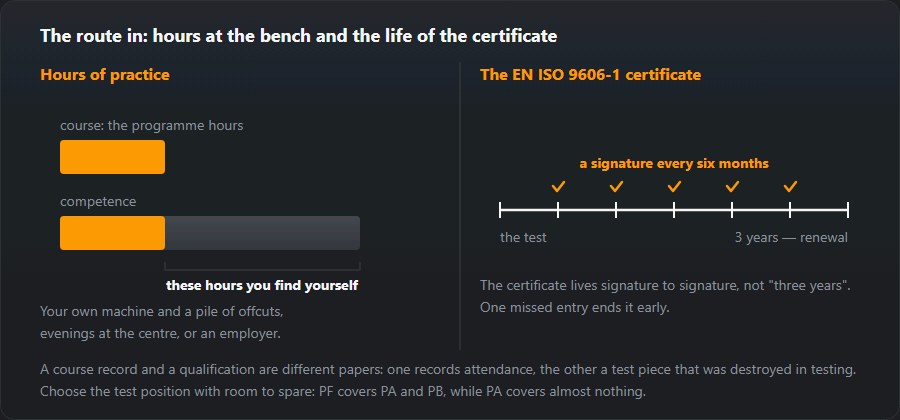
A basic course for one process is mostly bench time, and its length depends on the process and on where you start from. Costs move, so the figure worth asking about is what is included: the number of practice hours, the consumables, the examination fee and whether a re-sit is covered. A cheap course that charges separately for every re-sit is rarely cheap.
Someone who already welds does not need the course. Accredited centres will take an examination on its own, which is the sensible route for an experienced welder without EU paperwork — see welding work for foreign workers for what employers ask for besides the certificate.
Which processes are worth certifying
Structural fabrication runs on 135 (MAG solid wire) and 136 (flux-cored). Pressure and pipe work adds 141 (TIG) for root runs, usually combined with 111 for the fill. A welder holding 141 plus 111 or 135, in position PF and on pipe, is employable almost anywhere in the EU.
One certificate per process, and the ranges are worked out in the qualification range calculator. Certifying a process you never use is money that buys a piece of paper you then have to keep confirming every six months.
| Where you plan to work | What is worth certifying |
|---|---|
| Steel structures, in the shop | 135 (MAG), plate, positions PB and PF |
| Site erection | 111 (MMA) plus 135, positions PF and PE |
| Pipework and installations | 141 (TIG) on pipe, position H-L045 (6G) |
| Stainless, food industry | 141, material group 8.1 |
How an employer checks your certificate
A serious employer or site inspector does not just glance at the header. Expect four checks, in this order:
- Number and issuing body. Is the body accredited, and does the certificate number exist in its records? A document with no identifiable body stops the conversation here.
- The code against the job. Process, material group, thickness, diameter, position. Take a certificate for 135 on plate, butt weld, test piece 10 mm, position PF. It covers thicknesses from 3 to 20 mm and positions PA, PB and PF. A 16 mm plate in PF is covered; a 25 mm plate is not, and neither is overhead work in PE. A pipe test on Ø 114.3 mm in H-L045 covers diameters from 57.2 mm up and every position from PA to PF — and, being on pipe over 25 mm, plate as well. Your own case can be checked in the range calculator.
- The six-month confirmations. Every half-year must be signed. A gap means the certificate lapsed, whatever the date on the front says.
- The certificate against the WPS. The process and conditions on your certificate have to match the qualified procedure you will weld to. The certificate does not authorise a joint on its own — see what a WPS is. A 135 certificate does not cover a job the WPS writes for 136.
Common mistakes foreign welders make
- Showing the booklet instead of the certificate. The książeczka records qualifications; it does not replace the świadectwo. Bring both, but the świadectwo is what gets checked.
- Paying for “uprawnienia UDT” when 9606 is enough. Unless the job is on equipment under technical supervision, the UDT examination is not what the employer needs — ask before paying.
- Certifying a process you do not work with. 135 does not cover 136, TIG does not cover MAG. A certificate the employer cannot use is paper you still have to keep confirming.
- Letting a confirmation lapse. It happens most often when changing employer or between contracts: nobody signs for the half-year and the certificate quietly ends. Ask for the signature before you leave a job.
- A diploma from a school that is not accredited. It proves you attended a course. It is not a qualification, and the site inspector will tell the difference at a glance.
For the wider picture of where Polish and other EU certificates take you, see welding work in the EU.
Beyond the welder
A company doing structural steel in the EU also needs EN 1090 certification — factory production control, a responsible welding coordinator and qualified procedures. That is the employer's obligation and not the welder's, but it explains why a serious fabricator will ask for your certificate before letting you near a joint: their own certification depends on every welder on site being covered.
Frequently asked questions
Do I need Polish paperwork if I already hold an EU certificate?
No. EN ISO 9606-1 is a European standard and a certificate from an accredited body in any EU state is valid in Poland. What you may be asked for is a translation and proof that the six-month confirmations are up to date.
What about a certificate from outside the EU?
It is generally not recognised directly. In practice welders re-sit the examination at a Polish accredited centre — for someone who can already weld that is an examination, not a full course.
Is the "welder's book" still a thing?
The old booklet is a record, not a qualification. What counts is the current EN ISO 9606 certificate with valid confirmations. Employers still ask to see the booklet because it shows continuity of employment, but it is not what an inspector checks.
What documents does a welder need to work in Poland?
For the welding itself, one document: an examination certificate to EN ISO 9606-1 (świadectwo egzaminu spawacza) whose range covers the process, material, thickness and position of the job, with the six-month confirmations signed. A certificate from an accredited body in the EU is accepted as it is; one from outside the EU usually means re-sitting the examination in Poland. Citizens of non-EU countries also need the documents that allow them to work legally — that is a separate matter from the welding certificate.
Is a UDT certificate required to weld in Poland?
Only for work on vessels, boilers and pipework that are subject to technical supervision by Urząd Dozoru Technicznego. For steel structures, machinery and ordinary fabrication the EN ISO 9606-1 certificate is what is required. Adverts often write „uprawnienia UDT” loosely — ask what equipment the job actually involves.
How long does a Polish welding certificate last?
Three years, on condition that every six months the employer or the welding coordinator confirms that you have been welding within its range. A missed confirmation ends it before the three years are up. At the end of the term it is renewed by a new examination or, where the certifying body allows that route, on the basis of documented production tests.
Updated: