How much a welding course costs and what the price includes
Course prices vary by country and by year, so the useful question is not the headline figure but what is inside it. Here is what to compare.

How long each process takes
These are course lengths, not competence timelines. A three-to-four-week MAG course gets a motivated beginner through an examination on plate; it does not make them a production welder, and the honest centres say so.
A course is only one stage: the whole route from zero, from choosing a process to the test and a first job, is laid out in how to become a welder.
| Course | Length | Hours | Cost | Who it is for |
|---|---|---|---|---|
| MMA (111), basic | 3–4 weeks | 120–150 | 2,000–3,000 zł | Repairs, structures, site work |
| MAG (135), basic | 3–4 weeks | 120–160 | 2,200–3,200 zł | Production — the fastest route to a job |
| Flux-cored (136) | 3–5 days | 40–60 | — | A short add-on after 135, charged by the day |
| TIG (141), basic | 4–5 weeks | 140–180 | 3,000–4,500 zł | Stainless, aluminium, thin material |
| Pipe and positional, beyond basic | 2–4 weeks | 80–120 | 2,500–4,000 zł | After the basic course, the way into pipework |
| The examination and renewal alone | 1 day | — | 600–1,500 zł | For those already welding |
Polish market prices, in złoty, as of 2026. The hours are the whole programme, not bench time alone.
What the price should include
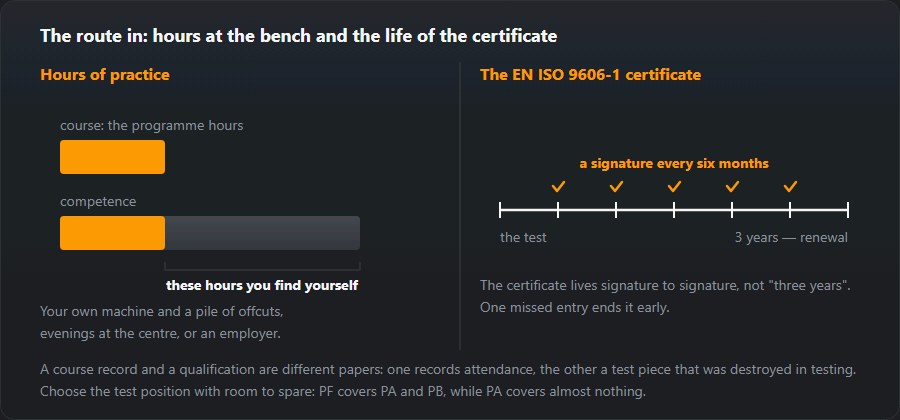
Bench hours. The number that matters. Two courses at the same price can differ by a factor of two here, and the classroom hours are not what you are buying.
Consumables. Electrodes, wire, gas, plate. Some centres include a generous allowance; others charge for everything past a minimum, and the practice you need then becomes an open-ended cost.
The examination fee. Frequently separate, and it is a significant fraction of the total.
Re-sits. Ask directly what a failed test costs. First-time pass rates on TIG and on positional work are not high, and a centre that charges a full examination fee for each attempt has a different total price from one that includes one re-sit.
Funding
Across the EU, welding appears on shortage-occupation lists, and that usually means public funding exists in some form: labour-office schemes for the unemployed, employer-sponsored training, sector funds, and EU programmes for retraining. It is worth an hour of research before paying privately — the money is often there and rarely advertised.
Employers also frequently pay for the certificate of a welder they have already hired, with a service commitment attached. Read that commitment: a two-year tie for a course worth a fortnight's pay is not always a good trade.
In Poland the schemes for the unemployed are described on the gov.pl portal, and the list of bodies supervising equipment and certification is published by the Office of Technical Inspection (UDT).
What the certificate is worth afterwards
An EN ISO 9606-1 certificate from an accredited body is recognised across the EU and is what a site will ask to see. A course attendance certificate from an unaccredited school is a receipt.
Check that the centre issuing it is accredited before booking, not after. And remember the certificate needs a six-monthly confirmation signature to stay valid — the requirement that most often invalidates one, as described in the qualification test article.
Frequently asked questions
What should I check before booking?
Four things: how many hours are at the bench rather than in a classroom, whether consumables are included, whether the examination fee is included, and what a re-sit costs. A cheap course that charges separately for all four is rarely the cheap option.
Can I skip the course and just sit the exam?
Yes, if you can already weld. Accredited centres take examinations on their own, and for an experienced welder without EU paperwork that is the sensible route — one day rather than three weeks.
Is an online welding course worth anything?
For the theory behind a coordinator qualification, yes. For welding itself, no: the skill is in your hands and it is examined on a destructively tested test piece. No amount of video substitutes for bench hours.
Updated: