Rebar weight calculator and chart
An 8 mm rebar weighs 0.395 kg/m, 10 mm 0.617, 12 mm 0.888 and 16 mm 1.578 kg/m. Below: a calculator for the weight per metre and per bar, a chart of 14 sizes from 6 to 40 mm with 6 m and 12 m bar weights, and a “metres of rebar per tonne” table.
Short answer
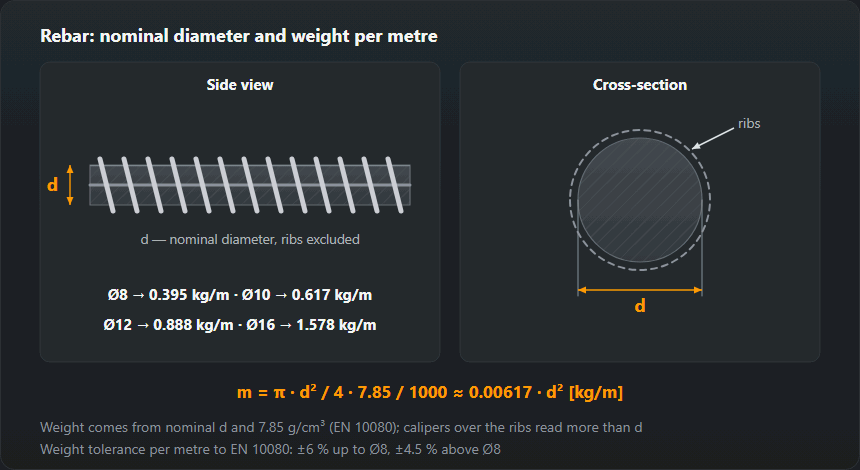
Rebar weight is 0.00617 · d² kg/m (d = nominal diameter in mm): EN 10080 takes the nominal mass from the area of a circle of the nominal diameter at 7.85 g/cm³, so the ribs do not change it. A 12 mm bar weighs 0.888 kg/m, a 12 m length 10.65 kg, and one tonne of 12 mm rebar is 1 126 m. Metres per tonne for every size are below.

Rebar weight chart: 6–40 mm
The nominal mass per metre is the same for B500A, B500B and B500C — it depends on the diameter only. The chart gives it to three decimals; EN 10080 rounds the same values to three significant figures (14 mm 1.21, 40 mm 9.86 kg/m).
| Diameter, mm | Cross-section, mm² | Nominal mass, kg/m | 6 m bar, kg | 12 m bar, kg | Mass tolerance EN 10080, % |
|---|---|---|---|---|---|
| 6 | 28.3 | 0.222 | 1.33 | 2.66 | ±6.0 |
| 8 | 50.3 | 0.395 | 2.37 | 4.74 | ±6.0 |
| 10 | 78.5 | 0.617 | 3.70 | 7.40 | ±4.5 |
| 12 | 113.1 | 0.888 | 5.33 | 10.65 | ±4.5 |
| 14 | 153.9 | 1.208 | 7.25 | 14.50 | ±4.5 |
| 16 | 201.1 | 1.578 | 9.47 | 18.94 | ±4.5 |
| 18 | 254.5 | 1.998 | 11.99 | 23.97 | ±4.5 |
| 20 | 314.2 | 2.466 | 14.80 | 29.59 | ±4.5 |
| 22 | 380.1 | 2.984 | 17.90 | 35.81 | ±4.5 |
| 25 | 490.9 | 3.853 | 23.12 | 46.24 | ±4.5 |
| 28 | 615.8 | 4.834 | 29.00 | 58.00 | ±4.5 |
| 32 | 804.2 | 6.313 | 37.88 | 75.76 | ±4.5 |
| 36 | 1 017.9 | 7.990 | 47.94 | 95.88 | ±4.5 |
| 40 | 1 256.6 | 9.865 | 59.19 | 118.38 | ±4.5 |
Bars are usually stocked in 12 m and 6 m lengths, small sizes also in coils. For any other length, type it into the “Length” field of the calculator. US bar sizes (#3, #4 … to ASTM A615) are designated differently and are not in this chart — enter their diameter in millimetres. The calculator uses the exact π/4·d²·7.85, so a whole bar may differ from the chart by 0.01 kg.
How many metres of rebar in a tonne
Merchants sell rebar by the tonne; the bar schedule lists metres. Metres per tonne = 1000 divided by the mass per metre: for 12 mm that is 1000 / 0.888 = 1 126 m, or about 94 bars of 12 m.
| Diameter, mm | Nominal mass, kg/m | Metres per tonne | 6 m bars per tonne | 12 m bars per tonne |
|---|---|---|---|---|
| 6 | 0.222 | 4 505 | 750.9 | 375.5 |
| 8 | 0.395 | 2 534 | 422.4 | 211.2 |
| 10 | 0.617 | 1 622 | 270.3 | 135.2 |
| 12 | 0.888 | 1 126 | 187.7 | 93.9 |
| 14 | 1.208 | 828 | 137.9 | 69.0 |
| 16 | 1.578 | 634 | 105.6 | 52.8 |
| 18 | 1.998 | 501 | 83.4 | 41.7 |
| 20 | 2.466 | 405 | 67.6 | 33.8 |
| 22 | 2.984 | 335 | 55.9 | 27.9 |
| 25 | 3.853 | 260 | 43.3 | 21.6 |
| 28 | 4.834 | 207 | 34.5 | 17.2 |
| 32 | 6.313 | 158 | 26.4 | 13.2 |
| 36 | 7.990 | 125 | 20.9 | 10.4 |
| 40 | 9.865 | 101 | 16.9 | 8.4 |
The other way round: 850 m of 10 mm bar weighs 850 × 0.617 = 524 kg. The real number of metres in a delivered tonne differs from the table within the mass tolerance — see below.
Why the ribs do not change the weight
A ribbed bar has no single diameter: the core is thinner and the ribs stand proud. So the standard does not measure the diameter, it measures the mass: the nominal diameter is the diameter of a plain round bar with the same mass per metre. EN 10080 works the nominal mass out from the nominal diameter at 7.85 g/cm³ — exactly what the calculator above does for a steel “Round bar”. A 12 mm rebar and a 12 mm plain round bar therefore weigh the same: 0.888 kg/m.
Mass tolerance. Under EN 10080 the actual mass per metre may deviate from nominal by ±6 % for sizes up to 8 mm and by ±4.5 % above 8 mm. One metre of 12 mm bar may thus weigh 0.848 to 0.928 kg, and a tonne holds roughly 1078 to 1179 m. When you pay by weight the weighbridge ticket counts; when you pay by length, the nominal mass in the table does.
Example: rebar for a strip footing
A 30 m strip footing, four 12 mm longitudinal bars, 6 mm links at 200 mm centres (151 links, 1.0 m developed length each).
- Longitudinal: 4 × 30 = 120 m × 0.888 = 106.6 kg.
- Links: 151 m × 0.222 = 33.5 kg.
- Total about 140 kg (106.6 + 33.5) — plus laps and cutting waste as per the drawing.
Tie wire is a separate small item and is not counted in the rebar mass.
What else to work out
Plain round and square bar (EN 10060, EN 10059) — steel round bar weight calculator; plate, tube, hollow section and angle — steel weight calculator; beams and channels — steel section weight table; cutting bars to length with the least waste — cutting plan.
Frequently asked questions
How much does 12 mm rebar weigh per metre?
0.888 kg (nominal mass to EN 10080). A 6 m bar weighs 5.33 kg, a 12 m bar 10.65 kg. 10 mm is 0.617 kg/m, 16 mm 1.578 kg/m.
How many metres of 12 mm rebar are in a tonne?
1 126 m, about 94 bars of 12 m. For 10 mm it is 1 622 m, for 8 mm 2 534 m, for 16 mm 634 m.
Does ribbed rebar weigh the same as plain round bar?
Yes, for the same nominal diameter. The nominal diameter of a ribbed bar is by definition the diameter of a plain bar of the same mass, and the mass is calculated at 7.85 g/cm³.
What is the mass tolerance of rebar?
Under EN 10080, ±6 % up to 8 mm and ±4.5 % above 8 mm. One metre of 12 mm bar may weigh 0.848 to 0.928 kg.
How much does a 6 m length of 8 mm rebar weigh?
6 × 0.395 = 2.37 kg. A 12 m bar weighs 4.74 kg, and a tonne of 8 mm rebar is 2 534 m.
Updated: