EN 1090 and the execution classes EXC1 to EXC4
EN 1090 is the European standard family for fabricated steel and aluminium structures. Part 2 sets the technical requirements and defines four execution classes, EXC1 to EXC4. The higher the class, the more the workshop has to prove: a welding quality system to EN ISO 3834, a qualified welding coordinator, qualified procedures and welders, and wider inspection.
Short answer
The designer sets the execution class; the workshop needs a certificate that covers it. From EXC1 to EXC4 the welding quality requirement rises from ISO 3834-4 to -3 to -2 (EXC3 and EXC4 share part 2). A welding coordinator to ISO 14731 is required from EXC2. The ISO 5817 level tightens from D to C to B (B+ at EXC4), and procedure qualification narrows to ISO 15614-1 or ISO 15613 at EXC3 and EXC4. Welders are tested to ISO 9606-1 in every class. If the documents name no class, EXC2 applies.
What EN 1090-1, -2 and -3 cover
- EN 1090-1 — conformity assessment of structural components: factory production control (FPC), CE marking and the declaration of performance. It says what the manufacturer has to prove.
- EN 1090-2 — technical requirements for the execution of steel structures: materials, cutting, bolting, welding, tolerances, inspection. It contains the execution classes and the welding requirements on this page.
- EN 1090-3 — the same for aluminium structures. Aluminium welds are assessed to ISO 10042, not ISO 5817 (ISO 10042 against ISO 5817).
How the execution class is chosen
The class is a design decision written into the specification; the fabricator does not pick it. Annex B of EN 1090-2 (informative) builds it from three inputs. EN 1993-1-1 gives a second route (Annex C in the 2005+A1:2014 edition).
- Consequence class CC1–CC3 — how serious the failure of the structure would be (EN 1990).
- Service category. SC1: static, quasi-static and low seismic actions. SC2: fatigue actions and medium or high seismic regions.
- Production category. PC1: non-welded components, and welded components in steel grades below S355. PC2: welded components in higher grades, welding on site, hot forming, heat treatment and end cuts of hollow-section lattice girders.

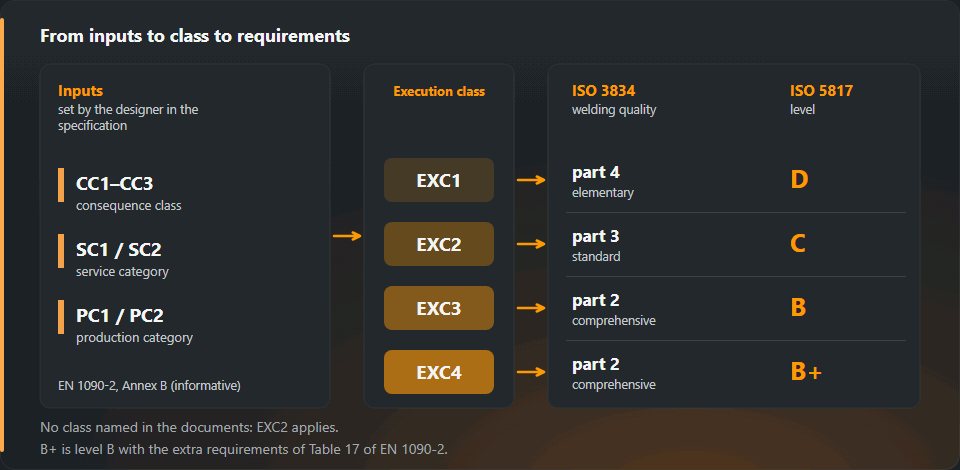
EN 1993-1-1 Annex C replaces the service and production categories by the type of loading and keeps EXC4 for structures with extreme consequences of failure. Typical use is a guide, not a rule: EXC1 farm buildings, EXC2 buildings in general, EXC3 bridges, EXC4 safety-critical structures. The class can be assigned to a whole structure or to a single component. When the documents name no class, EXC2 applies (EN 1090-2, clause 4.1.2). The matrix of Annex B (Table B.3) is not copied here: take it from the edition named in the contract.
Execution class: what the workshop needs
The table gathers the welding requirements of EN 1090-2 by class. Every class also needs welders tested to ISO 9606-1 (aluminium: ISO 9606-2).
| Class | Typical use | Welding quality (ISO 3834) | Welding coordinator (ISO 14731) | WPS qualification (EN 1090-2, Table 12) |
|---|---|---|---|---|
| EXC1 | farm buildings | part 4 — elementary | not required by EN 1090-2 | simpler routes allowed, see Table 12 |
| EXC2 | buildings in general | part 3 — standard | required; knowledge level from Table 14 | ISO 15614-1, 15613, 15612, 15611 or 15610 |
| EXC3 | bridges | part 2 — comprehensive | required; knowledge level from Table 14 | only ISO 15614-1 or ISO 15613 |
| EXC4 | safety-critical structures, extreme consequences of failure | part 2 — comprehensive | required; knowledge level from Table 14 | only ISO 15614-1 or ISO 15613 |
The class on the FPC certificate is a ceiling: a workshop certified for EXC2 may build EXC1 and EXC2 structures, not EXC3. ISO 3834 works the same way — a manufacturer that meets part 2 is taken to meet parts 3 and 4 (ISO 3834: parts 2, 3 and 4).
Factory production control and the certificate
EN 1090-1 (clause 6.3) asks for an FPC system based on ISO 9001 and made specific to EN 1090. Welding is a special process, so the part of ISO 3834 that matches the class is part of that system. A notified body audits it and issues the certificate; the manufacturer then CE-marks the components and issues the declaration of performance. The system covers:
- qualification of personnel;
- calibration and maintenance of equipment;
- purchasing specifications;
- fabrication controls and checks;
- treatment of non-conforming products;
- the welding quality system (ISO 3834).
Welding coordinator (ISO 14731)
EN 1090-2 requires welding coordination personnel for EXC2, EXC3 and EXC4. Their tasks and responsibilities follow ISO 14731: review of requirements, sub-contracting, personnel, equipment, production planning, inspection before, during and after welding, procedure qualification, WPS, consumables, identification and traceability. The knowledge needed is basic, specific or comprehensive (B, S, C); Table 14 gives the level for the class, steel grade and thickness, so read it for your case. IWE, IWT and IWS qualifications are the usual proof of knowledge.
In practice the coordinator signs the WPS and answers for the whole welding chain, which is also what an auditor checks first (WPQR at an EN 1090 audit).
WPS, WPQR and welder tests
Each welding procedure needs a WPS to ISO 15609-1, qualified by one of the routes of Table 12. At EXC2 the routes are a welding procedure test to ISO 15614-1, a pre-production test (ISO 15613), a standard welding procedure (ISO 15612), previous experience (ISO 15611) or tested consumables (ISO 15610). At EXC3 and EXC4 only ISO 15614-1 or ISO 15613 remain, so every WPS rests on its own test piece. The qualification range calculator shows what a test piece covers.
Welders are tested to ISO 9606-1 in every class, and the certificate must cover the material, process, thickness, diameter and position they will weld. The welder range calculator gives the range from the test data.
Weld quality level and inspection
The inspector does not choose the level: the class sets it (choosing the ISO 5817 level). On 8 mm plate the same imperfection is allowed or rejected depending on the class:
| Class | ISO 5817 level | Undercut, t = 8 mm | Linear misalignment, t = 8 mm |
|---|---|---|---|
| EXC1 | D | 1.0 mm | 2.0 mm |
| EXC2 | C | 0.5 mm | 1.2 mm |
| EXC3 | B | 0.4 mm | 0.8 mm |
| EXC4 | B+ (B and Table 17) | 0.4 mm | 0.8 mm |
B+ at EXC4 is level B plus the additional requirements of Table 17 for joints that must meet a fatigue design; it is not a fourth level of ISO 5817. Visual examination applies to all welds in every class (visual inspection report). Supplementary NDT (magnetic particle, penetrant, ultrasonic, radiographic) follows Table 24 of EN 1090-2 and its extent grows with the class; the first five joints made to a new WPS are inspected to twice that extent (clause 12.4.2.2). The percentages are not quoted here: take them from the edition in your contract.
Where a workshop starts
- Get the execution class from the specification, drawing or contract.
- Pick the ISO 3834 part for it and write the welding quality system.
- Appoint the welding coordinator at the knowledge level Table 14 asks for.
- Qualify the WPS: pWPS, test piece, WPQR (preliminary WPS).
- Test the welders to ISO 9606-1 and keep the six-month confirmations.
- Build the FPC system and book the audit with a notified body.
- Plan visual inspection and NDT by class.
Standards and sources
- EN 1090-1, EN 1090-2:2018, EN 1090-3 — conformity assessment, steel and aluminium execution; clause and table numbers as quoted by the sources below.
- EN 1993-1-1:2005+A1:2014, Annex C — selection of the execution class (SteelConstruction.info, AD 394).
- EN ISO 3834-1 to -5 and ISO 14731 — see the ISO 3834 page.
- TWI, Job Knowledge 120 and 131 (twi-global.com) — ISO 3834 part by class, FPC, coordinator, Table 12, first five joints.
- New Steel Construction, «Specifying the right execution class» (newsteelconstruction.com), and voestalpine Metsec, «Determination of the execution class» — categories, typical use, default class.
- Irish Department of Enterprise, information note on EN 1090 for steel fabricators (enterprise.gov.ie) — FPC contents, coordinator and welder standards.
Percentages of supplementary NDT, the matrix of Table B.3 and the knowledge levels of Table 14 are left out because no second open source confirmed them.
Frequently asked questions
What are the execution classes EXC1 to EXC4?
Four levels of requirements in EN 1090-2 for the fabrication of a structure. EXC1 is the least demanding and EXC4 the most. The class sets the ISO 3834 part, the coordinator, the way WPS are qualified, the ISO 5817 level and the inspection (table).
Who chooses the execution class?
The designer or the specifier, from the consequence class, the type of loading and the production category (EN 1090-2 Annex B or EN 1993-1-1 Annex C). The fabricator works to the class in the documents; if none is named, EXC2 applies.
Which ISO 3834 part does each execution class need?
EXC1: part 4 (elementary). EXC2: part 3 (standard). EXC3 and EXC4: part 2 (comprehensive). More in ISO 3834: parts 2, 3 and 4.
Is a welding coordinator needed in every class?
EN 1090-2 requires one for EXC2, EXC3 and EXC4, not for EXC1. The knowledge level (basic, specific, comprehensive) comes from Table 14 and grows with the class, the steel grade and the thickness. A contract or the customer may ask for a coordinator anyway.
Can a standard welding procedure be used at EXC3?
No. At EXC3 and EXC4 a WPS has to be qualified by a procedure test to ISO 15614-1 or a pre-production test to ISO 15613. Standard welding procedures (ISO 15612), previous experience and tested consumables are open only to the lower classes. See WPQR and the range calculator.
What does B+ at EXC4 mean?
Level B of ISO 5817 with the additional requirements of Table 17 of EN 1090-2 for joints designed against fatigue. The standard itself has only the levels B, C and D (ISO 5817 quality levels).
Updated: