Post-weld heat treatment: what it is for, when it is needed, how it enters the WPS
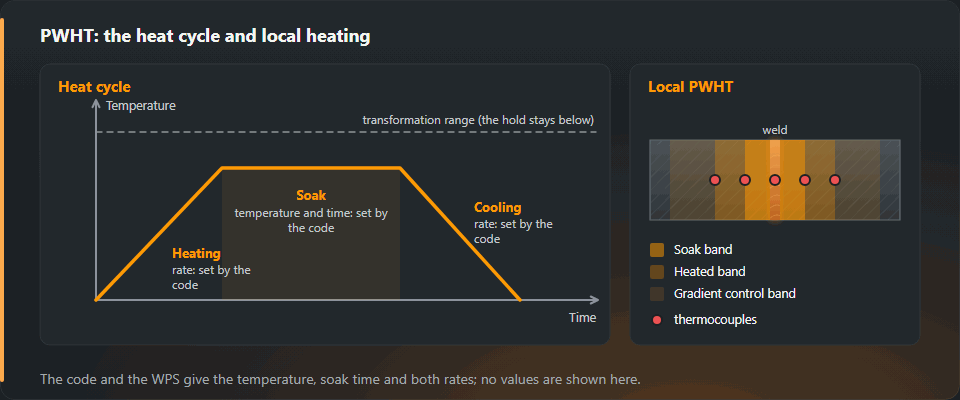
Post-weld heat treatment (PWHT) is a controlled heat cycle applied to a finished weld: the joint, or the whole part, is brought to a set temperature below the transformation range, held, and cooled at a limited rate. It is a different operation from preheat and interpass control, which act while the weld is being made.
Short answer
PWHT reduces residual stress and tempers the hard heat-affected zone. Whether it is needed is set by the product standard from the material group (ISO/TR 15608) and the thickness, not by the welder; the temperature, soak time and heating and cooling rates come from the code and the WPS. The pWPS generator on this site writes “not required” for group 1.1 (S235, S275), as the starting point for ordinary structural work; a thick pressure part can still need it. PWHT is an essential variable of the procedure: adding it, dropping it or leaving the qualified range means a new qualification.
What PWHT is for
TWI names three aims: dimensional stability, so the part keeps its tolerances in machining and early service; a required microstructure and properties; and lower residual stress, to reduce the risk of stress corrosion cracking and brittle fracture. Two effects do the work.
- Stress relief. At temperature the steel yields at a lower stress and the locked-in welding stress relaxes. It is reduced and redistributed, not removed to zero.
- Tempering. The hard, brittle structure in the heat-affected zone (HAZ) and weld metal softens and its toughness comes back. This is the reason for PWHT on hardenable and creep-resistant steels.
Hydrogen is a separate matter. Letting it out of a crack-sensitive joint is the job of post-heating, a hold at or above the preheat temperature right after welding (TWI); PWHT comes later. On Cr-Mo steel the joint is kept warm until the heat treatment starts, so that it does not cool down hard and loaded with hydrogen (10CrMo9-10 steel).
When PWHT is required
No general rule works for all steels. The decision comes from the material group of ISO/TR 15608, the thickness, the service (stress corrosion, brittle fracture, creep, dimensional stability) and the code that governs the product. Pressure codes such as EN 13445 and ASME VIII set a thickness above which PWHT applies, and the limit differs between them and between material groups, so for a given item the code decides. This page does not copy those limits.
| Group | Typical situation |
|---|---|
| 1.1 (S235, S275) | Not required for ordinary structural work, and so written in the pWPS generator. A thick pressure part or a special service can still call for it: the code decides. |
| 1.2, 1.3 (S355, normalised fine-grain) | By thickness, code and service; low-hydrogen filler and preheat do most of the work on thicker sections. |
| 2 (thermomechanically rolled) | By the steel maker’s data and the code; these steels are chosen to avoid heavy heat input, so check before specifying PWHT. |
| 3 (quenched and tempered, e.g. S500Q, S690Q) | Only by procedure, at a temperature below the tempering temperature of the steel. |
| 4–6 (Cr-Mo, creep-resistant) | Usually, per the WPS and the code; preheat is kept up until the heat treatment starts. |
| 7 (martensitic stainless) | Tempering after welding to soften the hard HAZ. |
| 8 (austenitic stainless) | Most austenitic weldments do not need PWHT (TWI). |
Hardness is a quick test of the HAZ: the hardness converter on this site gives 380 HV10 as the limit for groups 1 and 2 without PWHT to EN ISO 15614-1; above it the procedure needs heat treatment or a change of preheat and heat input (hardness converter, preheat calculator).
Temperature, soak and rates
All three come from the code, the material standard or the filler maker’s datasheet, and then go into the WPS. Two figures from this site’s sources show the order of magnitude for the creep-resistant steels.

| Case | What the source says |
|---|---|
| Creep-resistant steels, general | TWI: soak temperature between 650 and 750 °C. |
| 10CrMo9-10 (1.7380, P22), filler Böhler FOX CM 2 Kb | 700–750 °C, at least 1 h, furnace cooling to 300 °C, then still air; under boiler rules the treatment is specified separately (datasheet and thyssenkrupp, on the 10CrMo9-10 page). |
| Non-alloy and low-alloy structural steel | The temperature is taken from the table of the product standard; no range is quoted here. |
- Soak time is tied to the thickness. The rule of thumb in TWI’s articles is about one hour per 25 mm; the code gives the actual minimum.
- Heating and cooling rates are limited by the codes above roughly 350–400 °C. Too fast a cycle distorts the part by uneven heating and can crack a highly restrained one while it heats up.
- Quenched and tempered steels (group 3): the PWHT temperature must stay below the steel’s own tempering temperature, or the base metal is changed (TWI).
- Risks of the cycle itself: distortion, temper embrittlement, over-softening and reheat cracking in some steels. For steels that age or precipitate, ask a heat-treatment specialist for the times and temperatures.
Control: thermocouples and records
Furnace temperature is not proof that the part reached the right temperature. TWI’s guidance is to attach thermocouples to the component and to control heating, soak and cooling from them, so the whole part is at a uniform temperature. Capacitor-discharge welding of the wires is the most accurate fixing; wires fixed mechanically are covered with heat-resistant putty so they do not overheat. The positions go on a drawing and into the written procedure, and the chart of every cycle goes into the record with the WPS number.
PWHT in the WPS and WPQR
The treatment is an entry in the WPS (WPS) and it belongs to the range the qualification covers. What the site’s WPQR page says: if PWHT was applied to the test piece, it belongs to the range; if it was not, heat-treated work is not covered. TWI states the same rule for adding PWHT, deleting it, or using a time or temperature outside the qualified range: the procedure is requalified. The range calculator checks the other variables.
The pWPS generator puts “not required” in the PWHT line for ordinary structural groups such as 1.1 and 1.2, and “per design documentation” for group 3.1 (S500Q, S690Q). It is a starting point for the pWPS: when the code or the drawing calls for PWHT on a particular item, write the cycle in by hand.
How it differs from preheat, interpass and post-heat
| When | Purpose | Where it is set | |
|---|---|---|---|
| Preheat | Before and during welding | Slows cooling and lets hydrogen out; avoids a hard HAZ and cold cracks | Preheat calculator, WPS |
| Interpass temperature | Between runs; a maximum | Limits heat build-up so toughness and strength are not lost | Interpass page, WPS (WPQR +50 °C) |
| Post-heat | Right after welding, at or above the preheat temperature | Lets hydrogen out of crack-sensitive joints | WPS, client specification |
| PWHT | After welding, finished, at a set temperature | Reduces residual stress, tempers the HAZ | Code, WPS; essential variable of the WPQR |
For the first two, see the preheat calculator and interpass temperature. A joint left to cool between welding and PWHT is a risk for hydrogen cracking in crack-sensitive steel, so the WPS may require the hold at temperature or the PWHT soon after welding.
Local PWHT with heating bands
When a part is too big for a furnace, a band round the weld is heated instead. Methods listed by TWI: high-velocity gas burners, infrared burners, induction and resistance heating elements. Flexible low-voltage resistance elements and induction are the most common on site; high-voltage resistance is rarely used. The heated area has three zones:
- Soak band: the weld, both HAZs and some parent metal, held in the specified temperature range for the specified time.
- Heated band: the area covered by the elements. It is generally accepted that if its edge is above half the soak temperature, the temperature gradient is not harmful.
- Gradient control band: insulated, sometimes with extra heaters, so that the temperature falls off gradually to ambient.
Band widths differ between EN 13445, ASME VIII and ASME B31.3 and are minima, so the project code gives them. Thermocouples go on the weld centreline and at the edges of the soak band and the heated band, and TWI advises doubling them up. TWI also warns that local PWHT can leave more residual stress than a furnace cycle, so it is not treated as equivalent unless the code accepts it.
Standards and references
Where the statements on this page come from. The codes (EN 13445, ASME VIII) are named only as cited by TWI; their own limits are not quoted, as a second independent source was not found.
- TWI Job Knowledge 114, 115, 116 (Heat treatment of welded joints, parts 1–3), aims, creep-resistant steels 650–750 °C, thermocouples, rates, local PWHT with its bands and methods.
- TWI FAQs: postweld heat treatment and stress relief; post heating; austenitic stainless; avoiding PWHT, stress relief and tempering, soak rule of thumb, risks of the cycle, requalification, hydrogen post-heat, local PWHT.
- Böhler FOX CM 2 Kb datasheet; thyssenkrupp, 10CrMo9-10: 700–750 °C, at least 1 h, furnace cooling to 300 °C, then still air (see the site page 10CrMo9-10).
- EN ISO 15614-1; ISO/TR 15608, 380 HV10 limit for groups 1 and 2 without PWHT (as in the site’s hardness converter); material groups.
Frequently asked questions
Does S355 need post-weld heat treatment?
Usually not for ordinary structural work. The decision comes from the thickness, the service and the code of the product: pressure equipment is different from a building frame. If the HAZ hardness is above the limit of 380 HV10, raise the preheat or the heat input first (preheat calculator).
Is PWHT the same as stress relief?
Stress relief is one kind of PWHT. TWI uses PWHT as the umbrella term for stress relief and for tempering, and the soak temperature decides how much stress is reduced and how much the HAZ is softened.
Does PWHT remove hydrogen?
Not as its purpose. Hydrogen is let out by post-heating at or above the preheat temperature right after welding, in crack-sensitive ferritic steels. The joint should not cool to room temperature before the heat treatment unless the WPS allows it.
Can PWHT be done locally on site?
Yes, with heating bands (resistance elements, induction or gas burners) and thermocouples on the weld and the band edges. Band widths and gradients come from the code, and the result is not automatically equal to a furnace cycle: TWI notes that local treatment can leave higher residual stress.
What happens to the WPQR if PWHT is added or dropped?
The qualification no longer covers the work: adding or deleting PWHT, or going outside the qualified time and temperature, means requalifying. A WPQR made without PWHT does not cover heat-treated work (WPQR, range calculator).
Does austenitic stainless steel need PWHT?
Most austenitic weldments do not (TWI). Thick or highly stressed items are decided by the code, and a heat treatment of that kind can harm corrosion resistance, so do not copy a carbon steel cycle onto them (welding stainless steel).
Updated: