Distortion in welding
Every weld shrinks as it cools, and the cold plate around it resists. The difference shows up as shortening, bending, a flange pulled up towards the seam or, on thin sheet, waves. How much depends mostly on the amount of weld metal and on the order of welding.
Short answer
Put in less weld metal, weld in a balanced sequence, hold the parts with tacks and clamps, and straighten last. Fillet size is the first lever: the throat a need not exceed 0.7 × the thinner plate (fillet weld size), and a 7 mm leg holds 96 % more metal than a 5 mm leg. A double-V instead of a single-V on 10 mm plate cuts the groove area by more than a third. Heat straightening of structural steel is normally kept to 650 °C.
Types of distortion: cause and cure
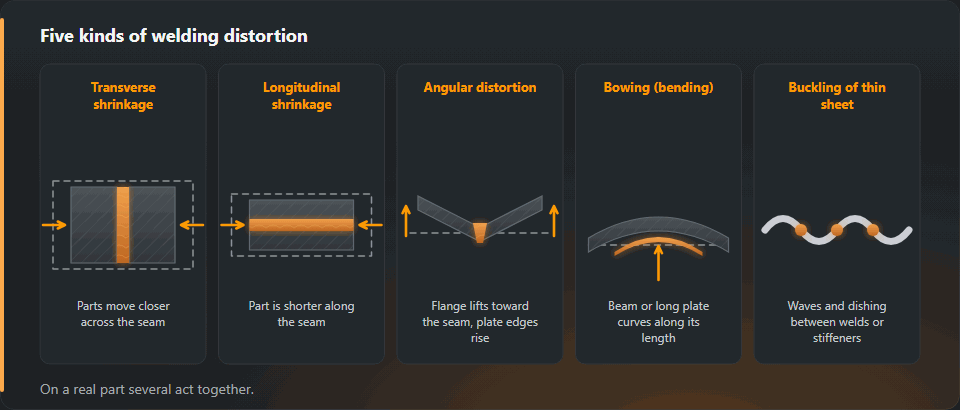
The weld metal and the heat-affected zone contract on cooling and pull on the cold metal around them. The pull acts along the seam, across it and through the thickness, so there are five typical results:

| Type | What you see | Cause | What to do |
|---|---|---|---|
| Transverse shrinkage | The parts end up closer together across the seam; the assembly is short in width. | The seam and its heat-affected zone contract across the joint; the larger the groove and the gap, the more. | Smaller groove and gap (groove selector); tacks and clamps to hold the gap; backstep; add the shrinkage to the cut length after a trial weld. |
| Longitudinal shrinkage | The part is shorter along the seam. | The seam contracts along its length; grows with seam length and cross-section. | Fillet no larger than needed (fillet size); intermittent welds where the drawing allows; backstep or skip; balance about the neutral axis. |
| Angular distortion | A flange lifts toward the seam; a butt joint folds; the plate edges rise. | More metal and heat on one side of the thickness: single V, one-sided fillet. The top contracts more than the root. | Symmetrical groove or double fillet; alternate sides; preset the angle against the pull; fewest runs on fillets; clamps. |
| Bowing (bending) | A beam or long plate curves along its length. | The weld lies away from the neutral axis of the section, so its contraction bends the part. | Balance the welds about the neutral axis (opposite sides, two welders); camber the part beforehand; weld toward the free end; stiffener along the seam. |
| Buckling of thin sheet | Waves, dishing between welds or stiffeners; presses flat and flips back. | Long-range compressive stress in the sheet exceeds the elastic limit of stability; a large deposit in one pass makes it worse. | Less heat per length; backstep or skip; close tacks; copper backing and clamps; stiffeners (thin sheet); correct with local heat spots. |
Several act together on a real part: a long fillet on a flange shortens it, lifts the flange edges and bows the whole beam.
What drives it
- Volume of weld metal. Shrinkage grows with the cross-section of the seam. Fillet welds are the easy place to over-weld: a leg of 7 mm has a cross-section of 24.5 mm² (½·z²), a leg of 5 mm 12.5 mm², so 96 % more metal for the same joint. The usual limit is a ≤ 0.7 × the thinner plate (fillet weld size). Groove joints: a 60° single V on 10 mm plate with a 2 mm gap is about 78 mm² of section, a symmetrical double V about 49 mm² (−37 %), geometry only, reinforcement not counted (groove preparation selector). The mass and the number of runs: deposited metal and passes.
- Heat input. It sets the width of the heated zone (heat input calculator). Deposit quickly with the largest electrode or current that does not cause lack of fusion, so the part is heated for a short time.
- Number of runs. For a fillet, angular distortion grows with the number of runs, so the fewest runs is the rule. For a butt joint a few large deposits give more shrinkage than many small runs, and the run order is then used to correct the angle.
- Fit-up. Poor fit-up and over-welding both increase distortion.
- Order and restraint. A long seam run in one direction closes the joint ahead of it. Restraint reduces movement but raises residual stress and the risk of cracking (weld cracks).
How to reduce it
- Less weld metal. Fillets no larger than the drawing and the 0.7·t limit require; a groove with the smallest angle and gap the process allows, double-sided where both sides are accessible.
- Balanced sequence. Weld around the neutral axis of the part: alternate sides of a double fillet, or two welders on opposite sides at the same time; in a butt joint choose the run order so that the angle is corrected as it forms. Identical parts can be welded back to back and separated afterwards.
- Backstep and skip welding. Backstep: short lengths laid against the general direction of travel, each starting where the previous one will end. Skip: short lengths in an even sequence, with gaps roughly the length of one electrode run-out. The backstep diagram is in welding thin sheet.
- Tacks and clamps. Tacks fix the gap and resist transverse shrinkage; too few and the joint closes up, so number, length and spacing are set by the sequence: tack straight through with clamps or wedges, or tack one end and backstep, or tack the centre and backstep.
- Presetting. Set the parts at an angle, or a beam with camber, opposite to the expected movement so that welding pulls them straight; the pre-set is found by trial on the first part.
- Stiffeners. On thin sheet a flat or angle along each side of the seam stops bowing; place it clear of the weld unless it sits on the back of a single-sided weld.
Thin sheet, where buckling is the main risk: welding thin sheet.
Straightening after welding
Mechanical: press, jack, or clamps and wedges against a stiff frame; the steel is formed past the target and springs back. Hammering leaves marks and damages edges and is not allowed on bridge steelwork. A buckled thin plate is unstable: forced flat, it can snap into a dish on the other side.
Thermal: a torch heats a small area (spots, lines or wedges); the heated metal expands against the cold surround, yields, and shortens on cooling, pulling the part back. The limit is the temperature, because heating changes the steel:
| Heating | Maximum, °C |
|---|---|
| Short, superficial (heat lines) | 900 |
| Short, through the whole section (spots, wedges) | 700 |
| Whole section with a longer hold | 650 |
| Usual practical limit in fabrication guidance (SCI GN 5.07), steel just beginning to glow | 650 |
- Use an oxy-propane torch with the nozzle for the job. An oxy-acetylene cutting torch burns hot enough to damage the steel.
- Measure the temperature (a pyrometer or contact thermometer); colour alone misleads in daylight.
- Let the part cool in still air. Water or air jets may harm the surface and are used only after procedure trials.
- SCI cites clause 6.5.3 of EN 1090-2, which asks for a procedure backed by evidence when flame straightening is used; what is required depends on the execution class. For thermomechanically rolled and other special grades, ask the steel producer: they are more easily affected by heating (SCI GN 5.07).
Standards and references
Where the figures on this page come from. The standards are cited through the publications named here; the full standard texts were not consulted. The 0.7·t limit and the geometry arithmetic are the site’s own.
- TWI Job Knowledge 033, 034, 036, types and causes of distortion, buckling instability, weld volume, number of runs, balanced welding, backstep and skip, presetting, tacks, clamping, stiffeners.
- SCI / SteelConstruction.info, Guidance Note 5.07, Straightening and flattening, flame straightening 650 °C normal maximum, 900–950 °C affects most steels, torch type, cooling, EN 1090-2 clause 6.5.3, hammering.
- Dillinger, Flame straightening, 06/2025 (quoting CEN/TR 10347), 900 / 700 / 650 °C by heating mode.
- EN 1090-2, execution of steel structures: clause 6.5.3, procedure for flame straightening (as cited by SCI).
Frequently asked questions
Why does a plate bend toward the weld?
The wide top of the seam holds more metal than the root, so it contracts more. That uneven contraction through the thickness rotates the plate: angular distortion. A symmetrical groove or alternating sides cancels it.
How do you stop thin sheet from warping when welding?
Put in as little heat as the joint needs, tack closely, weld in short skipped or backstepped lengths, and clamp to a copper bar or a stiff frame. Thin sheet buckles under compressive stress rather than just bending; details on welding thin sheet.
What is backstep welding?
Short lengths laid against the general direction of travel, each ending where the last began. The short lengths shrink in opposite directions, so the distortions largely cancel. It is used on long seams and thin plate.
What is the maximum temperature for flame straightening steel?
650 °C is the usual limit in fabrication guidance; CEN/TR 10347 allows 900 °C for short surface heating, 700 °C for short heating through the section and 650 °C for a longer hold on normalized and thermomechanical grades to S460M/ML. Ask the steel producer for other grades.
Does a smaller weld really reduce distortion?
Yes: shrinkage follows the cross-section of the weld. A 7 mm fillet leg holds 96 % more metal than a 5 mm leg, and the drawing seldom needs it: a throat of 0.7 × the thinner plate is the limit (fillet weld size).
Can I straighten a weld with a hammer?
On structural work, no: hammering marks the surface and damages plate edges, and bridge steelwork guidance forbids it. Use a press, jack or controlled local heating instead.
Updated: