How to read GOST 2.312 weld symbols on Soviet drawings
Equipment built to Soviet drawings is still in service across Europe, and the symbols on those drawings follow a different logic from the one in ISO 2553. The differences are systematic, which makes them learnable.
Different logic, not just different marks
ISO 2553 draws the weld: the symbol is a picture of the joint cross-section, and the dimensions sit around it. GOST 2.312 names the joint: the reference calls out a joint type from a catalogue of standard preparations in a companion standard, and that catalogue defines the geometry.
So a GOST reference such as С17 means "butt joint number 17"
from GOST 5264 — a V preparation with a specified angle, gap and root face.
You cannot read the geometry off the drawing; you look it up.

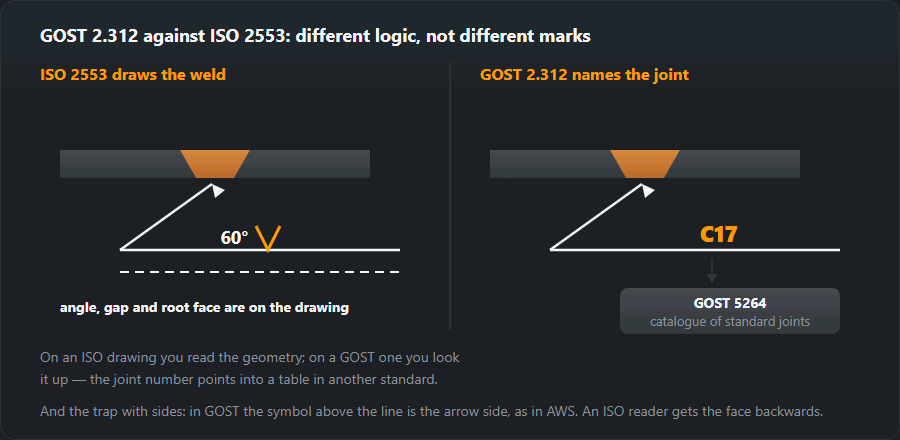
The visible differences
Note the first row: GOST has no dashed line and no arrow-side/other-side pair. The side is tied to the face of the joint: the designation sits on the shelf when the leader is drawn from the weld seen on the face side (the side the weld is made from) and under the shelf when it comes from the reverse side. That matches neither ISO system A nor AWS, where below the line is the arrow side — readers from both systems have to switch habits.
| Element | ISO 2553 | GOST 2.312 |
|---|---|---|
| Side of the joint | Continuous line — arrow side, dashed — other side | The shelf: above it the visible weld, below it the hidden one |
| Joint type | A drawn symbol: V, triangle, two lines | Letter and number: С butt, Т tee, У corner, Н lap |
| Edge preparation | Given by the symbol and dimensioned on the drawing | Given by the joint type number in the process standard |
| Fillet size | a — design throat, or z — leg | ⊿ with the leg size, e.g. ⊿6 |
| Process | ISO 4063 code in the tail of the arrow | Usually in the technical requirements, not in the symbol |
| Weld all round | Circle at the elbow | Circle at the elbow |
| Field weld | Flag | Flag |
The joint-type letters
- С — butt joint (stykovoye). GOST 5264 for manual arc welding, GOST 14771 for gas-shielded.
- Т — tee joint.
- У — corner joint.
- Н — lap joint.
- ⊿ before a number — the fillet leg size (the tables of
GOST 5264 call it K), so
⊿6is a 6 mm leg, equivalent to ISOz6and a throat of about 4.2.
Working from an old drawing
Three steps. Identify the joint code and find the preparation in the relevant GOST table — the angle, gap and root face are there, not on the drawing. Convert the fillet size: GOST gives the leg, so divide by 1.41 if your procedure works in throat. And check the material: the steel grade will be a GOST designation, so run it through the steel grade equivalents table before choosing a consumable.
One caution worth repeating: an equivalence table matches strength, not chemistry. Before welding a repair on unknown old steel, get the composition and put it through the carbon equivalent calculator — old structural steel is frequently higher in carbon than its modern nominal equivalent.
What a standard GOST 2.312 weld designation is made of
A GOST designation is written as one line on the shelf of a leader, and the leader, with a one-sided arrowhead, starts from the drawn weld. A visible weld is drawn as a thick continuous line, a hidden one as a dashed line, and a visible single spot weld as a "+". The designation line holds, in order:
- auxiliary signs at the bend of the leader — a circle for "weld along a closed line" and a flag for "weld during erection";
- the joint-type standard — GOST 5264 for manual metal arc welding, GOST 14771 for gas-shielded welding, and so on;
- the joint code — С, У, Т or Н with a number from that standard's table;
- the ⊿ sign and the leg — for fillet welds in tee, corner and lap joints;
- for an intermittent weld — the segment length, "/" (chain) or "Z" (staggered), and the pitch;
- other auxiliary signs — for instance "remove the reinforcement" or "dress irregularities with a smooth transition to the parent metal".
If every weld on the drawing follows one standard, its number may be moved to the technical requirements, leaving only the joint code and sizes on the line. Identical welds share one serial number and only one of them carries the full designation — so a leader with nothing but a number sends you to the weld with the same number.
Example: "ГОСТ 5264-80-Т3-⊿6" decoded and converted to ISO
- GOST 5264-80 — manual metal arc welding; that is process 111 in ISO 4063, and it has to be written into the ISO tail.
- Т3 — tee joint without edge preparation, weld on both sides (Т1 is the same welded from one side).
- ⊿6 — 6 mm leg.
In ISO 2553 system A: two triangles on both sides of the reference line,
no dashed line because the weld is symmetrical, size z6 or
a4.2, and 111 in the tail. A circle on the GOST leader
becomes the same circle at the elbow in ISO; a flag stays a flag.
Intermittent welds: "/", "Z" and the pitch
GOST writes an intermittent weld as segment length and pitch joined by the
arrangement sign: 50/100 is chain (segments on both sides opposite
each other), 50Z100 is staggered (segments on one side opposite the
gaps on the other). The pitch is the distance between the centres of adjacent
segments — the same as the AWS pitch.
ISO 2553 puts the space from the end of one segment to the start of the
next in the bracket, not the pitch. Hence the rule: space = pitch −
segment length. For 50/100 that is 100 − 50 = 50 mm, written
n×50 (50) in ISO; n comes from the joint length — a 1000 mm joint
takes (1000 + 50) / (50 + 50) = 10.5, i.e. 10 segments. Carrying the numbers over
unchanged — n×50 (100) — doubles every gap and loses almost a third
of the weld (350 mm instead of 500 on the same metre).
Face side and reverse side instead of arrow side
GOST defines the face side as follows: for a single-sided weld, the side it is welded from; for a double-sided weld with asymmetric preparation, the side of the main weld; for a symmetrical one, either side. The designation goes on the shelf if the leader starts from a weld drawn on the face side, and under the shelf if it starts from the reverse side.
When converting to ISO, decide first where the arrow will point on the new drawing. If it points at the face side, the face-side weld becomes the arrow side and its symbol goes on the continuous line, while the reverse-side weld goes on the dashed line. The AWS habit of "below the line is the arrow side" does not apply: in GOST, under the shelf means the reverse side.
GOST leg sizes and their ISO equivalents
The leg sizes you meet most often on older drawings, written to ISO 2553 for an equal-leg fillet:
| GOST: leg ⊿, mm | ISO: z | ISO: a ≈ ⊿ / √2 |
|---|---|---|
| ⊿3 | z3 | a2.1 |
| ⊿4 | z4 | a2.8 |
| ⊿5 | z5 | a3.5 |
| ⊿6 | z6 | a4.2 |
| ⊿8 | z8 | a5.7 |
| ⊿10 | z10 | a7.1 |
| ⊿12 | z12 | a8.5 |
Rounding the throat is the designer's call, not the welder's: a 6 mm leg gives a4.2, and choosing between a4 and a5 changes the weld cross-section by tens of per cent. Check the arithmetic in the fillet weld calculator.
Common mistakes when moving from GOST to ISO
- Leg carried over as a. ⊿6 → a6 instead of a4.2: the cross-section doubles (36 instead of 18 mm²).
- Pitch put in the ISO bracket. 50/100 → (100) instead of (50): the gaps double.
- Joint-type standard lost. A С, Т, У or Н number without its standard is ambiguous: the same number in GOST 5264 and GOST 14771 describes a different preparation.
- Process lost. In GOST the process follows from the joint standard; in ISO it has to be written in the tail as an ISO 4063 number — the full list is in the process number table.
- Preparation dimensions not transferred. Angle, gap and root face live in the GOST table, not on the drawing; when moving to ISO, check them against ISO 9692-1 — see joint preparation.
Establish which standard the sheet follows before reading any symbol — the ISO reading order is covered in how to read welding symbols.
Frequently asked questions
Where would I still meet a GOST drawing?
Wherever equipment built in the former Soviet Union is being repaired or modified — presses, cranes, boiler plant, agricultural machinery, railway stock. Drawings outlive the factories that made them, and a repair to an old machine is often done from the original documentation.
Can I convert a GOST symbol to ISO?
Not mechanically. GOST encodes the joint type and preparation in a designation from a table of standard joints, where ISO draws the weld shape. Converting means looking up what the GOST code specifies and then expressing that geometry in ISO terms — a translation, not a substitution.
What does the ⊿ sign mean in a GOST weld designation?
The fillet leg: ⊿6 is a 6 mm leg. In ISO 2553 the same size is written z6, and the design throat of that equal-leg fillet is a4.2 (6 / 1.41). Copying ⊿6 across as a6 orders a weld with twice the cross-section.
How do I convert a GOST intermittent weld such as 50Z100 or 50/100 to ISO?
In GOST the second number is the pitch between segment centres; in ISO 2553 the bracket holds the space from the end of one segment to the start of the next. Space = pitch − segment length = 100 − 50 = 50 mm, so GOST 50/100 is ISO n×50 (50). The "/" means chain (segments opposite each other), "Z" means staggered; the number of segments n comes from the joint length.
Updated: